Installation Library
Flexible Stone Installation
Updated
Practical guidance for planning, preparing and installing flexible stone panels. Final methods must be confirmed against the selected panel, substrate, adhesive system and local project requirements.
01
How to Install Flexible Stone Panels
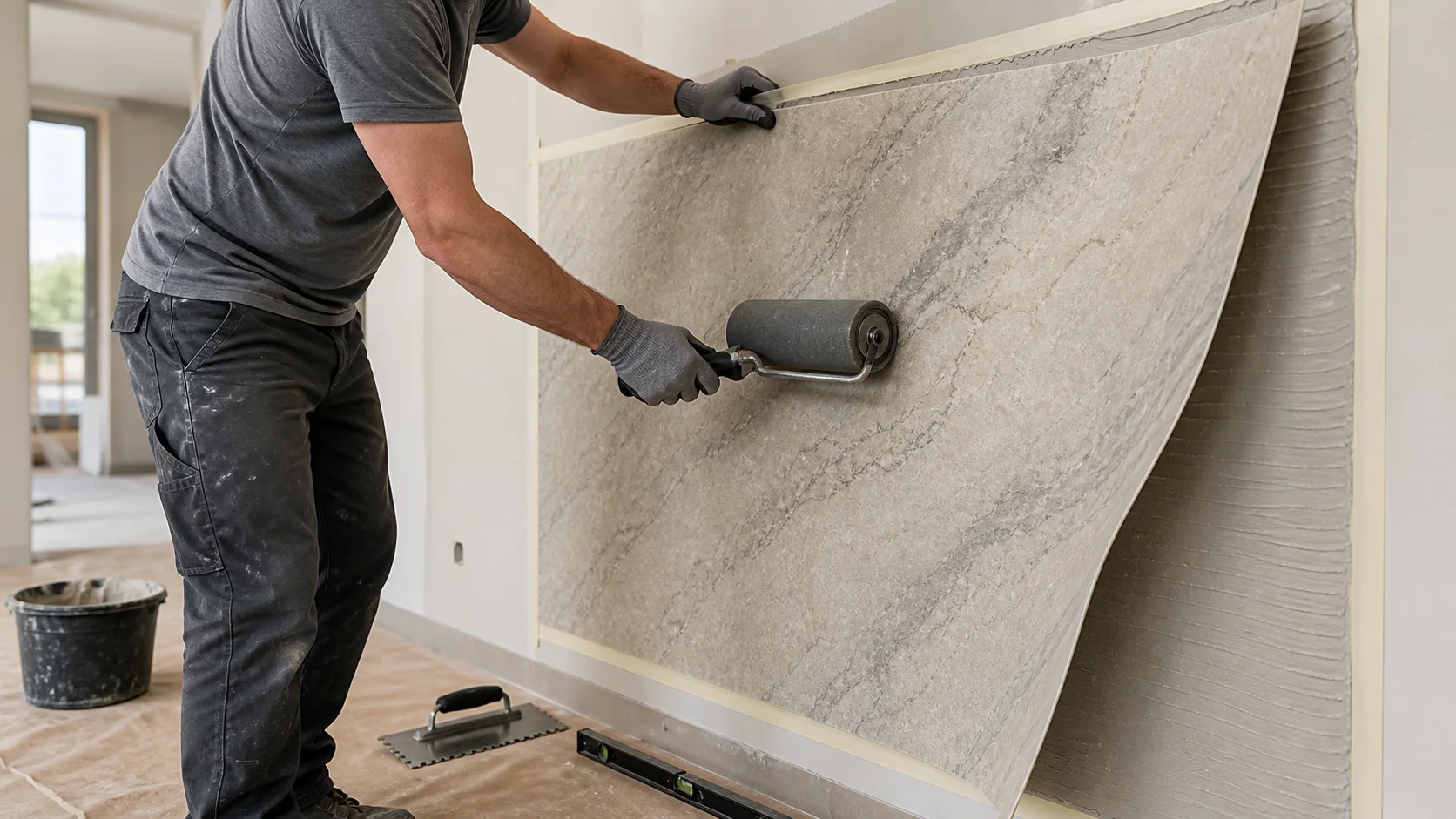
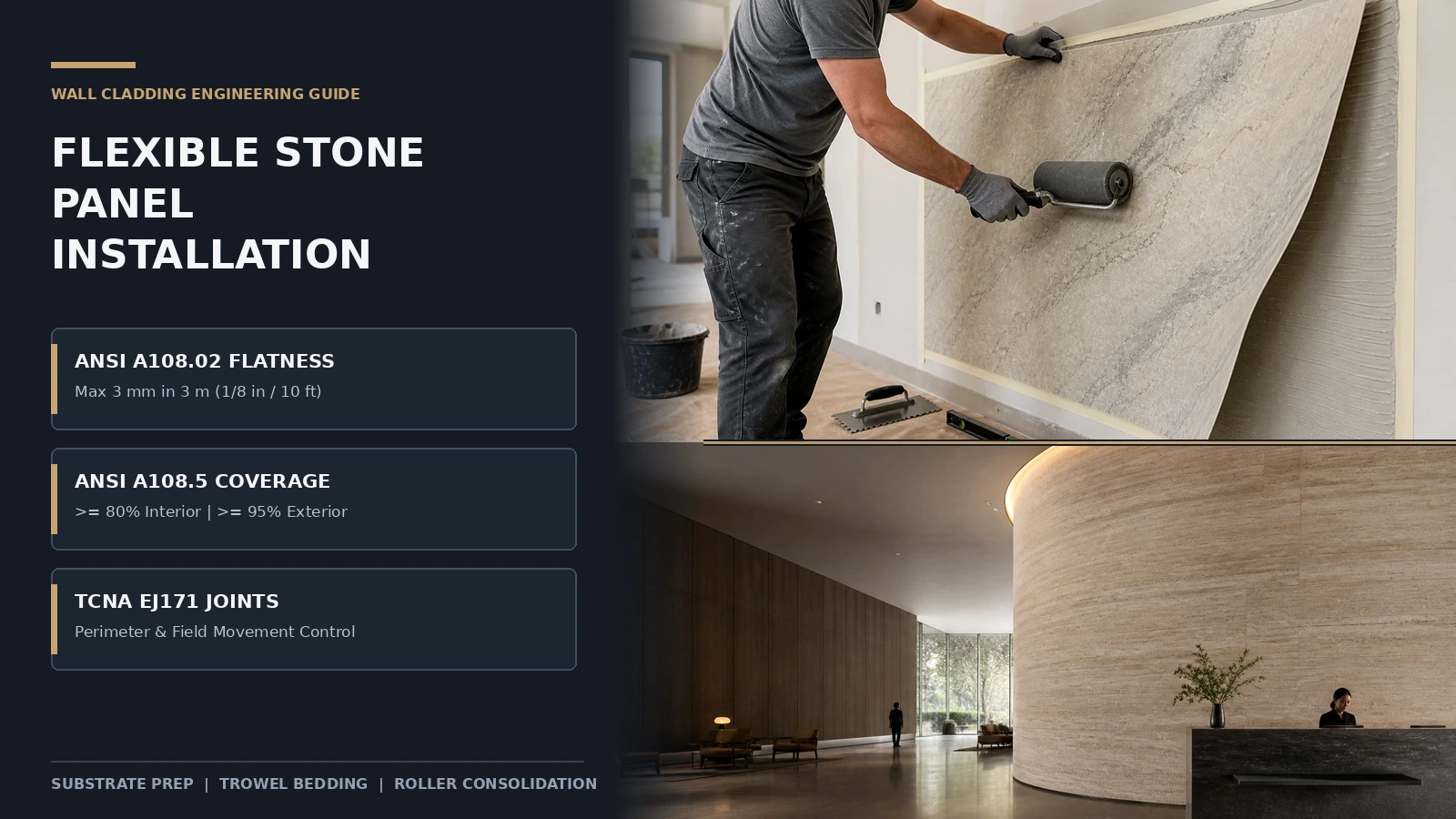
Installing flexible stone wall panels requires verifying substrate flatness to within 3 mm per 3 m (ANSI A108.02), matching the adhesive chemistry to the panel backing, and consolidating the sheet with a hand roller to achieve at least 80% interior or 95% exterior adhesive contact area (ANSI A108.5). Skipping moisture verification, substrate skimming, or full-system mock-up approval causes hollow-pocket delamination, telegraphing wall ridges, and costly panel tear-out and rework.
Read guide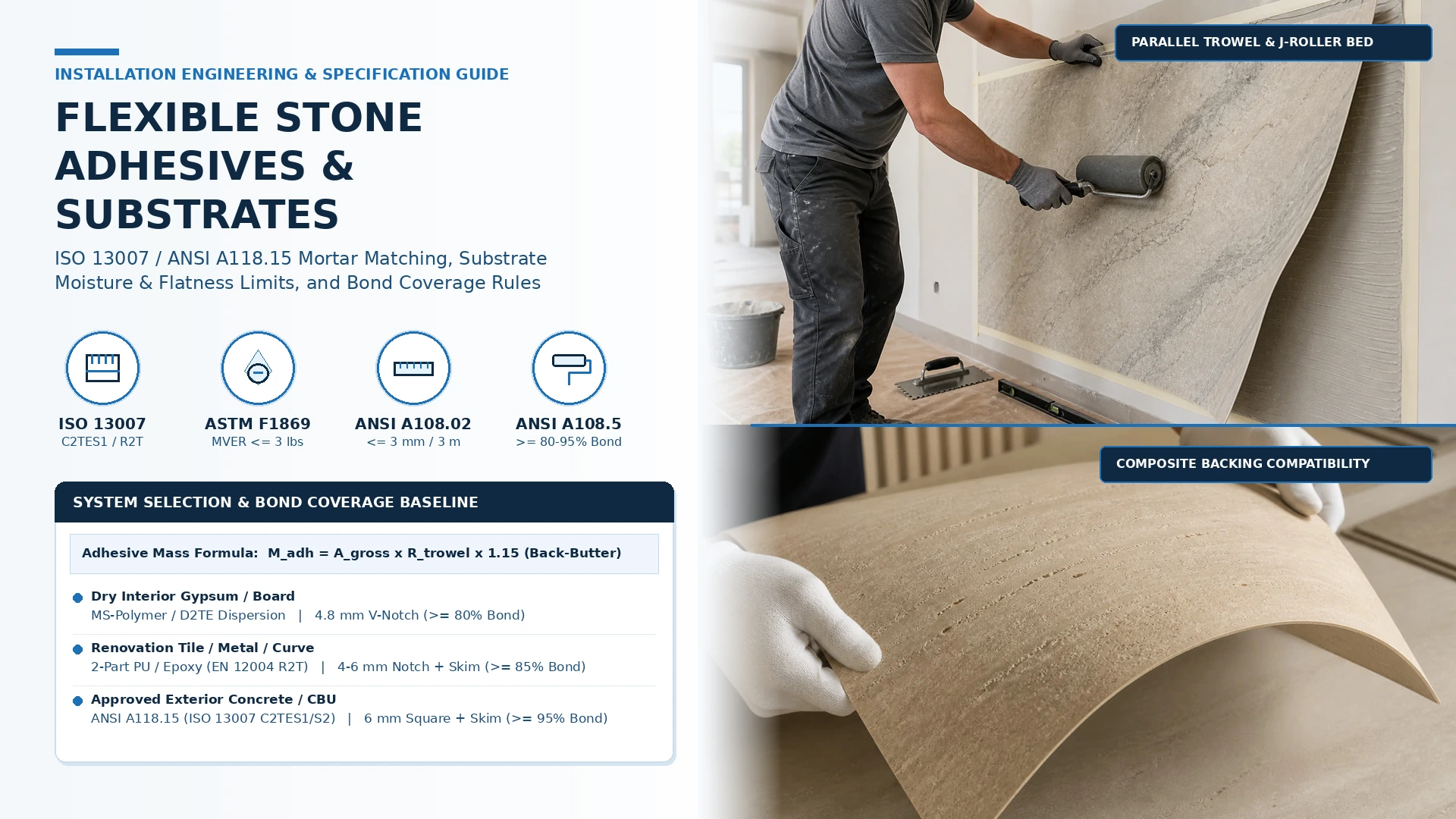
02
Flexible Stone Adhesives & Substrates
Bonding flexible stone panels with an incompatible adhesive chemistry or over an unverified substrate causes saponification detachment, hollow-pocket freeze-thaw blistering, and full-wall tear-out rework. Adhesive selection is a system engineering decision: match the panel backing (polymer-fiberglass, textile fleece, or MCM mineral matrix) and exposure zone to an ISO 13007 / EN 12004 (C2TES1/S2 or R2T) or ANSI A118.15 adhesive, verify substrate flatness to within 3 mm per 3 m (ANSI A108.02) and moisture to MVER <= 3 lbs / 1,000 sq. ft. / 24 h (ASTM F1869), and validate >= 80% interior or >= 95% exterior contact (ANSI A108.5) on a cured site mock-up before production release.
Read guide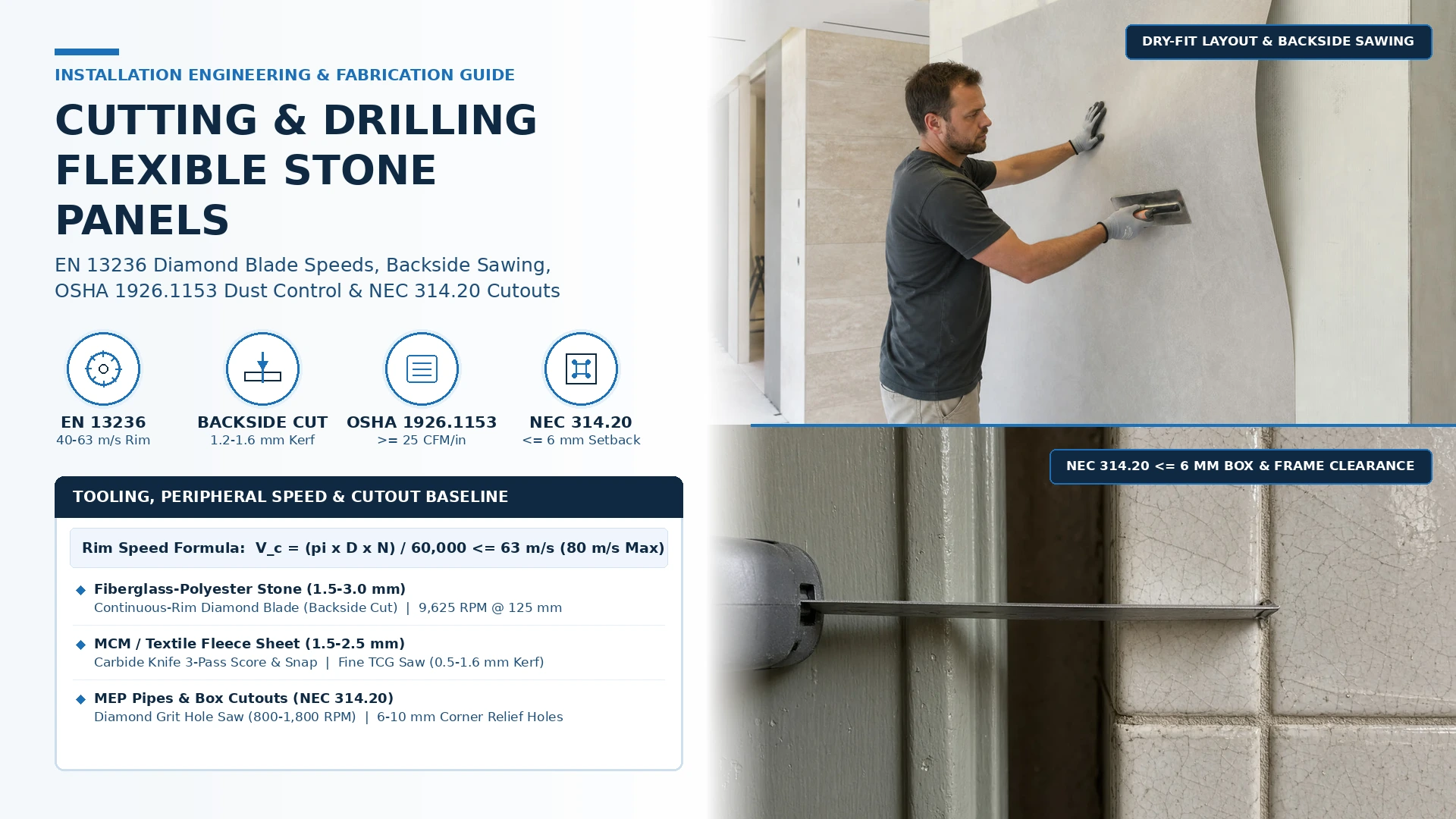
03
Cutting & Drilling Flexible Stone Panels
Cutting or drilling flexible stone panels with wood-tooth blades, dull utility knives, or uncalibrated high-RPM grinders causes stone cleft spalling, polyester-fiberglass backing delamination, thermal resin scorching, corner stress cracks, and costly panel waste and rework. Treat panel fabrication as a controlled machining process: match the cutting method to the panel backing architecture (fiberglass-polyester resin vs. breathable fleece/MCM), maintain continuous-rim diamond blade peripheral speed within 40 to 63 m/s (EN 13236 / ANSI B7.1), enforce wet suppression or >= 25 CFM per blade-inch HEPA extraction (OSHA 29 CFR 1926.1153), and pre-drill 6–10 mm corner relief radii on all rectangular cutouts before production release.
Read guide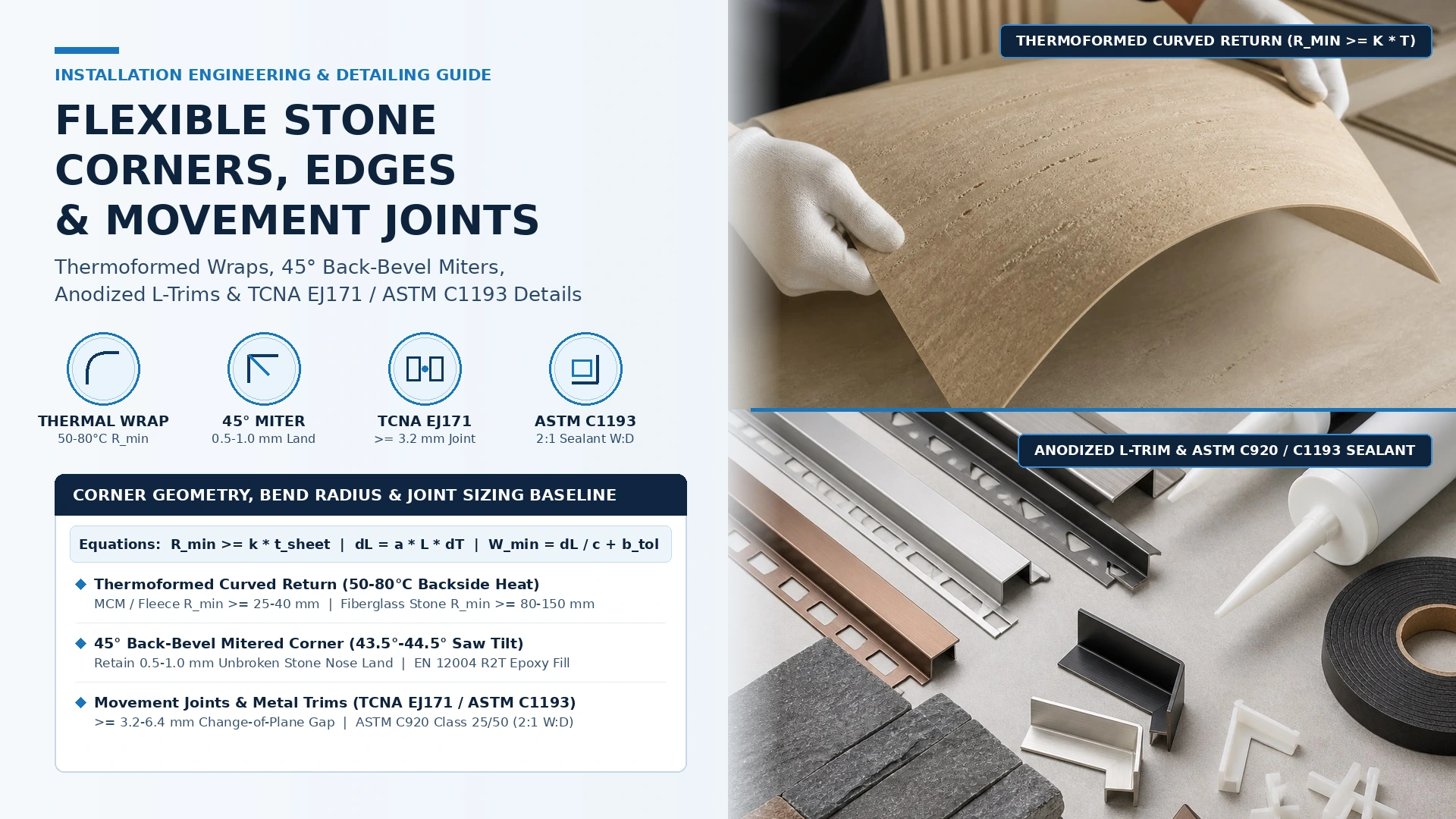
04
Flexible Stone Corners, Edges & Movement Joints
Forcing flexible stone panels around sharp 90-degree outside corners without backside heat-forming, beveling feather-thin miters freehand, or bridging substrate expansion joints causes stone cleavage cracking, elastic spring-back edge peel, exposed fiberglass seams, and water ingress rework. Engineer every transition before cutting production sheets: select between a thermoformed curved wrap (R_min >= k_bend * t_sheet heated at 50-80°C on the backing), a 43.5°-44.5° back-bevel miter retaining a 0.5-1.0 mm stone nose land, a dressed overlap butt joint, or an anodized aluminum L/J-trim with 1.5-2.0 mm expansion clearance, and honor all TCNA EJ171 / ASTM C1193 movement joints.
Read guide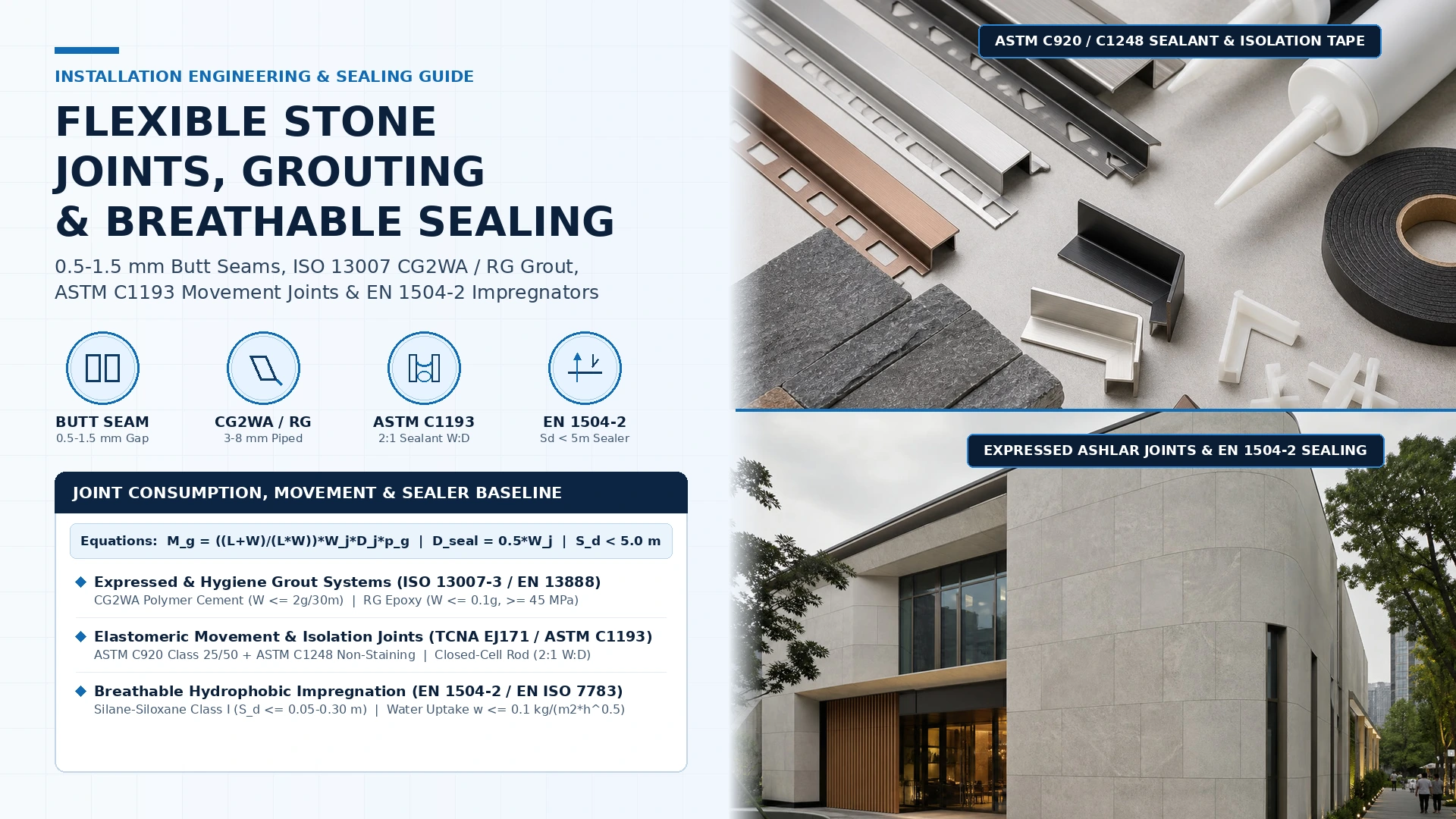
05
Flexible Stone Joints, Grouting & Breathable Sealing
Smearing cementitious grout across unsealed cleft stone faces, jamming flexible stone sheets together at a 0.0 mm pinch seam, using fluid-bleeding silicone in movement joints, or trapping substrate moisture behind film-forming acrylic lacquer causes permanent grout haze, compressive edge tenting, ASTM C1248 oil halo staining, and costly sealer delamination rework. Engineer the complete joint and surface protection schedule before installation to prevent panel tear-outs: select between a 0.5-1.5 mm micro-chamfered butt seam, piped ISO 13007-3 CG2WA / RG grout (3.0-8.0 mm), and TCNA EJ171 / ASTM C1193 2:1 elastomeric movement joints, protected by an EN 1504-2 breathable silane-siloxane impregnator (S_d < 5.0 m).
Read guide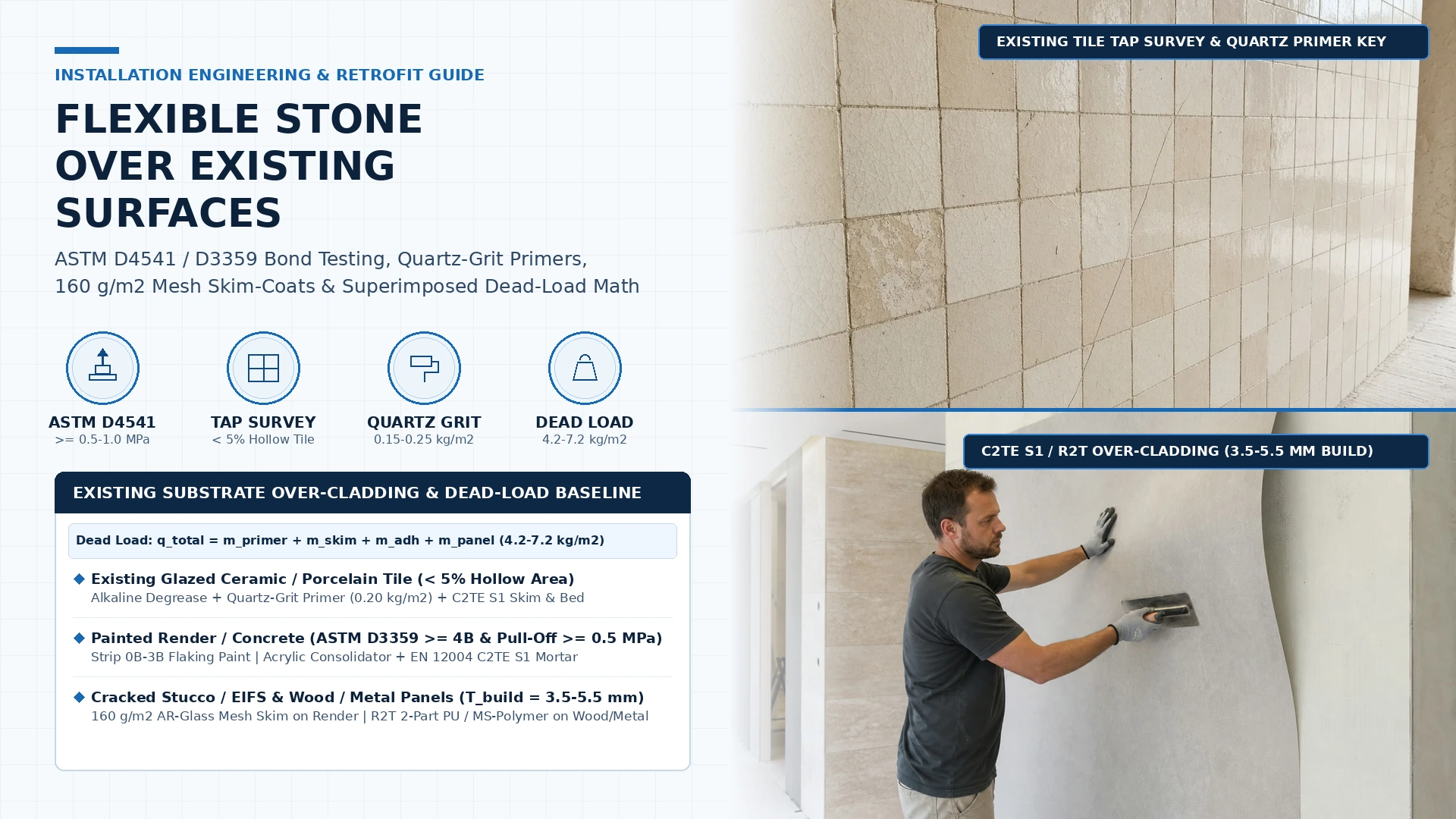
06
Installing Flexible Stone Over Existing Surfaces: Tile, Render, Paint & Board Retrofit Guide
Installing flexible stone over existing glazed ceramic tile, painted render, EIFS, or board walls requires verified ASTM D4541 tensile pull-off strength (>= 0.5–1.0 MPa), < 5% hollow tile area, and Grade 4B–5B cross-hatch paint adhesion (ASTM D3359). Bonding sheets over unprimed glaze, flaking paint, or un-skimmed grout joints causes shear delamination, sunken grid ghosting, and costly full-wall rework—whereas a quartz-grit primer and C2TE S1 skim coat lock in a 3.5–5.5 kg/m2 overlay without demolition.
Read guide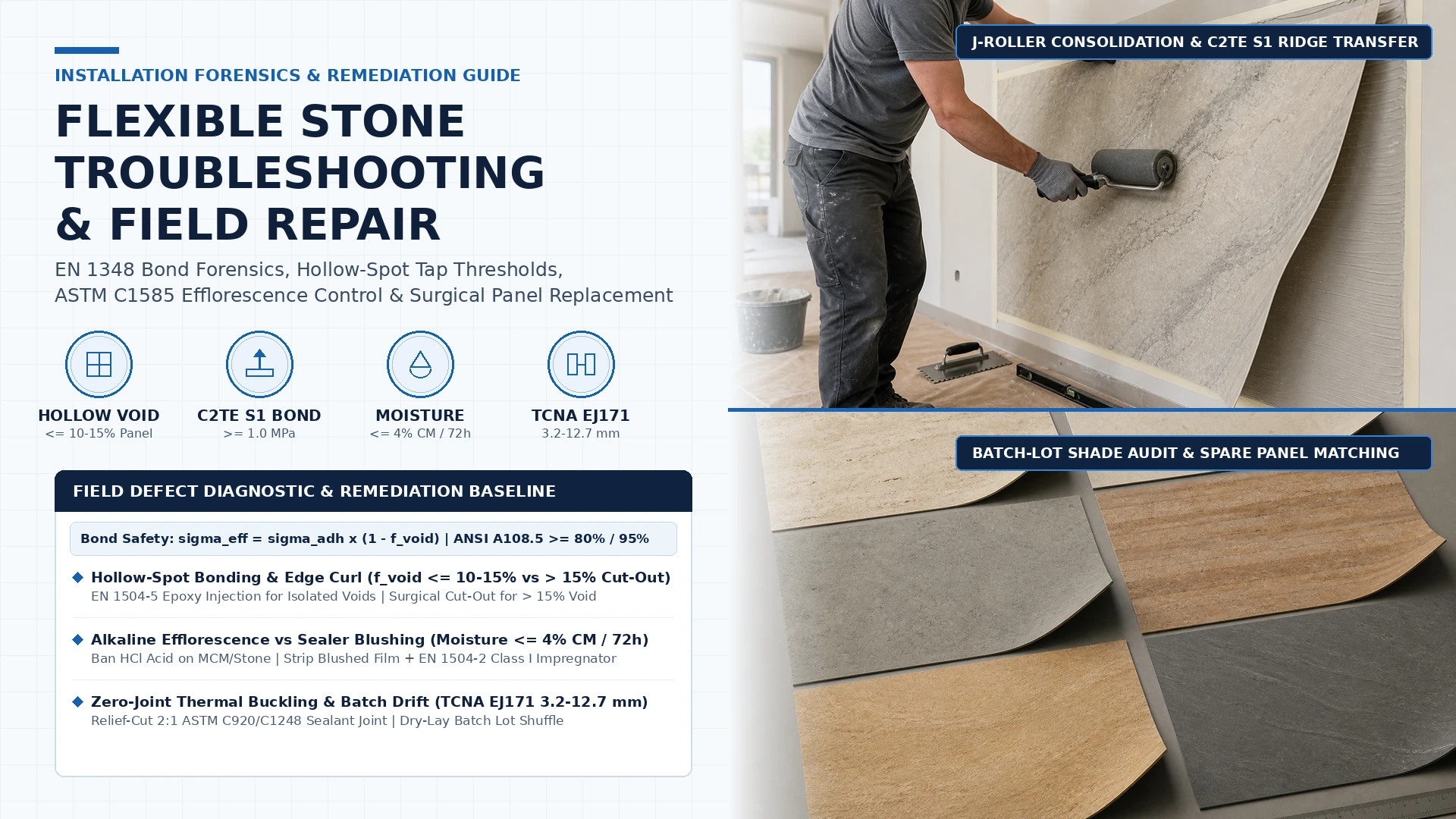
07
Flexible Stone Troubleshooting & Repair: Hollow Spots, Efflorescence, Edge Curl & Panel Replacement Guide
Troubleshooting flexible stone and MCM wall cladding requires diagnosing the exact failure plane before cutting, heating, or injecting adhesives: hollow-spot delamination exceeding > 10–15% of a panel area mandates surgical cut-out replacement rather than resin injection, white surface blooming requires separating ASTM C1585 alkaline efflorescence from topical sealer blushing (substrate moisture > 4% CM), and zero-joint thermal buckling demands TCNA EJ171 relief joints.
Read guideWhat to send us
Scroll the table horizontally to see all columns.
| Item | Why we need it | Example format |
|---|---|---|
| Finish or product reference | Identify the sample or product to quote | Product link or reference photo |
| Wall area and quantity | Define the quotation scope | Dimensioned drawing or quantity schedule |
| Application and substrate | Understand the proposed wall | Wall photos and substrate description |
| Destination | Discuss packing and shipping | City and country or port |
We reply within 24 hours.
Send your project details