Flexible Stone Installation
Flexible Stone Joints, Grouting & Breathable Sealing
Updated
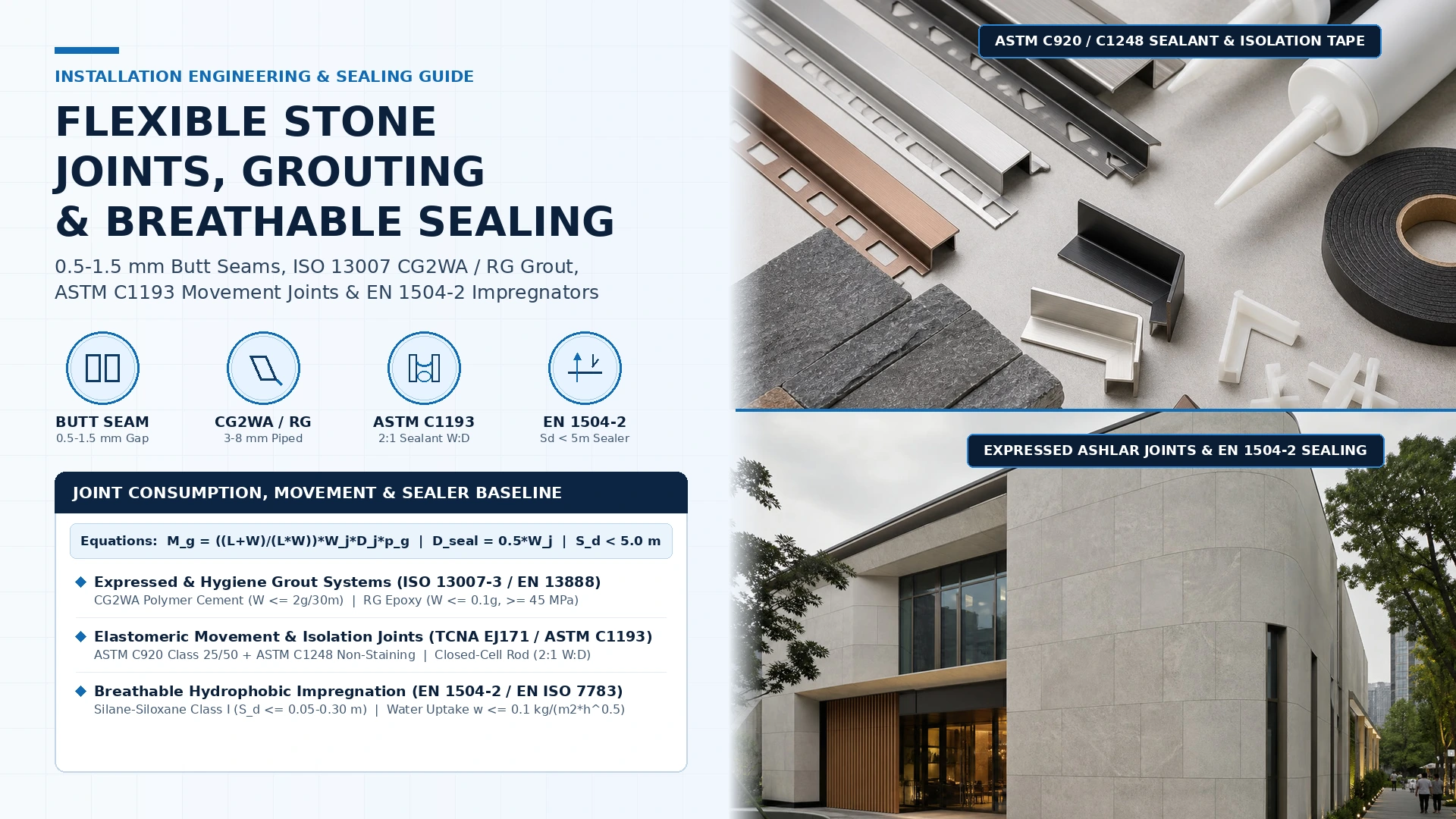
Smearing cementitious grout across unsealed cleft stone faces, jamming flexible stone sheets together at a 0.0 mm pinch seam, using fluid-bleeding silicone in movement joints, or trapping substrate moisture behind film-forming acrylic lacquer causes permanent grout haze, compressive edge tenting, ASTM C1248 oil halo staining, and costly sealer delamination rework. Engineer the complete joint and surface protection schedule before installation to prevent panel tear-outs: select between a 0.5-1.5 mm micro-chamfered butt seam, piped ISO 13007-3 CG2WA / RG grout (3.0-8.0 mm), and TCNA EJ171 / ASTM C1193 2:1 elastomeric movement joints, protected by an EN 1504-2 breathable silane-siloxane impregnator (S_d < 5.0 m).
Quick Specs: Joint Architecture, Grout Performance, Movement Sealants & Breathable Sealing
Scroll the table horizontally to see all columns.
| Joint / Sealing Parameter | Engineering Acceptance Baseline | Reference Standard & Mock-Up Verification |
|---|---|---|
| Micro-Chamfered Butt Seam (Close-Joint Ashlar Look) | 0.5-1.5 mm thermal relaxation gap; 80-120 grit 45° micro-chamfer (0.3-0.5 mm); color-matched mineral edge tint | Never install at 0.0 mm pinch contact; hold notched adhesive 10-15 mm back from seam edge to prevent bleed-through |
| Expressed Polymer-Modified Cement Grout (3.0-8.0 mm) | Piping-bag extrusion only between 18-24 mm low-tack taped edges; water uptake <= 2.0 g (30 min) / <= 5.0 g (240 min) | ISO 13007-3 / EN 13888 CG2WA & ANSI A118.7; pre-seal cleft stone face before taping and grouting |
| High-Hygiene Reaction-Resin Epoxy Grout (2.0-6.0 mm) | Water uptake <= 0.1 g (240 min); abrasion <= 250 mm3; compressive strength >= 45 MPa; zero efflorescence | ISO 13007-3 / EN 13888 RG & ANSI A118.3 / A118.19; emulsify surface residue within 15-20 min before crosslinking |
| Perimeter & Field Movement Joints (3.2-12.7 mm) | Every 6.0-7.6 m interior / 2.4-3.6 m exterior; 2:1 width-to-depth hourglass bead over closed-cell PE backer rod | TCNA EJ171 + ASTM C1193 geometry + ASTM C920 Class 25/50 neutral silicone or MS-polymer + ASTM C1248 non-staining |
| Breathable Hydrophobic Impregnator (Penetrating Sealer) | Water vapor diffusion Class I (S_d < 5.0 m, target S_d <= 0.05-0.30 m); liquid water reduction >= 82-92% (w <= 0.1 kg/(m2*h^0.5)) | EN 1504-2 + EN ISO 7783 + EN ISO 15148; apply 1-2 wet-on-wet coats after 72 h adhesive/grout moisture dissipation |
| Topical Film-Forming Acrylic / Polyurethane Lacquer | Prohibited on exterior facades, wet walls, and cementitious substrates with MVER > 3 lbs / 1,000 sq ft / 24 h | EN ISO 7783 Class II/III vapor barrier (S_d > 5-25 m) traps backside vapor, causing milky blushing and peeling |
Standard installation engineering baseline. Verify substrate flatness, adhesive compatibility, and mock-up bond performance against the project submittal pack before full wall release.
Overview
Joint finishing and surface sealing determine whether a 1.5 to 3.0 mm flexible stone installation maintains its natural mineral cleft texture for 15+ years or fails within months through irreversible cementitious grout haze, compressive seam buckling ("tenting"), silicone plasticizer oil halos (ASTM C1248 staining), and milky-white topical sealer delamination ("blushing"). Unlike glazed ceramic tile-whose vitrified surface releases smeared mortar easily and whose 8-12 mm bisque body offers deep joint shoulders-flexible stone veneers combine a micro-porous natural stone or MCM mineral face (50-400 um surface clefts) with a thin 2.0-4.0 mm composite panel + adhesive cross-section that undergoes thermal and hygric strain across the wall plane.
To eliminate trial-and-error staining and premature joint cracking, lock four engineering specifications on project shop drawings and cured mock-up panels before starting field installation: (1) Joint Architecture Classification (0.5-1.5 mm micro-chamfered butt seam vs. 3.0-8.0 mm piped ISO 13007-3 CG2WA cementitious joint vs. 2.0-6.0 mm ISO 13007-3 RG epoxy joint vs. 3.2-12.7 mm TCNA EJ171 / ASTM C1193 elastomeric movement joint), (2) Pre-Seal, Mask & Pipe-Only Grouting Protocol (zero rubber-float broadcasting over cleft stone), (3) Non-Staining Two-Sided Sealant Mechanics (ASTM C920 Class 25/50 + ASTM C1248 over closed-cell backer rod at W : D = 2 : 1), and (4) Breathable Hydrophobic Impregnation (EN 1504-2 / EN ISO 7783 Class I, S_d < 5.0 m). Compare the four architectural joint systems in the engineering matrix below and request lot-representative test panels via Request Samples:
| Architectural Joint System | Joint Width (W_j) & Depth (D_j) Envelope |
Applicable Exposure Zone & Stone Finish | Governing Material Standard & Application Protocol | Dominant Field Failure Mode & Engineering Prevention |
|---|---|---|---|---|
1. Micro-Chamfered Close Butt Seam (Dry-Look or Flush Micro-Bead) |
W_j = 0.5-1.5 mm thermal relaxation gap (never 0.0 mm); D_j = 2.0-3.5 mm panel thickness |
Climate-controlled dry interior feature walls, hotel headboards, reception backdrops, and curved columns using rectified 1200 x 600 mm or 2400 x 1200 mm slate, sandstone, quartzite, or MCM sheets |
Dress saw-cut edges with 80-120 grit diamond pad at 45° (0.3-0.5 mm); seal raw fiberglass carrier edge with mineral tint (>= 95% color match); optional flush micro-bead of color-matched ASTM C920 MS-polymer |
Compressive seam tenting (0.0 mm pinch stress) & adhesive bleed-through -> Maintain 0.5-1.5 mm shim gap during setting; hold notched trowel adhesive 10-15 mm back from seam edge or rake clean immediately |
2. Expressed Polymer-Modified Cementitious Grout (ISO 13007-3 CG2WA) |
W_j = 3.0-8.0 mm (1/8-5/16 in); D_j = 2.5-4.5 mm full panel + raked adhesive groove depth |
Modular ashlar, running-bond, travertine, brick-slip, and MCM masonry coursing on commercial interiors and sheltered/exterior facades |
ISO 13007-3 / EN 13888 CG2WA (ANSI A118.7): Water absorption <= 2.0 g at 30 min (<= 5.0 g at 240 min), abrasion <= 1,000 mm³, fine aggregate <= 0.2-0.3 mm. Pre-seal face (EN 1504-2), mask edges with 18-24 mm low-tack tape, pipe via nozzle bag, tool with slicker iron at 15-30 min |
Irreversible cleft-pore grout haze crust & HCl acid etching -> Never smear grout over split-face stone with a rubber floor float; pre-seal stone, mask both seam edges, pipe strictly into joint, and ban acid cleaners |
3. Reaction-Resin Epoxy / Urethane Hygiene Grout (ISO 13007-3 RG) |
W_j = 2.0-6.0 mm (5/64-1/4 in); D_j = 2.5-4.0 mm full panel depth |
High-hygiene F&B walls, commercial kitchens, hotel vanity splash zones, healthcare corridors, and dark pigmented joints requiring zero efflorescence | ISO 13007-3 / EN 13888 RG (ANSI A118.3 epoxy / ANSI A118.19 premixed urethane/acrylic): Water absorption <= 0.1 g at 240 min, abrasion <= 250 mm³, compressive strength >= 45 MPa. Mask joint edges, gun/pipe into channel, emulsify residue within 15-20 min |
Cross-linked glossy resin halo ("plastic picture-framing") & quartz scratching -> Never allow epoxy film to cross-link (24 h) on unmasked cleft stone; mask seam edges with tape and scrub with neutral emulsifier pad within 15-20 min |
4. Elastomeric Movement & Isolation Joint (TCNA EJ171 + ASTM C1193) |
W_j = 3.2-6.4 mm interior perimeters/corners; W_j = 6.0-12.7 mm exterior bays (D_seal = 0.5 * W_j hourglass bead) |
Mandatory at all TCNA EJ171 internal 90° corners, floor/ceiling transitions, window/door/elevator jambs, substrate changes, and field bays (6.0-7.6 m indoor / 2.4-3.6 m outdoor) |
ASTM C920 Class 25/50 (+/- 25% to +/- 50% movement) neutral-cure alkoxy silicone or MS-polymer, certified non-staining per ASTM C1248, installed over ASTM C1330 Type C closed-cell PE backer rod (+25-33% compression) or bond-breaker tape |
Three-sided adhesion cohesive tearing & ASTM C1248 silicone oil bleed -> Isolate joint bottom with closed-cell backer rod or bond-breaker tape (two-sided adhesion only), tool to 2:1 width-to-depth ratio, and ban acetoxy or fluid-bleeding silicones |
Details to review
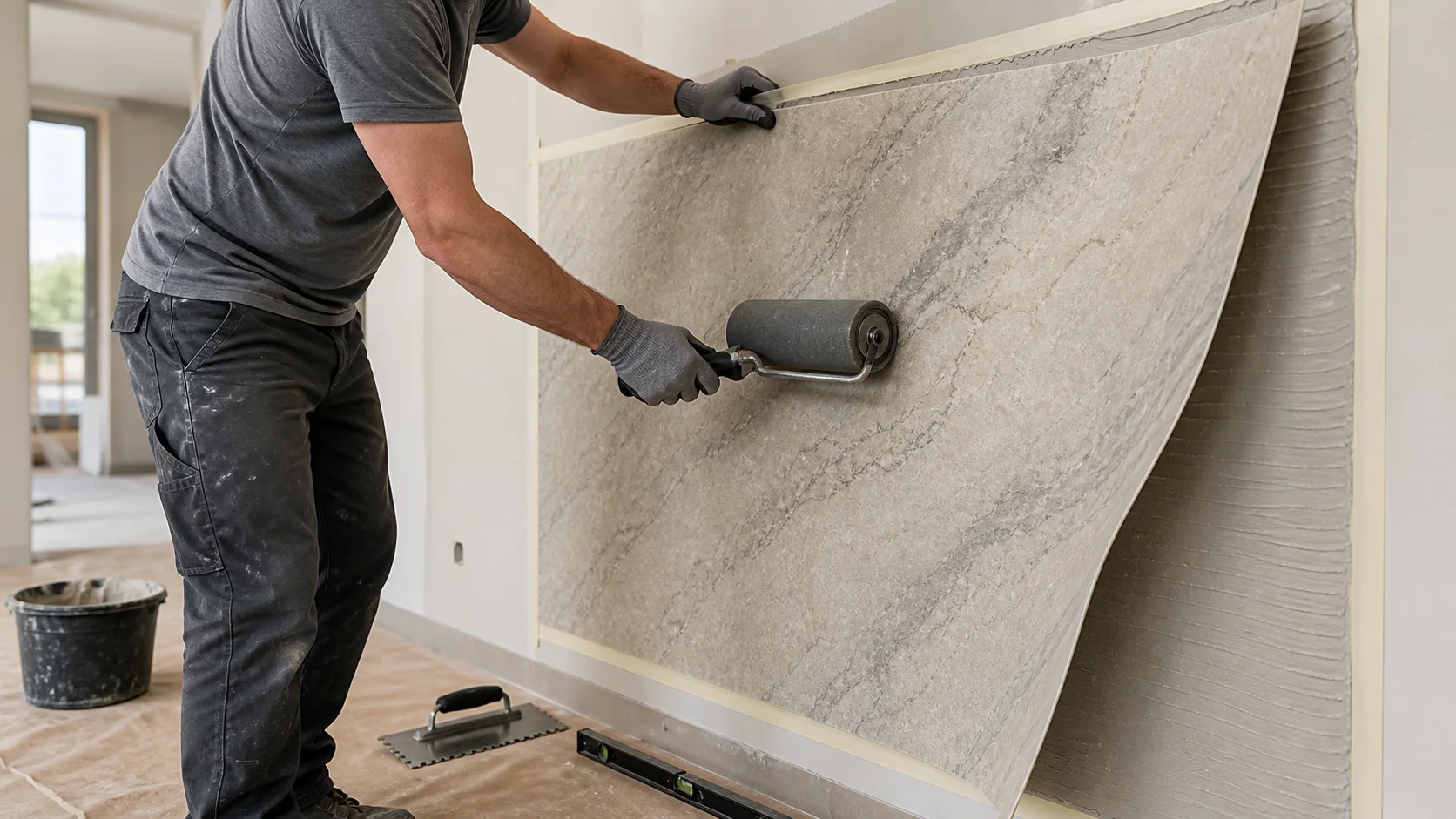
Use these visual references when reviewing the mock-up and work method with the project team.


Site checklist
1. Leave a `0.5-1.5 mm` Thermal Micro-Gap on Close Butt Seams (`Never 0.0 mm`)
Even when specifying a "seamless" dry-stacked ashlar wall, dress all cut edges at 45° (0.3-0.5 mm) per Cutting & Drilling and seal the exposed fiberglass carrier edge with mineral tint before bonding.
Engineering Rule of Thumb: If installing rectified 1200 x 600 mm or 2400 x 1200 mm panels with close butt seams indoors → maintain a 0.5 to 1.5 mm micro-gap using calibrated shims and keep notched trowel adhesive 10-15 mm back from panel perimeters because jamming fiberglass-backed sheets at 0.0 mm contact under a Delta_T = 20-30°C HVAC swing induces 0.30-0.55 mm of unconstrained thermal expansion per sheet that buckles ("tents") the seam.
2. Pre-Seal Cleft Stone, Mask Seam Edges & Pipe `CG2WA / RG` Grout (`Never Float`)
Natural split-face slate, quartzite, travertine, and textured MCM panels feature 50-400 um micro-clefts and open travertine vugs that trap smeared cement or resin particles permanently.
Engineering Rule of Thumb: If grouting expressed joints (3.0-8.0 mm) on cleft slate, sandstone, travertine, or textured MCM → apply one pre-grout coat of EN 1504-2 breathable impregnator to the stone face, mask both sides of every joint with 18-24 mm low-tack UV painter’s tape, and extrude ISO 13007-3 CG2WA or RG grout strictly into the channel via a grout piping nozzle bag because rubber-float smearing locks alkaline cement slurry into stone pores and hydrochloric acid washes (HCl) etch carbonate minerals and delaminate polyester binders.
3. Isolate Movement Bays with `ASTM C1193` `2:1` Sealant & `ASTM C1248` Non-Staining Silicone
Coordinate all internal corners, perimeter frames, and field expansion bays with Corners & Edges and Existing Surfaces so rigid grout never crosses an active movement plane.
Engineering Rule of Thumb: If sealing a perimeter or field movement joint (3.2-12.7 mm under TCNA EJ171) on natural stone or MCM cladding → install a closed-cell polyethylene backer rod (ASTM C1330 Type C, diameter 1.25-1.33 x W_joint) or bond-breaker tape at the joint root and tool an ASTM C920 Class 25/50 neutral-cure silicone or MS-polymer certified to ASTM C1248 (<= 0.5 mm stain migration) at a 2:1 width-to-depth ratio because three-sided adhesion tears the sealant cohesively and uncertified silicone plasticizer oils bleed 5-15 mm dark hydrophobic halos into porous stone edges.
4. Specify `EN 1504-2` Class I Breathable Impregnators (`S_d < 5.0 m`, Never Topical Films)
Verify assembly moisture exposure and substrate curing in Water & Weather Resistance and Adhesives & Substrates before applying any surface sealer.
Engineering Rule of Thumb: If protecting exterior facades, wet walls, or cement-bonded flexible stone against liquid water and oil staining → wait >= 72 hours after grouting (substrate moisture <= 4%) and apply a penetrating silane-siloxane or fluoropolymer hydrophobic impregnator (EN 1504-2 / EN ISO 7783 Class I, S_d <= 0.05-0.30 m, liquid water absorption w <= 0.10 kg/(m²·h^0.5)) rather than a topical acrylic or polyurethane film (S_d > 5.0-25.0 m) because vapor-blocking coatings trap outward moisture drive, causing milky-white delamination ("blushing") and freeze-thaw spalling.
Key steps
Step 1: Map Field Seams vs. `TCNA EJ171` Movement Joints & Rake Adhesive Channels
Distinguish rigid architectural joints (
0.5-1.5 mmclose butt or3.0-8.0 mmpiped grout) from activeTCNA EJ171movement joints (3.2-12.7 mmat internal corners, frames, and field bays) on elevation drawings before setting panels. During Flexible Stone Installation, hold notched adhesive10-15 mmback from close-butt edges or rake expressed joint channels clean to full panel depth (D_j = 2.5-4.5 mm) while the mortar is wet.Step 2: Pre-Seal Cleft Stone Faces & Mask Both Joint Edges with Low-Tack Tape
Allow the panel adhesive bed (Adhesives & Substrates) to cure for
24-48 hoursbefore grouting. On porous travertine, sandstone, split slate, or texturedMCM, apply one light pre-grout release coat of breathableEN 1504-2silane-siloxane impregnator to the stone face and mask both edges of every joint with18-24 mmlow-tack UV painter’s tape. Share your SKU code, joint width, and exposure conditions via Get a Quote or WhatsApp for a project-specific takeoff review within 24 hours.Step 3: Pipe `ISO 13007-3 CG2WA / RG` Grout & Tool `ASTM C1193` `2:1` Movement Sealants
Extrude
ISO 13007-3 CG2WApolymer-modified cement grout (3.0-8.0 mm) orRGreaction-resin grout (2.0-6.0 mm) directly into the taped joint channel using a nozzle piping bag-never smear grout across the stone face with a rubber floor float. Strike flush with a metal slicker iron at thumb-print set (15-30 min) and peel the masking tape at a45°angle before final cure. In movement joints, insertASTM C1330 Type Cclosed-cell backer rod and toolASTM C920/ASTM C1248neutral sealant to a2:1width-to-depth hourglass profile.Step 4: Apply `EN 1504-2` Class I Breathable Hydrophobic Impregnator After `72 Hours`
Once adhesive and cementitious grout have cured for
>= 72 hoursand residual substrate moisture drops below<= 4%(CM/ electrical impedance meter), apply1-2wet-on-wet flood coats of penetratingEN 1504-2silane-siloxane or fluoropolymer impregnator (S_d <= 0.05-0.30 m) using a low-pressure sprayer or microfiber roller. Wipe unabsorbed surface excess after10-15 minutesso no glossy surface film forms, and verify water-beading acceptance (RILEM II.4uptake<= 0.5 mL / 15 min) before handover.
Grouting Cleft & Porous Flexible Stone (`ISO 13007-3 CG2WA` vs. `RG` Epoxy): Piping Protocol & Mass Consumption Equation
Natural split-face slate, mica schist, sandstone, porous travertine, and textured MCM veneers (see Composition & Backing) possess a three-dimensional surface topography with micro-undercuts (50-400 um deep). Broadcasting cementitious or epoxy grout across the entire panel face with a rubber floor float forces fine pigment and binder into these micro-clefts, creating a permanent dull veil (grout haze) that cannot be scrubbed out mechanically-while washing with muriatic/hydrochloric acid (HCl) dissolves calcite in travertine/limestone, rusts iron-bearing slate, and degrades the polymer backing resin.
Engineering Rule of Thumb: If grouting expressed joints (3.0-8.0 mm) on cleft slate, quartzite, sandstone, travertine, or textured MCM → specify ISO 13007-3 / EN 13888 CG2WA fine-aggregate polymer-modified mortar (<= 0.2-0.3 mm aggregate, water uptake <= 2.0 g at 30 min) or ISO 13007-3 RG reaction-resin epoxy (ANSI A118.3, water uptake <= 0.1 g) applied strictly via a grout piping nozzle bag between 18-24 mm low-tack taped edges over a pre-sealed stone face because localized extrusion eliminates surface pore contamination and acid-wash damage.
Explicit Grout & Joint Filler Mass Consumption Formula (ISO 13007-3 Geometric Volume Balance)
Calculate total grout or joint sealant mass per square meter of cladding ($M_{\text{grout}}$, in $\text{kg/m}^2$) from panel length ($L$), panel width ($W$), joint width ($W_j$), effective grouted depth ($D_j = t_{\text{panel}} + d_{\text{groove}}$), wet cured bulk density ($\rho_g$), and piping/strike-off waste factor ($f_{\text{waste}}$):
$$M_{\text{grout}} = \left(\frac{L + W}{L \times W}\right) \times W_j \times D_j \times \rho_g \times (1 + f_{\text{waste}})$$
- Worked Example 1 (
600 x 300 mmAshlar Slate Modules with5.0 mmPipedCG2WAJoint): Given $L = 600\text{ mm}$, $W = 300\text{ mm}$, $W_j = 5.0\text{ mm}$, $D_j = 3.5\text{ mm}$ ($2.5\text{ mm}$ panel $+ 1.0\text{ mm}$ raked adhesive channel), $\rho_g = 1.60\text{ g/cm}^3$ (CG2WAfine polymer-modified grout), and $f_{\text{waste}} = 0.15$ (15%piping bag & strike-off allowance) $\rightarrow \text{Joint length factor } (L+W)/(L\times W) = 900 / 180{,}000 = 0.0050\text{ mm}^{-1}$ ($5.0\text{ linear meters of joint per m}^2$); $M_{\text{grout}} = 0.0050 \times 5.0 \times 3.5 \times 1.60 \times 1.15 = \mathbf{0.161\text{ kg/m}^2}$ (~16.1 kgper100 m², or one20 kgbag per124 m²). - Worked Example 2 (
1200 x 600 mmLarge-Format Travertine Sheets with4.0 mmRGEpoxy Joint): Given $L = 1200\text{ mm}$, $W = 600\text{ mm}$ ($(L+W)/(L\times W) = 1800 / 720{,}000 = 0.0025\text{ mm}^{-1}$, or $2.5\text{ m/m}^2$), $W_j = 4.0\text{ mm}$, $D_j = 3.0\text{ mm}$, $\rho_g = 1.50\text{ g/cm}^3$ (RGepoxy grout), and $f_{\text{waste}} = 0.15 \rightarrow M_{\text{grout}} = 0.0025 \times 4.0 \times 3.0 \times 1.50 \times 1.15 = \mathbf{0.052\text{ kg/m}^2}$ (~5.2 kgper100 m²).
| Joint Filler Chemistry & Standard | Target Joint Width (W_j) & Bulk Density (rho_g) |
Water Absorption & Mechanical Baseline | Cleft-Stone Application & Cleanup Window | Dominant Field Failure Mode & Engineering Prevention |
|---|---|---|---|---|
ISO 13007-3 / EN 13888 CG2WA Polymer-Modified Cement Grout (ANSI A118.7) |
W_j = 3.0-8.0 mm; $\rho_g = 1.55\text{-}1.65\text{ g/cm}^3$ (fine silica <= 0.3 mm) |
Water uptake <= 2.0 g (30 min) / <= 5.0 g (240 min); abrasion <= 1,000 mm³; flexural >= 2.5 MPa; compressive >= 15 MPa |
Pre-seal face (EN 1504-2), mask edges (18-24 mm tape), pipe via nozzle bag, strike with slicker iron at 15-30 min, damp sponge wipe orthogonal to joint |
Alkaline lime efflorescence & cleft-pore haze crust -> Mix with exact potable water ratio (<= 0.22-0.26 W/P); never over-wet sponge during tooling; never broadcast with floor float |
ISO 13007-3 / EN 13888 RG Two-Part Reaction-Resin Epoxy (ANSI A118.3) |
W_j = 2.0-6.0 mm; $\rho_g = 1.45\text{-}1.55\text{ g/cm}^3$ (color-coated quartz) |
Water uptake <= 0.1 g (240 min); abrasion <= 250 mm³; flexural >= 30 MPa; compressive >= 45 MPa; chemical/grease proof |
Mask both joint edges with tape, gun/pipe into channel (18-25°C), emulsify within 15-20 min using neutral epoxy scrub pad and warm water |
Irreversible glossy amine/epoxy halo ("plastic picture frame") -> Pull masking tape within 20 min of tooling; never leave microscopic epoxy film to cross-link (24 h) on matte stone |
ANSI A118.19 Single-Component Urethane / Acrylic Spherical-Quartz Grout |
W_j = 1.5-6.0 mm; $\rho_g = 1.35\text{-}1.45\text{ g/cm}^3$ (no mixing required) |
Zero Portland cement efflorescence; UV-stable acrylic-urethane binder; accommodates minor flexural vibration | Pipe or narrow-margin trowel between taped edges; mist lightly with water/emulsifier and wipe clean within 10-15 min; 72 h full coalescent cure |
Premature water immersion re-emulsification -> Do not expose single-component coalescent grouts to standing water or steam for 72 hours; use RG epoxy in continuous wet zones |
Elastomeric Movement Joints (`TCNA EJ171` & `ASTM C1193`) & `ASTM C1248` Non-Staining Sealant Mechanics
A grouted or tight-butted seam cannot absorb structural substrate movement, thermal bay expansion (Delta_L), or differential shear at internal 90° corners (see Corners & Edges). Under TCNA Handbook Detail EJ171 and ANSI A108.02, elastomeric movement joints are mandatory at: (1) all internal 90° wall-to-wall, wall-to-floor, and wall-to-ceiling intersections (3.2-6.4 mm), (2) all perimeter abutments against door, window, elevator, and millwork frames (3.2-5.0 mm), (3) directly over every existing substrate expansion, control, or isolation joint (100% unbridged width), and (4) intermediate field bays every 6.0-7.6 m (20-25 ft) indoors or every 2.4-3.6 m (8-12 ft) (6.0-12.7 mm width) on sunlit interior walls and exterior facades.
Two field failures dominate poorly specified movement joints on natural stone: three-sided adhesion tearing (when sealant bonds to the rigid substrate at the back of the joint as well as both stone edges, multiplying tensile strain by 300%) and ASTM C1248 plasticizer oil migration ("picture-framing") (when low-molecular-weight polydimethylsiloxane fluids or un-reacted plasticizers leach out of cheap general-purpose silicone caulks into porous travertine, sandstone, or marble, creating a permanent 5-15 mm dark wet-look border that collects airborne dirt).
Thermal Movement Joint Width, 2:1 Hourglass Depth & Backer-Rod Sizing Equations (TCNA EJ171 / ASTM C1193 / ASTM C1330)
Size the unrestrained bay movement ($\Delta L$), minimum movement joint width ($W_{\min}$), optimum sealant center depth ($D_{\text{seal}}$), and uncompressed closed-cell backer rod diameter ($d_{\text{rod}}$) using:
$$\Delta L = \alpha_{\text{eff}} \cdot L_{\text{bay}} \cdot \Delta T \quad ; \quad W_{\min} = \frac{\Delta L}{c_{\text{move}}} + b_{\text{tol}} \quad ; \quad D_{\text{seal}} = 0.5 \cdot W_{\text{joint}} \quad ; \quad d_{\text{rod}} = (1.25 \text{ to } 1.33) \cdot W_{\text{joint}}$$
- Worked Example (
3.6 mExterior Sunlit Facade Bay withASTM C920 Class 25Neutral Silicone): Given bay length $L_{\text{bay}} = 3{,}600\text{ mm}$, effective composite/substrate thermal expansion coefficient $\alpha_{\text{eff}} = 14 \times 10^{-6}\text{ °C}^{-1}$, seasonal solar skin temperature swing $\Delta T = 55\text{°C}$ ($-10\text{°C}$ winter to $+45\text{°C}$ sunlit summer), sealant movement capability $c_{\text{move}} = 0.25$ (ASTM C920 Class 25), and fabrication tolerance allowance $b_{\text{tol}} = 3.0\text{ mm}$ $\rightarrow \Delta L = 14 \times 10^{-6} \times 3{,}600 \times 55 = \mathbf{2.77\text{ mm}}$; $W_{\min} = (2.77 / 0.25) + 3.0 = \mathbf{14.08\text{ mm}}$ (or specify anASTM C920 Class 50sealant where $c_{\text{move}} = 0.50 \rightarrow W_{\min} = (2.77 / 0.50) + 2.5 = \mathbf{8.04\text{ mm}}$, selecting a nominal8.0 to 10.0 mmexterior movement joint, tooled to a center depth $D_{\text{seal}} = 0.5 \times 8.0 = \mathbf{4.0\text{ mm}}$ over a $d_{\text{rod}} = 10.0\text{ to }11.0\text{ mm}$ closed-cell polyethylene backer rod).
| Elastomeric Sealant & Backing Component | Governing ASTM / ISO Standard | Movement Capability & Geometry Target | Porous Stone Compatibility (ASTM C1248) |
Dominant Field Failure Mode & Engineering Prevention |
|---|---|---|---|---|
| Neutral-Cure Alkoxy Weatherproofing Silicone (Non-Bleeding Stone Grade) | ASTM C920 Type S, Grade NS, Class 25 or Class 50, Use NT, M, G, A + ISO 11600 F 25 LM |
+/- 25% (Class 25) to +/- 50% (Class 50); low modulus (<= 0.4 MPa at 100% extension); UV/ozone life >= 20 years |
Certified ASTM C1248 non-staining (0.0-0.5 mm fluid migration after heat/UV aging) |
Plasticizer oil halo staining ("picture-framing") from standard sanitary silicone -> Ban general-purpose and acetoxy-cure (vinegar-smelling) silicones; require written ASTM C1248 stone test certification |
Silyl-Terminated Polyether (MS-Polymer / Hybrid Elastomeric Sealant) |
ASTM C920 Type S, Grade NS, Class 25/35 + EN 15651-1 F-EXT-INT-CC |
+/- 25% to +/- 35% movement; zero free silicone oils (100% non-staining on travertine/sandstone); paintable/matte finish |
Zero silicone fluid bleed (ASTM C1248 pass); low sheen matches matte cleft stone without glossy stripe |
Excessive depth (W:D = 1:1) causing adhesive peel at stone edge -> Tool to D_seal = 0.5 * W_joint (minimum 3.0 mm, maximum 6.0-8.0 mm) with concave slicker stick |
| Closed-Cell Polyethylene Backer Rod & PTFE Bond-Breaker Tape | ASTM C1330 Type C (non-gassing closed-cell PE rod) or 0.15 mm self-adhesive PE/PTFE tape |
Size rod diameter to 1.25-1.33 x W_joint (25-33% compression); use bond-breaker tape in shallow 2.0-3.5 mm veneer joints |
Inert polyolefin; prevents three-sided adhesion against mortar bed or substrate | Outgassing bubbles from punctured rod or three-sided cohesive splitting -> Never puncture closed-cell rods with sharp screwdrivers; use blunt roller wheel or ASTM C1330 Type B bicellular rod |
Breathable Hydrophobic Impregnation (`EN 1504-2` / `EN ISO 7783 Class I`) vs. Film-Forming Topical Coatings
Flexible stone and MCM panels installed over concrete, masonry, or cement backer boards (see Water & Weather Resistance and Maintenance & Cleaning) must allow residual construction moisture and thermal vapor drive to escape outward. Coating the stone face with a topical film-forming acrylic, polyurethane, or "wet-look" lacquer (20-80 um continuous surface film, EN ISO 7783 Class II/III, equivalent air layer thickness $S_d = 5.0\text{ to }>25.0\text{ m}$) traps outward vapor behind the membrane. Within weeks of solar heating or HVAC cycling, condensed moisture turns the coating milky-white (sealer blushing), accelerates sub-florescence salt spalling, and peels the stone wearing layer.
Instead, specify a penetrating monomeric silane / oligomeric siloxane or fluoropolymer hydrophobic impregnator (EN 1504-2 Hydrophobic Impregnation). With a molecular diameter of 1.0-5.0 nm, these active molecules penetrate 1.0-4.0 mm into capillary pores and chemically cross-link (Si-O-Si bonds) to silicate mineral walls without blocking pore throats-achieving EN ISO 7783 Class I vapor breathability ($S_d \le 0.05\text{ to }0.30\text{ m}$, retaining >= 90-95% natural vapor permeability) while reducing liquid capillary water uptake under EN ISO 15148 by 82-92% ($w \le 0.05\text{ to }0.10\text{ kg/(m}^2\cdot\text{h}^{0.5}\text{)}$).
Penetrating Impregnator Volume Consumption Formula (EN 1504-2 Wet-on-Wet Saturation)
Calculate required penetrating sealer volume ($V_{\text{sealer}}$, in $\text{L}$) from net cladding area ($A_{\text{net}}$), number of wet-on-wet saturation coats ($N_{\text{coats}}$), stone capillary absorption rate ($r_{\text{abs}}$), and sprayer/roller transfer loss ($f_{\text{overspray}}$):
$$V_{\text{sealer}} = A_{\text{net}} \times N_{\text{coats}} \times r_{\text{abs}} \times (1 + f_{\text{overspray}})$$
- Worked Example (
250 m²Exterior Sandstone / Travertine Facade Sealed with2Wet-on-Wet Coats ofEN 1504-2Silane-Siloxane): Given $A_{\text{net}} = 250\text{ m}^2$, $N_{\text{coats}} = 2$, $r_{\text{abs}} = 0.14\text{ L/m}^2$ per coat on medium-porosity sandstone/travertine (0.08-0.12 L/m²on dense slate/quartzite), and $f_{\text{overspray}} = 0.10$ (10%low-pressure sprayer allowance) $\rightarrow V_{\text{sealer}} = 250 \times 2 \times 0.14 \times 1.10 = \mathbf{77.0\text{ L}}$ (order four20 Lpails, including3.0 Lfor pre-grout mock-up and cut-edge sealing).
| Surface Protection Chemistry | Vapor Diffusion Resistance (EN ISO 7783 $S_d$) |
Capillary Water & Oil Uptake (EN ISO 15148) |
Optical Shift (Delta_E*ab & 60° Gloss) |
Dominant Field Failure Mode & Engineering Prevention |
|---|---|---|---|---|
Waterborne / Low-VOC Silane-Siloxane Impregnator (EN 1504-2 Natural Matte) |
Class I ($S_d \le 0.05\text{-}0.20\text{ m}$); >= 92% vapor permeability retained |
Reduces water uptake by >= 85-92% ($w \le 0.05\text{-}0.10\text{ kg/(m}^2\cdot\text{h}^{0.5}\text{)}$); RILEM II.4 <= 0.3 mL / 15 min |
Invisible natural matte ($\Delta E^*_{ab} \le 1.0\text{-}1.5$; gloss shift <= +1 to +2 GU) |
White crystalline silane residue from over-application on dense slate -> Wipe unabsorbed surface excess with microfiber cloth 10-15 min after flood coat |
Fluoroalkyl-Siloxane Oleophobic & Hydrophobic Impregnator (F&B / Wet Zone) |
Class I ($S_d \le 0.10\text{-}0.30\text{ m}$); breathable against wall moisture |
Repels both liquid water (w <= 0.08) and cooking oils, wine, coffee, and cosmetics (AATCC 118 >= Grade 5-6) |
Natural matte ($\Delta E^_{ab} \le 1.5$) or color-enhancing wet-look mineral deepener ($\Delta E^_{ab} = 3.0\text{-}6.0$ without film) | Premature sealing over damp mortar (< 72 h) locking in efflorescence -> Wait >= 72 hours after grouting (substrate moisture <= 4%) before applying impregnator |
Topical Film-Forming Acrylic / Polyurethane Lacquer (Prohibited Outdoors & Wet Walls) |
Class II / III ($S_d = 5.0\text{ to }>25.0\text{ m}$); blocks outward vapor diffusion |
Surface barrier until film cracks or UV-chalks (12-24 months outdoors) |
High artificial plastic sheen (+15 to +45 GU); UV yellowing ($\Delta E^*_{ab} > 4.0$) |
Milky-white "sealer blushing", blister delamination & freeze-thaw spalling -> Never apply film-forming acrylics or urethanes on exterior, wet, or cement-bonded flexible stone |
5-Year Joint & Sealer Rework TCO Ledger + Project Submittal Checklist ("What to Send Us")
Attempting to save $1.20-$2.80/m² on low-tack masking tape, piping bags, ASTM C1248 non-staining sealant, or breathable EN 1504-2 impregnators is the single largest trigger of post-installation facade and lobby rejection. Once cementitious or epoxy grout cross-links inside 50-400 um split-stone clefts-or once silicone plasticizer oils migrate 10 mm into porous travertine-chemical stripping fails and affected panels must be mechanically chiseled off the substrate (see Troubleshooting and Flexible Stone Installation).
Cost & Risk Component (100 m² Commercial Wall / Facade Basis) |
Unmasked Float Grouting + General Silicone + Topical Acrylic Film | Pre-Sealed + Taped Piping (CG2WA / RG) + ASTM C1248 Sealant + EN 1504-2 Impregnator |
5-Year Net Engineering Impact |
|---|---|---|---|
| Initial Jointing, Masking & Sealer Material Cost | $3.20-$4.80/m² (bulk sanded floor grout, hardware-store acetoxy silicone, topical acrylic sealer) |
$6.80-$10.50/m² (18-24 mm UV tape, piping bags, CG2WA/RG filler, ASTM C1248 sealant, EN 1504-2 silane-siloxane) |
+$3.60-$5.70/m² upfront precision delta |
| Grouting & Cleanup Labor Productivity | 4.5-7.0 hours / 10 m² (repeated acid/solvent scrubbing trying to remove smeared cleft haze) |
2.2-3.2 hours / 10 m² (clean nozzle piping into taped groove; peel tape at 15-25 min with zero face scrubbing) |
Saves 35-50% total finishing labor hours |
| 5-Year Haze, Oil-Halo & Blushing Tear-Out Risk | 20-40% rejection rate ($115-$210/m² full panel demolition, substrate grinding, and replacement SKU order) |
< 1.0% defect rate (15+ year UV-stable, vapor-permeable, stain-free mineral surface) |
Eliminates 10x-20x non-billable tear-out liability |
What to Send Us for a Project-Specific Joint, Grout & Sealer Takeoff
Before releasing site crews to grout or seal production walls on Interior Walls, Exterior Facades, Wet Areas, or Curved Walls & Columns, send the five technical inputs below via Get a Quote or WhatsApp for a written takeoff and compatibility schedule within 24 hours:
| Submittal Input | Required Engineering Detail | Example Specification |
|---|---|---|
| 1. Panel SKU, Format & Surface Relief | Exact product code, nominal dimensions ($L \times W \times t_{\text{panel}}$), and cleft/porosity profile | Slate Kosha 1200 x 600 x 2.5 mm (split-face cleft) or Travertine Maya 600 x 300 x 2.0 mm (open vug) |
| 2. Target Joint Architecture & Width ($W_j$) | Close micro-chamfered butt seam (0.5-1.5 mm), expressed piped grout (3.0-8.0 mm), or metal trim reveal |
4.0 mm expressed horizontal & vertical joints piped with charcoal ISO 13007-3 CG2WA grout |
3. Movement Joint Layout (TCNA EJ171) |
Internal corner linear meters, window/door perimeter lengths, and intermediate bay spacing ($L_{\text{bay}}$) | 42 linear meters of 6.0 mm internal corner & jamb joints + exterior field bays every 3.0 m |
| 4. Exposure Zone & Substrate Class | Dry interior, wet splash/F&B zone, or sunlit/coastal exterior facade + substrate (concrete, CMU, drywall) |
Exterior south-facing rendered concrete facade (+45°C solar peak) + ground-floor F&B entrance |
| 5. Desired Optical Finish & Sealer Target | Invisible natural matte ($\Delta E^*_{ab} \le 1.5$) vs. color-enhancing mineral deepener + oil/water repellency | EN 1504-2 Class I natural matte silane-siloxane impregnator (S_d <= 0.15 m, zero gloss change) |
Frequently asked questions
Can flexible stone panels be installed with a zero-width (0.0 mm) seamless butt joint?
No. Even when designing a close-jointed monolithic ashlar wall, you must maintain a 0.5 to 1.5 mm thermal relaxation micro-gap between adjacent sheets, dress all saw-cut edges with an 80-120 grit diamond pad at a 45° micro-chamfer (0.3-0.5 mm), and pre-tint the cut fiberglass edge. Jamming sheets together at 0.0 mm pinch contact leaves zero room for hygric or thermal expansion (0.30-0.55 mm per 1.2 m panel over a 25°C swing), causing adjacent edges to buckle outward ("tent") or spall.
Why did white or grey grout haze lock into our split-face flexible stone, and how do we prevent it?
Irreversible grout haze occurs when installers smear cementitious or epoxy grout across the full cleft face with a rubber floor float, packing fine pigment and binder into 50-400 um surface micro-pores. Unlike vitrified ceramic tile, natural slate, sandstone, and travertine cannot be acid-washed with HCl without etching carbonate minerals and degrading the polymer backing. Prevent haze by pre-sealing the stone face with one coat of EN 1504-2 breathable impregnator, masking both joint edges with 18-24 mm low-tack UV painter’s tape, and piping grout strictly into the 3.0-8.0 mm channel with a nozzle bag.
When should we specify ISO 13007-3 CG2WA cementitious grout versus RG reaction-resin epoxy grout?
Specify fine-aggregate polymer-modified cementitious grout (ISO 13007-3 / EN 13888 CG2WA, ANSI A118.7) for 3.0-8.0 mm architectural joints on dry commercial interiors and breathable exterior facades where vapor transmission through the joint is beneficial. Specify reaction-resin epoxy or urethane grout (ISO 13007-3 RG, ANSI A118.3 / A118.19; water absorption <= 0.1 g, compressive strength >= 45 MPa) for 2.0-6.0 mm joints in commercial kitchens, F&B splash zones, hotel vanities, and dark pigmented joints requiring zero lime efflorescence and chemical/grease immunity.
Why do dark oily stains ("picture-framing") appear along silicone movement joints on travertine and sandstone?
Dark hydrophobic borders along movement joints are caused by low-molecular-weight silicone fluids and plasticizers migrating out of uncertified general-purpose or sanitary acetoxy silicone caulks into the capillary pores of natural stone. Always specify an ASTM C920 Class 25 or Class 50 neutral-cure alkoxy silicone or silyl-terminated polyether (MS-polymer) carrying written ASTM C1248 non-staining certification (<= 0.5 mm fluid migration on porous stone), installed over a closed-cell polyethylene backer rod (ASTM C1330 Type C) at a 2:1 width-to-depth ratio.
Why did our exterior flexible stone sealer turn milky-white and peel ("sealer blushing")?
Milky-white blushing and delamination occur when a topical film-forming acrylic, polyurethane, or wet-look lacquer (EN ISO 7783 Class II/III vapor barrier, S_d > 5.0-25.0 m) is applied over flexible stone bonded to concrete or masonry. Outward moisture vapor drive condenses into liquid water behind the impermeable plastic film, breaking its bond and emulsifying the polymer. Always specify an EN 1504-2 / EN ISO 7783 Class I penetrating silane-siloxane or fluoropolymer hydrophobic impregnator (S_d <= 0.05-0.30 m) applied >= 72 hours after grouting.
How often do breathable EN 1504-2 impregnating sealers need reapplication on flexible stone walls?
Because monomeric silane and oligomeric siloxane impregnators chemically cross-link (Si-O-Si bonds) 1.0-4.0 mm inside the mineral pores rather than sitting on the surface, they do not peel or flake. On dry interior feature walls, a two-coat EN 1504-2 impregnation lasts 10 to 15+ years. On high-wash F&B splashbacks, wet areas, and sun-exposed exterior facades, inspect water beading annually (RILEM II.4 uptake <= 0.5 mL / 15 min) and apply a single maintenance flood coat every 5 to 8 years after pH-neutral cleaning.
Continue planning
Use these related guides before fixing details or releasing material.
Coordinate TCNA EJ171 corners, miters & L-trims
Align field joint spacing with 45° back-bevel miters, thermoformed returns, and internal 90° movement corners.
Read moreDress cut edges & calibrate 45° micro-chamfers
Sand saw-cut panel perimeters with 80-120 grit diamond pads and pre-tint raw fiberglass edges before grouting.
Read moreMatch adhesive cure times & moisture limits before sealing
Ensure EN 12004 C2TES1/S2, R2T epoxy, or MS-polymer beds reach full cure before closing joints or applying impregnators.
Read moreMap existing substrate control joints & damp zones
Carry every structural expansion joint and substrate transition cleanly through the stone veneer without bridging.
Read moreReview EN ISO 15148 water uptake & freeze-thaw specs
Verify how breathable EN 1504-2 impregnators and capillary-break joints protect exterior facades and wet areas.
Read moreSubmit joint schedule & SKU for takeaway takeoff
Share your panel SKU, joint width, exposure zone, and wall area for a tailored grout/sealant takeoff within 24 hours.
Read moreWhat to send us
Scroll the table horizontally to see all columns.
| Item | Why we need it | Example format |
|---|---|---|
| Panel SKU, module dimensions (L x W x t_panel mm) and surface cleft profile | Calculate linear meters of joint per m2 and verify porosity for pre-sealing | Product code, sheet size (600x300, 1200x600 or 2400x1200 mm) and cleft/vug texture |
| Target joint architecture, width (W_j mm) and ISO 13007-3 grout class | Match 0.5-1.5 mm butt seam or 3.0-8.0 mm piped CG2WA / RG epoxy filler to zone | Joint width (mm), colour target and CG2WA cement vs RG epoxy selection |
| TCNA EJ171 movement joint schedule and ASTM C920 / C1248 sealant TDS | Verify 2:1 hourglass depth (ASTM C1193), closed-cell backer rod and non-staining rating | Internal corner / jamb linear meters, bay spacing (m) and sealant data sheets |
| Exposure environment, substrate class and EN 1504-2 breathable sealer target | Select Class I silane-siloxane or fluoropolymer impregnator (S_d < 5.0 m, w <= 0.1) | Interior dry, wet splash or exterior sunlit elevation notes + matte vs enhancing finish |
| Cured mock-up photos (72 h), net wall area (m2) and delivery destination | Confirm cured grout/sealer appearance and compute full project material takeoff | Before/after mock-up photos, total cladding area (m2) and destination city/port |
We reply within 24 hours.
Send your project details