Flexible Stone Installation
Flexible Stone Troubleshooting & Repair: Hollow Spots, Efflorescence, Edge Curl & Panel Replacement Guide
Updated
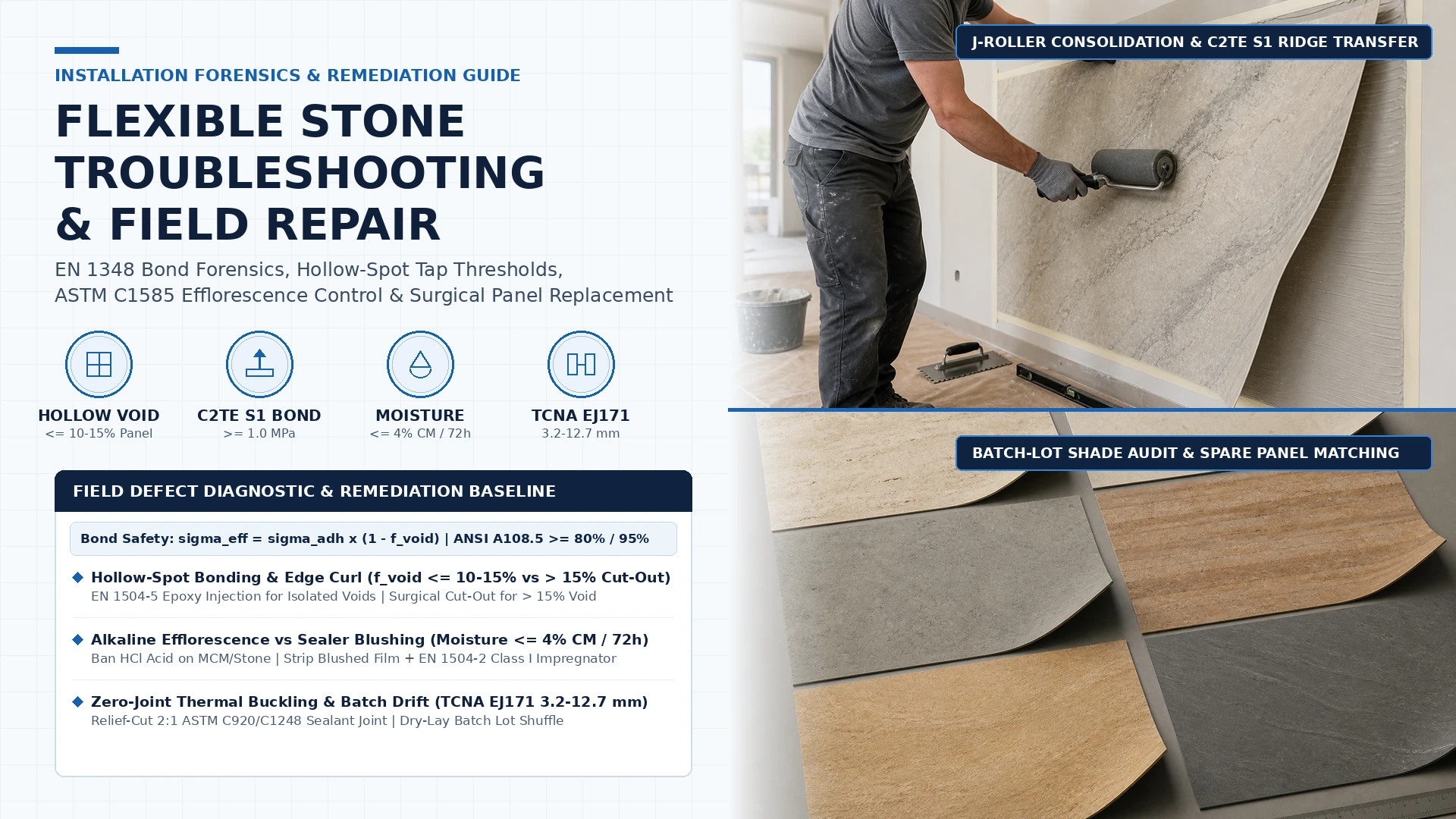
Troubleshooting flexible stone and MCM wall cladding requires diagnosing the exact failure plane before cutting, heating, or injecting adhesives: hollow-spot delamination exceeding > 10-15% of a panel area mandates surgical cut-out replacement rather than resin injection, white surface blooming requires separating ASTM C1585 alkaline efflorescence from topical sealer blushing (substrate moisture > 4% CM), and zero-joint thermal buckling demands TCNA EJ171 relief joints.
Quick Specs: Flexible Stone Field Defect Forensics, Thresholds & Remediation Baseline
Scroll the table horizontally to see all columns.
| Defect / Forensic Parameter | Engineering Acceptance & Repair Threshold | Governing Standard & Field Diagnostic Check |
|---|---|---|
| Wet Adhesive Transfer Coverage (A_cov) | >= 80% dry interior walls; >= 95% wet or exterior facades; 100% within 50 mm of all edges/corners; max single void <= 13 cm2 (2 sq in) | ANSI A108.02 / ANSI A108.5 wet lift check & cured 100% steel-ball acoustic tap survey |
| Hollow-Void Area Threshold per Panel (f_void) | <= 10–15% isolated interior void (< 5% of wall bay): EN 1504-5 low-viscosity epoxy/acrylic injection; > 10–15% panel void or exterior curl: surgical panel cut-out | Acoustic tap grid mapping + 2.0–3.0 mm dual-port (injection + upper air-vent) joint drilling |
| Tensile Bond Strength & Open-Time Skinning | EN 12004 C2TE S1 >= 1.0 MPa (EN 1348); extended open time >= 0.5 MPa at 30 min (EN 1346); R2T reactive PU/epoxy >= 2.0 MPa shear (EN 12003) | ASTM D4541 / EN 1542 pull-off dolly test + forensic failure-plane inspection (backing vs ridge vs render) |
| Substrate Moisture & Sealer Cure Gate | <= 4.0% CM mass moisture; MVER <= 3–5 lbs/1,000 sq ft/24 h (ASTM F1869); internal RH <= 75% (ASTM F2170); >= 72 h cure before EN 1504-2 Class I sealing | Carbide/impedance moisture meter + water/xylene wetting test (salt efflorescence vs sealer blushing) |
| Surface Cleaning & Acid-Wash Prohibition | Zero hydrochloric / muriatic acid (HCl) on polymer-modified MCM clay, travertine, limestone or slate; use pH 6.5–8.5 cleaner or buffered organic salt remover | Offcut chemical compatibility trial (24 h dry check) before touching visible wall faces |
| Thermal Expansion & Movement Joint Relief | 0.5–1.5 mm minimum butt relaxation gap (never 0.0 mm); 3.2–6.4 mm indoor / 6.0–12.7 mm outdoor movement joints every 2.4–3.6 m (outdoor) or 6.0–7.6 m (indoor) | TCNA EJ171 / ASTM C1193 2:1 hourglass ASTM C920 Class 25/50 + ASTM C1248 non-staining sealant |
Standard installation engineering baseline. Verify substrate flatness, adhesive compatibility, and mock-up bond performance against the project submittal pack before full wall release.
Overview
Unresolved field defects on flexible stone and modified clay (MCM) wall installations-hollow-sounding bond voids (ANSI A108.5 coverage failure), lifting or curling perimeter edges, alkaline white salt efflorescence (ASTM C1585 capillary migration), milky topical sealer blushing (moisture > 4.0% CM), zero-joint thermal seam buckling ("tenting"), cured adhesive/grout smears, and post-installation batch shade drift-escalate from localized $85-$120/panel surgical repairs into $120-$220/m² full-wall tear-out liabilities when installers apply the wrong remedy before identifying the physical failure plane. Injecting epoxy into a moisture-compromised or > 15% hollow panel traps water and fails under exterior wind suction; washing MCM or travertine with muriatic acid (HCl) permanently etches the mineral matrix; and applying uncontrolled heat guns to pry off a damaged sheet scorches adjacent polymer-composite panels.
Under our Two-Track Engineering Authority protocol, all tensile bond (EN 1348 >= 1.0 MPa), wet transfer coverage (ANSI A108.5 >= 80% dry interior / >= 95% wet & exterior), moisture (<= 4.0% CM / MVER <= 3-5 lbs/1,000 sq ft/24 h), and movement-joint (TCNA EJ171) thresholds below represent Standard Engineering Baselines under Reference Conditions (20-23°C, 50% RH). Because actual remediation depends on your exact SKU backing chemistry (fiberglass-polyester vs. MCM vs. textile fleece), adhesive class (EN 12004 C2TE S1, R2T 2-part PU/epoxy, or MS-polymer), and substrate condition, always record the defect map, diagnose the failure plane in the matrix below, and validate the approved cleaning or replacement method on an offcut or discreet test zone (24-48 h cure) before touching the visible wall. Send your defect photos, carton batch labels, and adhesive data sheets via Get a Quote or WhatsApp for a written remediation protocol-We reply within 24 hours:
| Field Symptom & Visual / Acoustic Cue | Primary Engineering Root Cause (To Verify) |
Mandatory Site Evidence to Record First | Approved Remediation Path (After Offcut Trial) |
Dominant Secondary Failure Mode & Prevention |
|---|---|---|---|---|
1. Hollow-Sounding Spots Behind Cured Panels (Acoustic Tap Ring) |
Adhesive open-time skinning (EN 1346 > 15-25 min), uncollapsed notched trowel ridges, skipped back-buttering/J-rolling (A_cov < 80% / 95%), or dusty backing |
100% steel-ball acoustic tap map marking hollow area $A_{\text{hollow}}$ per panel ($f_{\text{void}} = A_{\text{hollow}} / A_{\text{panel}}$), SKU/batch label, and adhesive TDS |
If $f_{\text{void}} \le 10\text{-}15%$ isolated indoor void (zero cracks, solid edges): dual-port 2-3 mm joint injection with EN 1504-5 low-viscosity epoxy/acrylic. If $f_{\text{void}} > 10\text{-}15%$ or exterior: surgical panel cut-out replacement |
Blind resin injection blowing out weak panels or trapping active rear moisture -> Never inject if $f_{\text{void}} > 15%$, if substrate moisture > 4% CM, or if paint/render is delaminating (ASTM D4541 < 0.5 MPa) |
| 2. Lifting, Peeling, or Curling Panel Edges & Corners | Perimeter trowel hold-back (< 100% edge contact), un-wiped substrate/backing dust, curved wrap below minimum bend radius ($R < R_{\min}$), or 0B-3B paint peel |
Feeler-gauge gap depth (mm), lifted edge length (mm), inspection of detached interface (clean panel back vs skinned mortar vs paint stuck to mortar) |
Clean gap with compressed air (oil-free), mask face with 24 mm tape, inject compatible MS-polymer or EN 12004 R2T 2-part PU/epoxy into perimeter void, roll & brace under flat batten for 24 h |
Scorching polymer binder with open heat guns or snapping brittle stone corners -> Do not pry dry lifted corners past 15° or heat unconfirmed adhesives; if paint peeled off wall, strip bay per Existing Surfaces |
| 3. Compressive Seam Buckling ("Tenting") Along Shared Joints | 0.0 mm hard-butted seams without thermal relaxation gap (0.5-1.5 mm), or bridging structural control joints / TCNA EJ171 movement bays under $\Delta T = 35\text{-}60^\circ\text{C}$ |
Straightedge lippage reading (mm), elevation bay length ($L_{\text{bay}}$), solar exposure temperature ($^\circ\text{C}$), and location of underlying substrate joints |
Saw-cut a 3.2-6.4 mm (indoor) or 6.0-12.7 mm (outdoor) relief joint along pinched seam (cold diamond blade), re-bond edges, fit ASTM C1330 Type C rod + ASTM C920 / C1248 2:1 neutral sealant |
Repeat seam buckling after re-gluing without cutting expansion relief -> Never force tented panels flat without saw-cutting a TCNA EJ171 movement gap first; see Joints & Sealing |
4. White Powdery Salt Crust (Efflorescence) vs. Milky Haze (Sealer Blushing) |
Efflorescence: water wicking Ca(OH)_2 salts through unprimed render (ASTM C1585). Blushing: topical film sealer applied at moisture > 4% CM or < 72 h cure |
Water & weak organic-acid drop test (fizzes/powders = salt efflorescence; clears when wet with water/xylene = sealer blushing) + CM moisture reading (%) |
Efflorescence: stop water leak, dry-brush with nylon bristles, wash with buffered organic salt neutralizer. Blushing: strip topical film, dry wall to <= 4.0% CM, seal with EN 1504-2 Class I impregnator ($S_d < 5.0\text{ m}$) |
Permanent acid etching, yellow iron rusting & MCM binder degradation from HCl acid wash -> Strictly prohibit muriatic acid (HCl) and wire brushes; ban film-forming sealers on exterior or damp walls |
| 5. Cured Adhesive Smears, Grout Haze, or Silicone Oil Halos on Face | Broadcast-floating grout over un-sealed cleft stone (50-400 um pores), failing to mask seam edges (18-24 mm tape), or using non-ASTM C1248 sanitary silicone |
Close-up macro photo of pore deposit, exact adhesive/grout/sealant brand & chemistry (C2TE S1 cement vs RG epoxy vs MS vs silicone), and cure age (hours/days) |
Test removal on offcut first: poultice/buffered cleaner for cement haze; dedicated epoxy emulsifier for < 24 h resin; solvent poultice for silicone oil; surgical panel replacement if cross-linked > 72 h |
Gouging cleft stone texture with metal scrapers or glossy acid-burn halos -> Never scrape cleft stone with steel blades; pre-seal and mask joints with 18-24 mm tape per Joints & Sealing |
| 6. Chipped Cut Edges or Post-Installation Batch Shade / Texture Drift | Dull/Segmented blade chipping (outside EN 13236 40-63 m/s), mixed production carton lots, skipped dry-lay shuffling, or rotated directional grain (90°-180°) |
Carton batch/lot numbers, grazing-light (15°-30°) photos at 2.0 m viewing distance, arrow direction check, and remaining spare panel inventory from original batch |
Dress minor edge chips with 80-120 grit diamond pad + mineral edge tint or anodized L-trim; for severe batch/grain mismatch, surgically replace outlier panels using batch-matched attic stock |
Ordering replacement panels without batch lot codes, creating a second shade mismatch -> Retain all carton batch labels until handover and order 5-8% spare panels from the original production lot |
Details to review
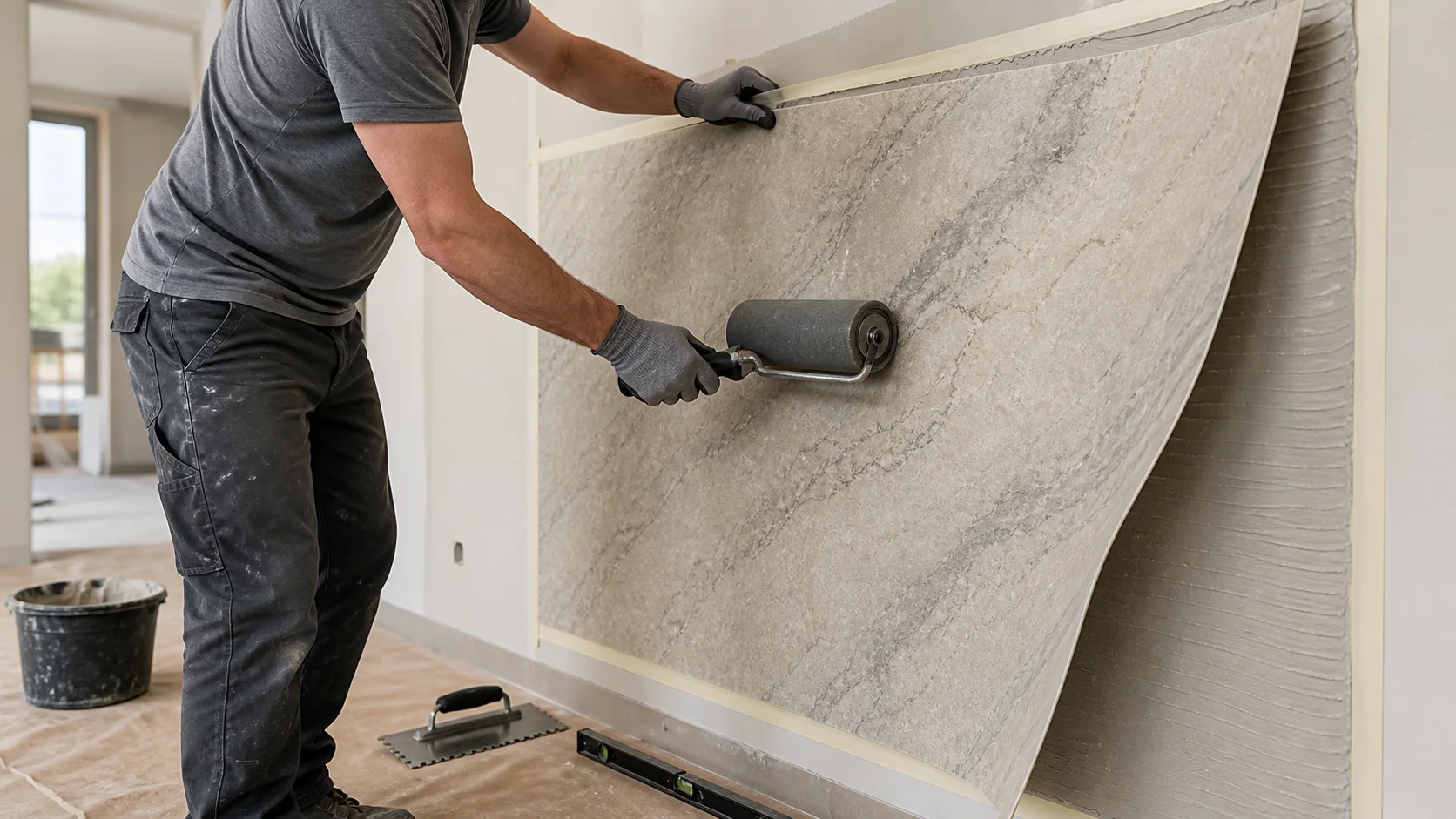
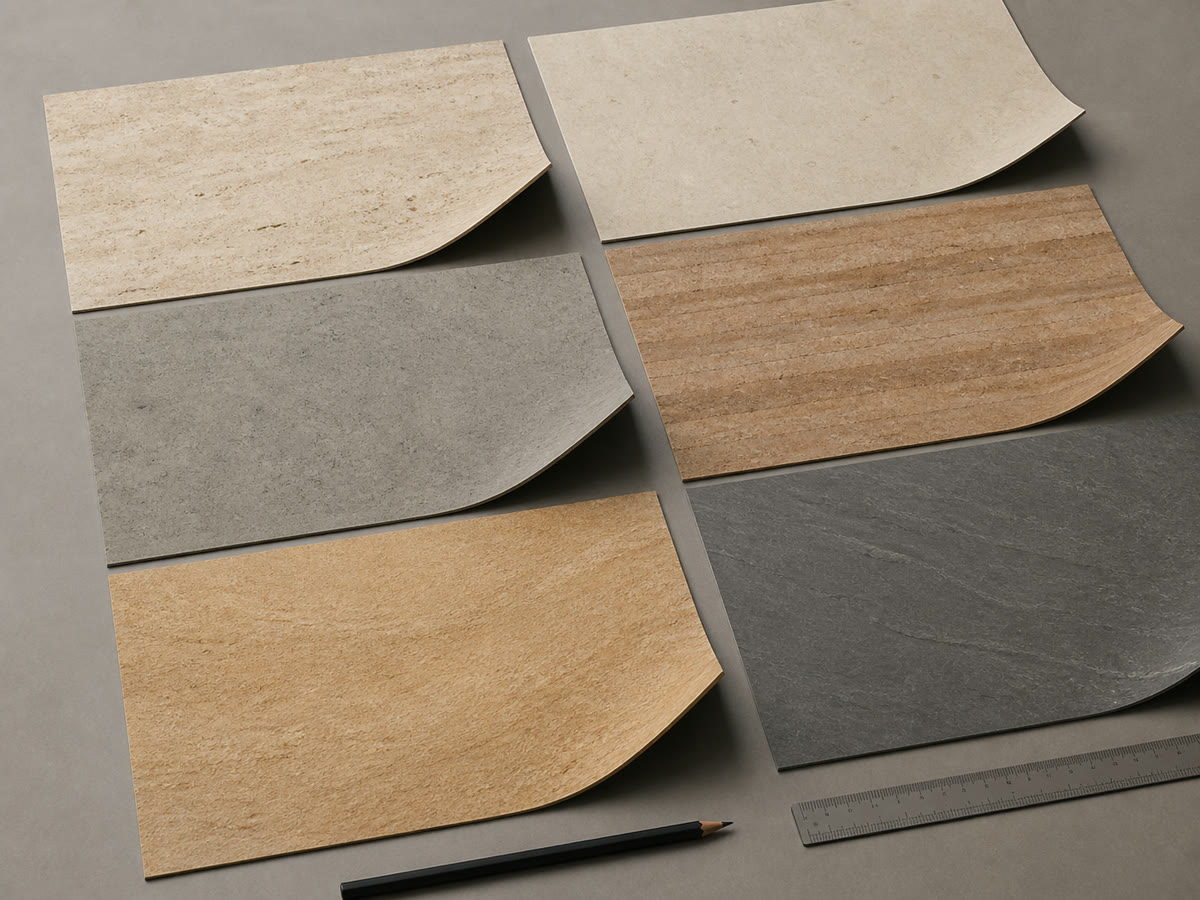
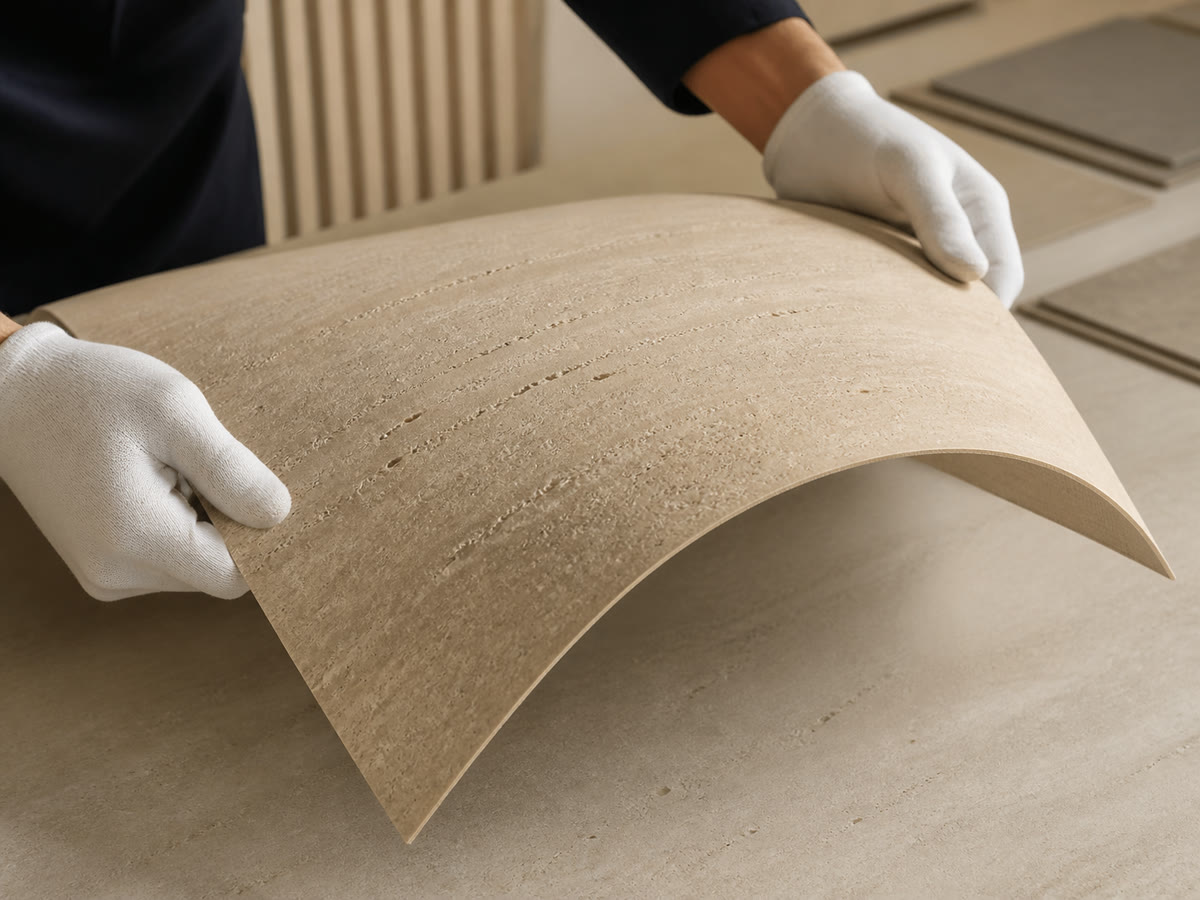
Use these visual references when reviewing the mock-up and work method with the project team.
Site checklist
1. Map Hollow-Void Ratio (`f_void <= 10-15%` Injection vs. `> 10-15%` Surgical Cut-Out)
Never inject resin blindly into a hollow-sounding panel or dismiss perimeter voids without quantifying coverage against ANSI A108.5 (Flexible Stone Installation).
Engineering Rule of Thumb: If a post-cure steel-ball acoustic tap survey reveals an isolated interior hollow pocket covering <= 10-15% of a single panel’s area (f_void <= 0.10-0.15, < 5% of total wall area, zero surface cracks, and 100% solid perimeter edges on a dry indoor wall) → remediate in place via dual-port (2.0-3.0 mm) low-viscosity EN 1504-5 epoxy or acrylic resin injection from the adjacent joint; if hollow voids exceed > 10-15% of the panel area, reach any panel corner/edge on an exterior facade (where ANSI A108.5 mandates >= 95% contact), or accompany panel tenting/cracking → prohibit resin injection and execute a surgical single-panel cut-out replacement (or full-bay re-cladding if >= 10-15% of the wall bay is hollow) because skinned-over mortar ridges lack tensile shear capacity under thermal and wind-suction cycling.
2. Separate `ASTM C1585` Efflorescence from Sealer Blushing (`Moisture <= 4% CM` & `72 h` Gate)
White discoloration on installed flexible stone or MCM cladding stems from two opposite chemical mechanisms that are ruined if misdiagnosed (Joints & Sealing and Water & Weather Resistance).
Engineering Rule of Thumb: If white surface patches dissolve or fizz slightly under a weak organic acid drop and brush off as dry crystalline powder → diagnose ASTM C1585 capillary alkaline salt efflorescence ($ ext{CaCO}_3 / ext{Na}_2 ext{SO}_4$) migrating from unprimed damp render; if white patches look milky/cloudy within a surface coating and temporarily turn transparent when wiped with clean water or xylene → diagnose topical sealer blushing caused by sealing over substrate moisture > 4.0% CM (MVER > 3-5 lbs/1,000 sq ft/24 h per ASTM F1869) or before >= 72 hours mortar/grout cure, requiring solvent stripping of the trapped film, drying to <= 4.0% CM, and re-sealing strictly with an EN 1504-2 / EN ISO 7783 Class I breathable silane-siloxane impregnator ($S_d < 5.0 ext{ m}$).
3. Ban Muriatic Acid (`HCl`) & Uncontrolled Heat Guns on Polymer-Modified `MCM` & Natural Stone
Improper remedial tools cause worse permanent facade damage than the original installation defect (Maintenance and Cutting & Drilling).
Engineering Rule of Thumb: If removing cured cementitious mortar smears, grout haze, or efflorescence from polymer-modified MCM clay panels, travertine, limestone, sandstone, or iron-bearing split slate → strictly prohibit hydrochloric/muriatic acid (HCl), phosphoric acid (pH < 3), wire brushes, and > 80°C open heat guns because strong mineral acids dissolve calcareous matrices, oxidize ferrous minerals into permanent orange ferric rust stains, and hydrolyze acrylic-polymer/fiberglass binders; use only pH 6.5-8.5 neutral stone cleaners, poultice pastes, or buffered organic salt removers validated on a scrap offcut (24 h dry observation) and remove damaged panels via cold diamond-plunge relief kerfing rather than scorching adjacent sheets.
4. Relieve Zero-Joint Thermal Buckling with `TCNA EJ171` (`3.2-12.7 mm`) `2:1` Elastomeric Joints
Edge lifting and ridging ("tenting") along panel seams occur when sheets are set at 0.0 mm hard contact or bridge structural joints (Corners & Edges).
Engineering Rule of Thumb: If adjacent flexible stone or MCM panels buckle outward into a tented ridge along a shared seam under solar heating ($Delta T = 35 ext{-}60^circ ext{C}$) or building frame creep → saw-cut a clean 3.2-6.4 mm (interior) or 6.0-12.7 mm (exterior) relief channel along the pinched seam per TCNA EJ171, re-bond any lifted 50-100 mm edge margins with EN 12004 C2TE S1 / R2T or MS-polymer adhesive, insert ASTM C1330 Type C closed-cell backer rod (or bond-breaker tape), and tool ASTM C920 Class 25/50 neutral sealant certified non-staining per ASTM C1248 at a 2:1 width-to-depth profile (ASTM C1193) because re-gluing a 0.0 mm pinched seam without expansion clearance guarantees repeat buckling on the next thermal cycle.
Key steps
Step 1: Freeze Unverified Work, Map the Elevation Grid & Record Batch + Adhesive Evidence
Before cutting, heating, scraping, or injecting any material, halt remedial work on the affected bay. Photograph the defect from
2.0 m(overall pattern under working and grazing light) and150 mm(macro texture/joint interface), run a100%acoustic steel-ball tap survey across the elevation to calculate the hollow-void ratio ($f_{\text{void}} = A_{\text{hollow}} / A_{\text{panel}}$), measure substrate moisture (% CM), and record the exact SKU, carton batch number, primer, andEN 12004adhesive class (Adhesives & Substrates).Step 2: Identify the Physical Failure Plane & Confirm the Protocol Within 24 Hours
Determine whether the fault lies at the panel-backing interface (dusty fiberglass/MCM back or incompatible mortar), within skinned-over trowel ridges (
EN 1346open-time failure), inside a weak/peeling substrate layer (ASTM D4541 < 0.5-0.8 MPaorASTM D3359 0B-3Bpaint per Existing Surfaces), or in trapped moisture/thermal pinch (moisture > 4% CMor0.0 mmbutt joints). Submit your evidence pack via Get a Quote or WhatsApp to confirm the exact repair method-We reply within 24 hours.Step 3: Validate Cleaners, Injection Resins or Cold Cut-Out Methods on an Offcut (`24-48 h`)
Never trial a chemical stripper, poultice, or cutting blade directly on the centre of a visible feature wall. Test every
pH 6.5-8.5cleaner, buffered organic salt neutralizer, epoxy emulsifier, or diamond-blade kerfing setup (Cutting & Drilling) on an unbonded spare offcut or a concealed bottom corner first, and inspect the dried finish after24-48 hoursunder grazing light to verify zero gloss shift, mineral bleaching, or edge delamination.Step 4: Execute Targeted Remediation, Re-Verify Acoustic Bond & Protect with `EN 1504-2` Sealer
Carry out the approved repair-dual-port
EN 1504-5resin injection (for isolated <= 10-15% indoor voids), cold diamond-plunge surgical panel replacement (for > 10-15% hollow panels or shade outliers, using batch-matched attic stock), orTCNA EJ171relief-joint sawing (3.2-12.7 mmfilled withASTM C920 / C12482:1neutral sealant). After48-72 hourscure and moisture verification (<= 4.0% CM), re-tap 100% of repaired panels and apply breathableEN 1504-2 Class Iimpregnator per Joints & Sealing.
Hollow-Spot Bonding & Delamination Forensics (`EN 1348`, `ANSI A108.5` & `EN 1346` Open-Time Skinning): Epoxy Injection vs. Surgical Cut-Out
When a cured flexible stone or MCM sheet produces a hollow ring during a 100% steel-ball acoustic tap survey, the defect indicates that the adhesive bed failed to achieve the ANSI A108.02 / ANSI A108.5 wet contact baseline (>= 80% on dry interior walls and >= 95% on wet areas or exterior facades, with 100% continuous support within 50 mm of all edges and corners and no individual void exceeding 13 cm² / 2 sq in). Before selecting between non-destructive resin injection and panel removal, inspect a lifted edge or core a diagnostic port to identify which of the three physical failure planes governs the debonding (see Adhesives & Substrates and Flexible Stone Installation).
Engineering Rule of Thumb: If an acoustic tap survey on a dry interior wall identifies an isolated internal hollow pocket covering <= 10-15% of a single panel’s area (f_void <= 0.10-0.15, < 5% of total wall bay, intact perimeter edges, and substrate pull-off >= 0.5-0.8 MPa) → remediate via dual-port (2.0-3.0 mm lower injection port + upper air-vent port) low-viscosity EN 1504-5 epoxy or acrylic injection through the adjacent joint; if the hollow void exceeds > 10-15% of the panel area, breaches a perimeter edge on an exterior facade (ANSI A108.5 >= 95% zone), or shows mortar skinning / substrate paint peel (ASTM D3359 0B-3B) → prohibit resin injection and execute a cold diamond-plunge surgical single-panel replacement because injecting resin into a > 15% skinned-over or moisture-compromised bed fails to restore EN 1348 shear capacity.
Quantitative Hollow-Spot Delamination Shear Margin & Bond Safety Factor Equation (EN 1348 / ANSI A108.5)
Compute the panel hollow-void ratio ($f_{\text{void}}$), effective residual tensile/shear bond strength ($\sigma_{\text{eff}}$, in $\text{MPa}$), and structural safety factor ($SF_{\text{bond}}$) under combined thermal-shear and exterior wind-suction demand ($\sigma_{\text{demand}}$):
$$f_{\text{void}} = \frac{A_{\text{hollow}}}{L \times W} = 1 - \frac{A_{\text{cov}}}{100%} \quad ; \quad \sigma_{\text{eff}} = \sigma_{\text{adh}} \times (1 - f_{\text{void}}) \quad ; \quad SF_{\text{bond}} = \frac{\sigma_{\text{eff}}}{\sigma_{\text{demand}}}$$
- Worked Example 1 (Defective Exterior
1200 x 600 mmPanel Set Over Skinned-Over Mortar Ridges with45%Hollow Area): Given panel area $A_{\text{panel}} = 1.20 \times 0.60 = 0.72\text{ m}^2$, tap-mapped hollow area $A_{\text{hollow}} = 0.324\text{ m}^2$ ($f_{\text{void}} = 0.324 / 0.72 = \mathbf{45.0%}$, leaving only $A_{\text{cov}} = 55.0%$ contact vs.ANSI A108.5 >= 95%exterior baseline), degraded skinned-ridge tensile bond $\sigma_{\text{adh}} = 0.25\text{ MPa}$ (vs. EN 1348 >= 1.0 MPaforC2TE S1), and combined solar thermal shear + wind-suction stress $\sigma_{\text{demand}} = 0.18\text{ MPa} \rightarrow \sigma_{\text{eff}} = 0.25 \times (1 - 0.45) = \mathbf{0.1375\text{ MPa}}$; $SF_{\text{bond}} = 0.1375 / 0.18 = \mathbf{0.76 < 1.0}$ (active delamination failure requiring surgical cut-out). - Worked Example 2 (Compliant Back-Buttered
EN 12004 C2TE S1Exterior Assembly with96%Consolidated Contact): Given $f_{\text{void}} = 0.04$ ($A_{\text{cov}} = 96.0%$), curedC2TE S1tensile adhesion $\sigma_{\text{adh}} = 1.10\text{ MPa}$ (EN 1348), and $\sigma_{\text{demand}} = 0.18\text{ MPa} \rightarrow \sigma_{\text{eff}} = 1.10 \times (1 - 0.04) = \mathbf{1.056\text{ MPa}}$; $SF_{\text{bond}} = 1.056 / 0.18 = \mathbf{5.87}$ (exceeding the>= 2.0-3.0facade engineering safety factor).
| Forensic Delamination Plane & Inspection Cue | Physical Root Cause (EN / ANSI Violation) |
Eligibility for In-Place Injection (f_void <= 10-15%) |
Mandatory Surgical Cut-Out or Bay Strip Protocol | Dominant Secondary Failure Mode & Prevention |
|---|---|---|---|---|
1. Plane A: Clean Separation at Panel Backing (Adhesive Stays on Wall, Panel Back Clean) |
Un-wiped factory release dust on fiberglass/polyester resin carrier, OR standard C1 cement mortar used on non-porous composite back instead of MS-polymer, R2T PU, or primed C2TE S1 |
Only if $f_{\text{void}} \le 10\text{-}15%$ local pocket caused by missed roller pressure; drill 2-3 mm ports in joint & inject low-viscosity EN 1504-5 epoxy/MS resin |
If widespread (>= 15%): chemistry mismatch -> remove panel, wipe replacement sheet back with IPA/damp cloth, back-butter 1.0 mm key coat of approved C2TE S1 / R2T / MS-polymer |
Re-bonding with the same incompatible C1 mortar -> Verify backing class per Composition & Backing and Adhesives & Substrates |
2. Plane B: Fracture at Uncollapsed Trowel Ridge Crests (Standing Rib Marks, < 60% Transfer) |
Adhesive skinning (EN 1346 open time > 15-25 min exceeded in draft/sun), wrong notch size, zero back-buttering, or skipping 35-50 kg J-roller consolidation |
Eligible if $f_{\text{void}} \le 10\text{-}15%$ indoor pocket with intact perimeter edges; inject low-viscosity resin from bottom port until air vents from top port; clamp 24 h |
If $f_{\text{void}} > 10\text{-}15%$ or exterior facade: score perimeter joints, plunge-cut relief grid with cold diamond blade, chisel skinned mortar to bare substrate, and re-set spare sheet | Injecting thick paste through a single un-vented hole (air lock & panel blister) -> Always drill both a lower injection port and an upper air-relief port (2-3 mm) in the joint |
3. Plane C: Cohesive Substrate / Paint Peel (Old Paint, Skim or Render Stuck to Adhesive Back) |
Bonding over flaking paint (ASTM D3359 Grade 0B-3B), dusty weak render (ASTM D4541 < 0.5-0.8 MPa), or unprimed gypsum/glazed tile (Existing Surfaces) |
Strictly Prohibited (0% eligible) - injecting resin above a peeling paint or weak render plane leaves the entire assembly hanging on a failing layer |
Strip failing bay to structural backing, diamond-cup grind >= 80-90% of 0B-3B paint, apply penetrating acrylic consolidator or quartz-grit primer (0.20 kg/m²), and re-clad |
Cascading full-wall sheet collapse under adhesive cure shrinkage -> Run ASTM D4541 pull-off (>= 0.5-1.0 MPa) and ASTM D3359 (4B-5B) tests before re-cladding |
4. Perimeter Corner & Edge Curl (Lifted 10-80 mm Margin Around Sheet Perimeter) |
Holding notched trowel 15-30 mm back from sheet edges, dust accumulation at perimeter, or dry-wrapping curves tighter than minimum radius ($R < R_{\min}$) |
Eligible for perimeter re-bonding if central >= 85% of panel is solid: blow out dust with oil-free air, mask stone edge, inject MS-polymer or R2T PU, brace flat 24 h |
If panel was bent past $R_{\min}$ with micro-cracked backing or > 15% perimeter detachment: cut out panel and detail corner with thermoforming (50-80°C), 45° miter, or L-trim |
Prying dry lifted stone corners past 15° or scorching face with heat gun -> Never force-bend cold cured panels; see Corners & Edges |
Alkaline Salt Efflorescence (`ASTM C1585`) vs. Topical Sealer Blushing (`Moisture > 4% CM`): Diagnostic Drop Test & Breathable `EN 1504-2` Remediation
White patches, chalky streaks, or cloudy milky veils appearing days or months after installing flexible stone or modified clay (MCM) panels are frequently misdiagnosed as "bad stone batches"-leading maintenance crews to scrub the facade with muriatic acid (HCl) or apply another coat of glossy acrylic sealer, both of which lock in permanent damage. In building forensics, white surface blooming divides strictly into two mechanisms governed by ASTM C1585 capillary water sorptivity and EN 1504-2 / EN ISO 7783 water-vapor diffusion resistance ($S_d$) (see Joints & Sealing and Water & Weather Resistance):
- Alkaline Salt Efflorescence (
Crystalline CaCO3 / Na2SO4 Deposit): Liquid water infiltrates behind the cladding (through un-flashed parapet copings, unprimed damp concrete/blockwork, or pinholes in cementitious grout), dissolves free calcium hydroxide ($\text{Ca(OH)}_2$) and alkali sulfates from Portland cement, wicks outward through capillary pores (ASTM C1585), and reacts with atmospheric carbon dioxide ($\text{CO}_2$) upon evaporation to precipitate a dry white crystalline crust. - Topical Sealer Blushing / Whiten-Out (
Emulsified Polymer Haze): A film-forming topical sealer (acrylic, styrene-acrylate, polyurethane, or solvent lacquer with $S_d > 5.0\text{ m}$) was applied over a damp substrate (moisture> 4.0% CMorMVER > 3-5 lbs/1,000 sq ft/24 hperASTM F1869) or before the cementitious adhesive and grout cured for>= 72 hours. Outward vapor pressure condenses beneath the non-breathable polymer film, micro-blistering and turning the coating milky white.
Engineering Rule of Thumb: Never wash polymer-modified MCM clay veneers, calcareous stones (travertine, limestone, marble), or iron-bearing split slate with hydrochloric / muriatic acid (HCl) or unbuffered strong acids (pH < 3.0), and never apply any surface sealer until substrate moisture reads <= 4.0% CM after >= 72 hours adhesive/grout cure; strip blushed topical films completely and protect exterior or wet-zone veneers exclusively with an EN 1504-2 / EN ISO 7783 Class I hydrophobic silane-siloxane or fluoropolymer impregnator ($S_d < 5.0\text{ m}$, capillary uptake $w \le 0.1\text{ kg/m}^2\cdot\text{h}^{0.5}$).
| Surface Discoloration / Blooming Type | 60-Second Field Diagnostic Check | Root Moisture / Chemical Mechanism | Step-by-Step Engineered Remediation Protocol | Dominant Field Failure Mode & Prevention |
|---|---|---|---|---|
1. Primary / Secondary Alkaline Efflorescence (White Powdery Salt Crust) |
Scrape with fingernail -> dry white powder; apply clean water + weak organic acid drop -> dissolves / fizzes slightly (CaCO3 salt) |
Rear water intrusion + unprimed cement render (ASTM C1585 capillary wicking of Ca(OH)_2 + CO_2 -> CaCO_3) |
Step 1: Seal parapet/flashing water entry. Step 2: Dry-brush crystals with stiff nylon brush. Step 3: Wash with pH-buffered organic salt remover (offcut tested), low-pressure rinse (<= 40 bar), dry to <= 4% CM, and apply EN 1504-2 Class I impregnator |
Washing with muriatic acid (HCl) or high-pressure water (> 60 bar) -> HCl etches MCM/travertine and saturates the substrate with chloride salts, triggering heavier repeat efflorescence |
2. Topical Sealer Moisture Blushing (Milky / Cloudy White Veil) |
Wipe patch with clean water or xylene on a cloth -> milky haze temporarily turns clear/transparent while wet (optical refraction test), then returns as it dries |
Film-forming acrylic/urethane sealer applied at substrate moisture > 4.0% CM (MVER > 3-5 lbs) or < 72 h mortar cure, trapping vapor under high-$S_d$ film |
Step 1: Apply biodegradable masonry coating stripper / xylene solvent poultice (offcut tested), agitate with nylon pad, and wet-vac emulsified film. Step 2: Dry wall to <= 4.0% CM. Step 3: Apply penetrating EN 1504-2 Class I silane-siloxane |
Applying a second coat of topical sealer over blushed stone -> Traps moisture deeper and causes cohesive stone/MCM surface spalling under freeze-thaw cycling (Freeze-Thaw Performance) |
3. Ferrous Iron Oxidation / Acid-Burn Yellowing (Orange-Brown Rust Blotches) |
Non-water-soluble rust-orange or yellow stains inside slate, quartzite, or sandstone pores following an acid wash or continuous dampness | Hydrochloric/acid cleaner reacting with natural trace pyrite/ferrous iron ($\text{Fe}^{2+} \rightarrow \text{Fe}^{3+}$ oxide), or rusting steel anchors/frames | Apply a neutral chelating rust-remover poultice (sodium hydrosulfite / ammonium oxalate paste, pH 6.5-7.5, tested on offcut) under polyethylene wrap for 12-24 h; rinse with deionized water and dry to <= 4% CM |
Permanent ferric oxide staining across entire facade -> Ban all mineral acids (HCl, H2SO4) on natural stone and MCM; specify stainless AISI 304/316 or anodized aluminum trims |
| 4. Silicone Plasticizer Oil Bleed ("Picture-Framing" Dark Border at Joints) | 5-15 mm dark, wet-look greasy halo bordering movement joints that does not dry out under heat gun warming (non-volatile silicone fluid) |
Cheap sanitary or acetoxy silicone caulk leaching low-molecular-weight polydimethylsiloxane oil into porous stone (violating ASTM C1248) |
Cut out offending silicone bead, apply absorbent fuller’s earth / diatomaceous poultice with mineral spirits (24-48 h draw cycle) to extract oil from pores, and re-seal with certified ASTM C920 + ASTM C1248 non-staining sealant |
Irreversible oil migration into travertine/sandstone clefts -> Require written ASTM C1248 non-staining stone certification or 100%-solids MS-polymer on all movement joints |
Zero-Joint Thermal Buckling ("Tenting"), Cured Adhesive/Grout Smears, Cut Chipping & Batch Shade Drift (`TCNA EJ171` & `EN 13236`)
Even when adhesive coverage and substrate dryness pass inspection, four visible workmanship faults-compressive seam buckling ("tenting"), cured adhesive or grout smears in cleft pores, chipped saw-cut edges, and post-installation batch shade/texture drift-can trigger handover rejection under architectural raking light (15°-30° incidence). Each fault requires a targeted mechanical or optical protocol (see Cutting & Drilling, Corners & Edges, and Joints & Sealing).
Engineering Rule of Thumb: If adjacent panels lift into a peaked ridge along a 0.0 mm hard-butted seam (compressive tenting) or crack over a bridged substrate joint → cold-saw a 3.2-6.4 mm (indoor) or 6.0-12.7 mm (outdoor) TCNA EJ171 expansion relief channel directly through the pinched seam using an EN 13236 continuous-rim diamond blade (40-63 m/s), re-bond the 50-100 mm flanking panel margins with EN 12004 C2TE S1 / R2T or MS-polymer, and seal over ASTM C1330 Type C closed-cell backer rod with ASTM C920 Class 25/50 + ASTM C1248 non-staining sealant (2:1 width-to-depth ratio); and if a bonded panel exhibits a severe batch shade jump (CIE Delta E* > 2.5-3.0) or 90°-180° inverted travertine/wood grain → surgically cut out the outlier panel and replace it from reserved original-batch attic stock (5-8% spare allowance).
| Workmanship / Visual Defect | Governing Standard & Tolerance Limit | Root Installation Error | Approved Field Remediation Protocol (Offcut Validated) |
Dominant Secondary Risk & Engineering Prevention |
|---|---|---|---|---|
| 1. Compressive Seam Buckling ("Tenting") & Bridged Joint Cracking | TCNA EJ171 / ANSI A108.02: min 0.5-1.5 mm butt relaxation gap; 3.2-12.7 mm movement bays every 6.0-7.6 m indoor / 2.4-3.6 m outdoor |
Butting sheets tightly at 0.0 mm or bridging concrete-to-block / drywall control joints across $\Delta T = 35\text{-}60^\circ\text{C}$ thermal swings |
Plunge-cut a 3.2-12.7 mm relief joint along the tented seam to substrate depth (never force panels flat without cutting clearance), inject MS-polymer / R2T under lifted borders, brace 24 h, and tool 2:1 ASTM C920 / C1248 sealant |
Sawing into structural waterproof membranes or EIFS mesh -> Set diamond plunge depth strictly to $t_{\text{panel}} + t_{\text{adh}}$ (3.5-5.5 mm) using a depth-stop track saw |
2. Cured Cement (C2TE S1), Epoxy (RG) or MS-Polymer Smears on Face |
ISO 13007-3: zero residual binder veil inside 50-400 um natural stone or MCM surface clefts |
Loading trowel over panel face, skipping 18-24 mm masking tape along joints, or rubber-floating grout across un-sealed split stone |
Fresh smears (< 30 min): wipe with damp microfiber sponge (cement) or manufacturer solvent wipe (MS/RG). Cured smears (24-72 h): apply offcut-tested buffered cement softener or epoxy stripper gel + stiff nylon brush; if cross-linked > 72 h deep in clefts, replace panel |
Wire-brushing or chisel-scraping cleft stone faces -> Leaves shiny metallic burnish marks and tears composite mineral skin; always mask seams with 18-24 mm tape before grouting |
| 3. Chipped, Delaminated or Frayed Saw-Cut Edges & Socket Cutouts | EN 13236: continuous-rim diamond blade (1.2-1.8 mm kerf at 40-63 m/s) or 40-60 TPI carbide blade; lippage <= 1.0 mm |
Cutting with segmented masonry blade, dull utility knife, unsupported sheet overhang, or wrong feed direction without offcut trial | Minor edge chips (<= 1.5 mm): dress at 45° with 80-120 grit diamond hand pad, touch up raw fiberglass carrier with mineral pigment tint (>= 95% match), or cap with anodized aluminum L-trim. Severe corner fracture: surgical panel replacement |
Exposed white fiberglass threads wicking water at wet/exterior edges -> Seal all site-cut edges with EN 1504-2 impregnator or ASTM C920 / C1248 bead per Cutting & Drilling |
| 4. Post-Installation Batch Shade, Gloss or Grain-Direction Mismatch | Single production batch per elevation; directional vein arrows aligned (0° deviation); dry-lay shuffle across >= 4-6 cartons |
Mixing leftover cartons from different production dates, installing sheets sequentially without shuffling, or flipping directional travertine 180° |
Audit carton batch labels, raking-light angle (15°-30°), and viewing distance (2.0 m indoor / 3.0 m outdoor). Re-orient or surgically replace only the high-contrast outlier panels using matching batch attic stock (never paint or topical-stain natural stone) |
Applying tinted topical varnish to "blend" mismatched stone panels -> Peel and UV-yellowing within 6-18 months; send batch labels via Request Samples to match spare stock |
5-Year Unprimed Efflorescence Remediation, Hollow-Tile Wind-Suction Failure & Adhesive Coverage TCO Ledger + Project Submittal Checklist ("What to Send Us")
When field defects appear on commercial Interior Walls, Exterior Facades, or Hospitality projects, property owners and general contractors must decide whether surgical single-panel cut-out replacement ($C_{\text{surgical}}$) is more economical than full-elevation stripping and re-cladding ($C_{\text{reclad}}$). As long as the receiving substrate passes ASTM D4541 / C1583 pull-off verification (>= 0.5-1.0 MPa) and moisture limits (<= 4.0% CM), cold diamond-plunge surgical replacement of isolated defective panels saves 80-94% of remediation cost and eliminates multi-week commercial closure.
Quantitative Single-Panel Surgical Cut-Out vs. Full-Wall Re-Cladding Cost Formula ($C_{\text{surgical}}$ vs. $C_{\text{reclad}}$)
Calculate the total surgical panel replacement cost ($C_{\text{surgical}}$, in $\text{USD}$), full-wall tear-out and re-cladding cost ($C_{\text{reclad}}$, in $\text{USD}$), and break-even defect ratio ($r_{\text{crit}}$) for $N_{\text{def}}$ defective panels out of $N_{\text{total}}$ installed sheets over wall area $A_{\text{wall}}$ ($\text{m}^2$):
$$C_{\text{surgical}} = N_{\text{def}} \times \left( A_{\text{panel}} \cdot c_{\text{mat}} + c_{\text{cut-lab}} + c_{\text{consum}} \right) \quad ; \quad C_{\text{reclad}} = A_{\text{wall}} \times \left( c_{\text{strip}} + c_{\text{prep}} + c_{\text{mat}} + c_{\text{install}} \right) \quad ; \quad r_{\text{crit}} = \frac{C_{\text{reclad}}}{N_{\text{total}} \times c_{\text{panel-fix}}}$$
- Worked Example (
80 m²Commercial Feature Wall with6Hollow or Acid-Damaged1200 x 600 mmPanels vs. Full Wall Tear-Out): Given wall area $A_{\text{wall}} = 80\text{ m}^2$ ($N_{\text{total}} = 111\text{ panels}$ at $A_{\text{panel}} = 0.72\text{ m}^2$), $N_{\text{def}} = 6\text{ defective panels}$ (5.4%of wall area), batch-spare sheet material cost $A_{\text{panel}} \cdot c_{\text{mat}} = 0.72 \times $32.00 = $23.04/\text{panel}$, cold diamond-plunge relief kerfing + mortar chiseling + re-bonding labor $c_{\text{cut-lab}} = $68.00/\text{panel}$, and primer +EN 12004 C2TE S1 / MS-polymerconsumables $c_{\text{consum}} = $13.96/\text{panel}$ ($\text{unit surgical cost } c_{\text{panel-fix}} = $105.00/\text{panel}$) $\rightarrow C_{\text{surgical}} = 6 \times $105.00 = \mathbf{$630.00}$, compared against full-wall demolition, substrate grinding, and re-cladding at $c_{\text{reclad-unit}} = $135.00/\text{m}^2 \rightarrow C_{\text{reclad}} = 80 \times $135.00 = \mathbf{$10{,}800.00}$ (saving $\mathbf{$10{,}170.00}$ or94.2%, with surgical replacement remaining economical up to a break-even defect threshold of $r_{\text{crit}} = $10{,}800 / (111 \times $105) = \mathbf{92.7%}$ financially, though engineering rules mandate full-bay stripping once systemic substrate/bond failure exceeds>= 15-20%of the wall bay).
5-Year TCO, Risk & Remediation Dimension (100 m² Commercial Facade / Lobby Basis) |
Unprimed / Skinned-Mortar Shortcut (C1 Mortar, < 60% Coverage, 0.0 mm Butt, HCl Acid Wash) |
Blind Spot-Patching Without Root-Cause Forensics (Un-Vented Injection / Topical Sealer Over Damp Wall) |
Engineered Prevention & Forensic Protocol (C2TE S1 >= 95% Coverage, <= 4% CM, EN 1504-2, Surgical Repair) |
5-Year Engineering & Financial Verdict |
|---|---|---|---|---|
| Initial Primer, Adhesive Coverage & Joint Control Cost | $6.50-$9.00/m² (cheap C1 mortar, spot-dabbed or single-buttered, zero primer or movement joints) |
$12.00-$18.00/m² (initial install + $1,500-$3,000 wasted on cosmetic topical re-coating or blind caulk) |
$11.50-$16.50/m² (acrylic/quartz primer, back-buttered EN 12004 C2TE S1, TCNA EJ171 joints, EN 1504-2 Class I sealer) |
+$5-$7/m² upfront investment locks in >= 1.0 MPa bond and vapor-open drainage |
| Hollow-Tile Wind-Suction Delamination & Edge Curl Liability | 20-40% hollow-spot & perimeter peel rate within 6-24 months ($13,500-$22,000 full facade re-clad + scaffolding) |
15-30% repeat failure rate (injected resin pops off with peeling 0B-3B paint or wet render) |
< 0.5-1.0% localized defect rate; isolated <= 10-15% indoor voids fixed at $45-$65/panel or surgical cut-out at $95-$120/panel |
Prevents $13,500-$22,000 catastrophic wind-suction failure on 100 m² facades |
| 5-Year Unprimed Efflorescence & Sealer Blushing Remediation Cost | $35-$65/m² ($3,500-$6,500 acid-burn etching, recurring CaCO3 salt crust, and panel replacement) |
$45-$80/m² ($4,500-$8,000 chemical stripping of milky blushed acrylic films + freeze-thaw spall repair) |
$0 efflorescence/blushing rework (<= 4% CM moisture gate + 72 h cure + breathable S_d < 5.0 m silane-siloxane) |
Saves $3,500-$8,000 per 100 m² in recurring chemical stripping & salt remediation |
| Batch Shade Drift & Spare-Stock Handover Continuity | 0% spare stock or lost batch labels (requires stripping entire 20-40 m² elevation to avoid patch mismatch) |
Random replacement cartons ordered without lot codes (visible CIE Delta E* > 3.5 checkerboard patch) |
5-8% labelled original-batch attic stock retained at handover (single-panel replacement completed in < 2 hours) |
Cuts single-panel damage recovery from $3,500+ bay strip to $105 surgical swap |
What to Send Us for a 24-Hour Forensic Troubleshooting & Replacement Review
Before cutting into a bonded panel, applying heat, or purchasing chemical strippers, send the five diagnostic records below via Get a Quote or WhatsApp-We reply within 24 hours with a written remediation protocol and batch-matched replacement availability:
| Item | Why We Need It | Example Format |
|---|---|---|
1. Numbered Defect Map, Wide/Close-Up Photos & Hollow-Void % ($f_{\text{void}}$) |
Determines whether <= 10-15% dual-port EN 1504-5 resin injection, > 10-15% cold diamond-plunge surgical panel replacement, or full-bay stripping is required |
Dimensioned elevation PDF marking 4 affected panels (f_void = 8% on P1, 35% on P2-P4) + 2.0 m raking-light & 150 mm macro photos |
| 2. Product SKU, Sheet Format ($L \times W \times t_{\text{panel}}$) & Carton Batch Labels | Matches replacement sheets to your exact original production lot shade/grain and confirms backing chemistry (fiberglass-resin vs MCM vs fleece) |
SKU: Slate Kosha 1200 x 600 x 2.2 mm, Carton Batch #HM-202604-B09 photo, 4 spare sheets on site |
3. Substrate Stack, Primer & EN 12004 Adhesive / Grout Data Sheets |
Identifies the forensic failure plane (panel backing vs skinned C2TE S1 ridge vs ASTM D3359 0B-3B paint peel) and compatible repair solvent/adhesive |
Interior painted cement render, no primer used, bonded with C1 mortar (6x6 mm trowel, single-buttered 14 days ago) |
4. Substrate Moisture (% CM), TCNA EJ171 Joint Widths & Drop-Test Result |
Separates ASTM C1585 alkaline salt efflorescence from topical sealer blushing (moisture > 4% CM) and checks thermal pinch (0.0 mm seams) |
CM moisture = 5.4% near parapet, white veil turns clear when wet with water (sealer blushing), 0.0 mm butt joints |
| 5. Replacement Quantity ($N_{\text{def}}$ or $\text{m}^2$), Offcut Availability & Destination | Calculates surgical replacement takeoff, matched adhesive/cleaner consumables, and express air courier vs sea crate lead time | Need 8 replacement panels (5.76 m²) matching Batch #HM-202604-B09 + MS-polymer cartridges, air freight to Dubai, UAE |
Frequently asked questions
What diagnostic evidence should we record when hollow spots are found behind flexible stone panels, and when is resin injection permitted?
Before drilling or cutting any panel, run a 100% steel-ball acoustic tap survey across the elevation and mark the exact hollow perimeter on a numbered wall grid to compute the panel void ratio (f_void = A_hollow / A_panel), alongside substrate moisture (% CM), product SKU/carton batch labels, and the EN 12004 adhesive data sheet. Dual-port (2.0-3.0 mm lower injection port + upper air-vent port) low-viscosity EN 1504-5 epoxy or acrylic resin injection through the adjacent joint is permitted only when f_void is <= 10-15% of an individual panel (< 5% of the total wall bay), the panel sits on a dry interior wall (moisture <= 4% CM), all perimeter edges are 100% solidly bonded, and the underlying substrate/paint is sound (ASTM D4541 >= 0.5 MPa, ASTM D3359 Grade 4B-5B). If f_void exceeds > 10-15% of a panel, reaches an exterior facade edge (where ANSI A108.5 requires >= 95% contact), or accompanies paint skin-off, resin injection is prohibited and surgical panel cut-out or bay stripping is required.
Can we use a heat gun to soften the adhesive and peel off a damaged flexible stone panel for replacement?
Never apply an open heat gun (> 80°C) to a bonded flexible stone wall before confirming the exact panel backing and adhesive chemistry. Cross-linked cementitious mortars (EN 12004 C2TE S1/S2), two-part polyurethanes/epoxies (EN 12004 R2T), and cured MS-polymers are thermoset or elastomeric networks that do not melt cleanly under heat-instead, uncontrolled heating scorches adjacent panels, yellows polyester/acrylic binders, and delaminates the stone cleft layer from its fiberglass carrier. To replace a single damaged panel safely, mask the surrounding panels, score the perimeter joints to substrate depth, plunge-cut 100 x 100 mm relief kerfs across the damaged panel interior using a depth-stopped EN 13236 continuous-rim diamond blade (set to t_panel + t_adh = 3.5-5.5 mm), chisel out the fractured strips cold from the centre inward, dress and re-prime the substrate, and bond a batch-matched spare sheet.
How do we tell the difference between white salt efflorescence and milky sealer blushing on installed stone panels?
Run a 60-second optical wetting and weak-acid test on a corner of the white patch. If scraping with a fingernail yields a dry crystalline powder that dissolves or fizzes slightly under a drop of diluted organic acid (such as 5% acetic/citric acid), the deposit is alkaline salt efflorescence (CaCO3 / Na2SO4) wicked from damp unprimed cement render via ASTM C1585 capillary suction. If the white veil sits inside a surface coating and temporarily turns transparent/clear when wiped with clean water or xylene solvent-reappearing as it dries-it is topical sealer blushing caused by applying a film-forming acrylic or urethane sealer over substrate moisture > 4.0% CM or before 72 hours of mortar cure. Remediate efflorescence with dry nylon brushing and a pH-buffered organic salt neutralizer (never HCl muriatic acid); remediate blushing by solvent-stripping the topical film, drying the wall to <= 4.0% CM, and applying a breathable EN 1504-2 Class I silane-siloxane impregnator (Sd < 5.0 m).
Why is muriatic (hydrochloric) acid prohibited for cleaning mortar smears or efflorescence off MCM and flexible stone?
Hydrochloric/muriatic acid (HCl, pH < 1.0) causes three irreversible failures on flexible stone and modified clay (MCM) veneers: (1) on calcareous travertine, limestone, and marble, it aggressively dissolves calcium carbonate, pitting the micro-cleft surface and dulling natural mineral luster; (2) on iron-bearing split slate, quartzite, and sandstone, acid oxidizes trace ferrous minerals (Fe2+) into insoluble ferric oxide (Fe3+), locking permanent orange-brown rust stains across the panel face; and (3) on polymer-modified MCM clay and fiberglass-resin backings, strong mineral acid hydrolyzes the acrylic/polyester binder matrix and introduces soluble chloride ions into the mortar bed, accelerating heavier secondary efflorescence. Always clean cured cement haze or salt deposits using pH 6.5-8.5 neutral stone cleaners or buffered organic salt removers validated on a scrap offcut for 24 hours.
What causes adjacent flexible stone panels to buckle or tent along a shared seam, and how do we fix it permanently?
Seam tenting (compressive edge buckling) occurs when flexible stone or MCM panels are installed with 0.0 mm hard-butted joints or bridged directly across a structural substrate control joint without TCNA EJ171 expansion clearance. When solar radiation or seasonal heating raises wall skin temperature by Delta T = 35-60°C, unrestrained thermal expansion (Delta L = alpha_eff * L_bay * Delta T) builds axial compressive stress along the veneer plane until two meeting edges pop outward into a peaked ridge. Simply injecting glue and pressing the ridge flat without relieving the pinch guarantees repeat buckling. To fix tenting permanently, plunge-cut a 3.2-6.4 mm (interior) or 6.0-12.7 mm (exterior) relief channel along the buckled seam with a cold diamond blade, inject EN 12004 R2T or MS-polymer adhesive beneath the flanking 50-100 mm panel borders, brace flat for 24 hours, insert closed-cell polyethylene backer rod (ASTM C1330 Type C), and tool ASTM C920 + ASTM C1248 non-staining sealant at a 2:1 width-to-depth ratio.
How do we verify batch shade matching when ordering or using spare panels for a post-installation repair?
Because split-face natural stone veneers and mineral-pigmented MCM sheets exhibit natural lot-to-lot variation in shade, veining, and cleft relief, every project should retain 5-8% labelled attic stock from the original production batch at handover. Before bonding a replacement panel, check the carton batch/lot code, align the directional backing arrows (0° orientation match), and dry-hold the replacement panel flat against the surrounding wall under the room’s final raking light (15°-30° incidence angle) from a 2.0-3.0 m viewing distance. If original attic stock is exhausted, send us the original carton batch sticker photo, SKU code, and a daylight photo of the installed wall alongside a neutral grey card or ruler via Request Samples or Get a Quote-we will pull and photograph the closest matching production lot from factory inventory for your approval before shipping.
Continue planning
Use these related guides before fixing details or releasing material.
Audit ANSI A108.02 flatness & ANSI A108.5 (80% / 95%) coverage
Trace hollow-spot delamination and edge curling back to notched-trowel open time, back-buttering, and J-roller consolidation.
Read moreMatch EN 12004 C2TE S1, R2T & MS-polymer to backing chemistry
Verify EN 1348 tensile bond baselines (>= 1.0 MPa), primer selection, and substrate moisture limits (<= 4% CM / MVER <= 3 lbs).
Read moreExecute cold diamond-plunge relief cuts & edge dressing
Use EN 13236 diamond blades (40-63 m/s) and 80-120 grit diamond hand pads for surgical single-panel cut-outs without chipping.
Read moreRemediate grout haze, sealer blushing & TCNA EJ171 joints
Apply ISO 13007-3 CG2WA/RG piped grouts, ASTM C1248 non-staining sealants, and EN 1504-2 Class I breathable impregnators (Sd < 5.0 m).
Read moreDiagnose ASTM D3359 paint skin-off & tile-over-tile shear failures
Evaluate ASTM D4541 pull-off strength (>= 0.5-1.0 MPa), quartz-grit primers, and 160 g/m2 AR-glass mesh skim coats on retrofit walls.
Read moreSet pH-neutral (pH 6.5-8.5) post-repair cleaning & care protocols
Protect repaired MCM and natural stone veneers with non-acidic cleaning schedules and breathable re-impregnation intervals.
Read moreWhat to send us
Scroll the table horizontally to see all columns.
| Item | Why we need it | Example format |
|---|---|---|
| Numbered defect map, wide/close-up photos & hollow-void % per panel (f_void) | Distinguish <= 10-15% isolated epoxy injection vs > 10-15% surgical panel cut-out or full re-clad | Dimensioned PDF elevation marking hollow zones, edge curl or white patches + raking-light photos |
| Panel SKU, sheet format (L x W x t_panel mm), backing class & carton batch labels | Match replacement panels to original production lot shade/grain and backing chemistry | Product code, carton batch/lot sticker photos and remaining spare panel count |
| Substrate layer stack, primer, EN 12004 adhesive class (C2TE S1 / R2T / MS) & trowel notch | Identify the forensic failure plane (panel back, skinned mortar ridge or substrate/paint peel) | Adhesive/primer data sheets, notch size (e.g., 6x6 mm), back-buttering notes and cure dates |
| Substrate moisture reading (% CM / ASTM F1869), TCNA EJ171 joint spacing & sealer TDS | Diagnose ASTM C1585 alkaline efflorescence vs topical sealer blushing (moisture > 4% CM) | CM moisture log (%), movement joint widths (3.2-12.7 mm), water-wetting test and sealer label |
| Remediation scope (panel count or m2), spare stock status & delivery destination | Quote batch-matched replacement sheets, repair consumables and express air/sea freight | Required replacement panel count / net m2, offcut trial notes and destination city/port |
We reply within 24 hours.
Send your project details