Flexible Stone Installation
Flexible Stone Adhesives & Substrates
Updated
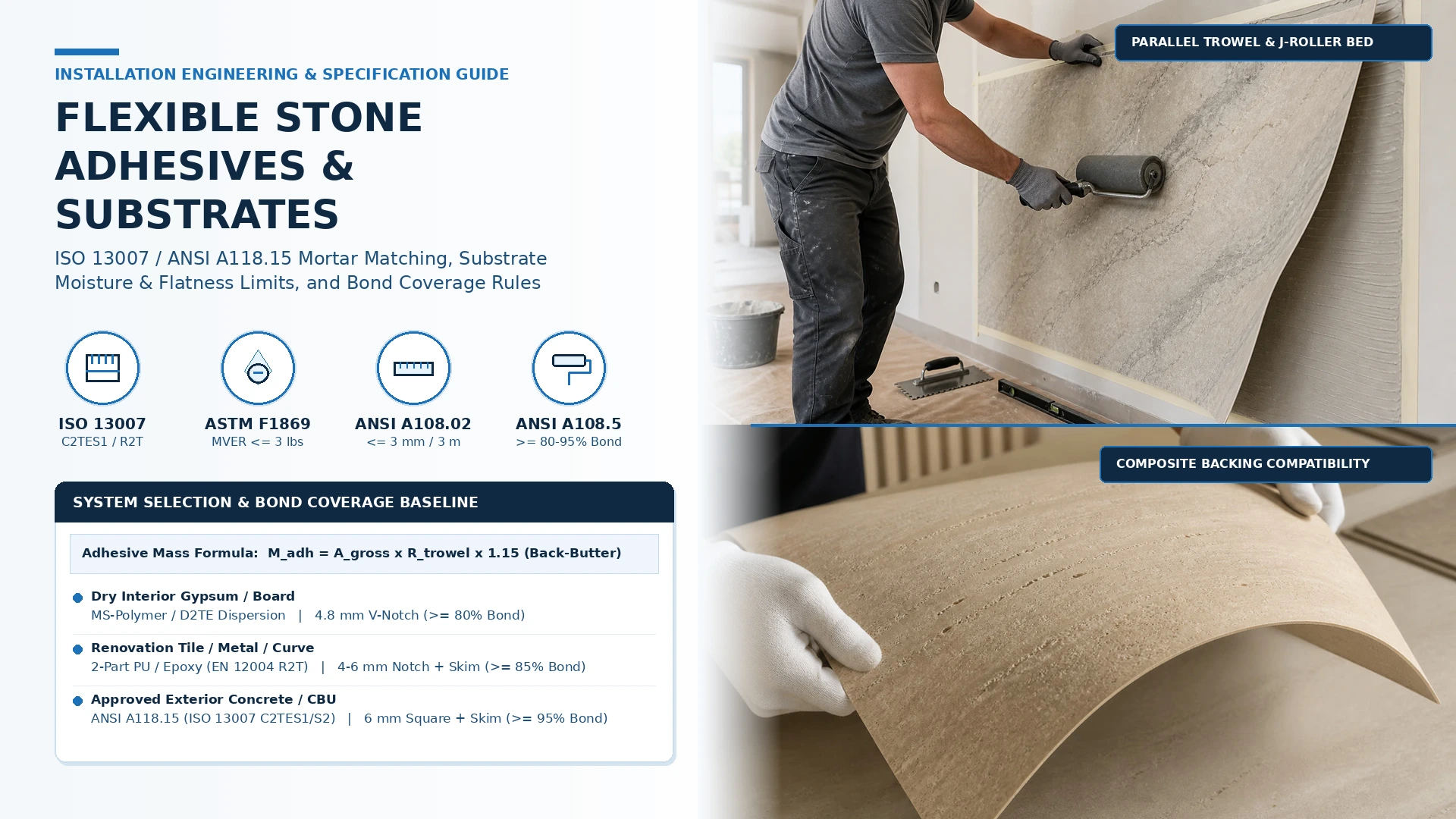
Bonding flexible stone panels with an incompatible adhesive chemistry or over an unverified substrate causes saponification detachment, hollow-pocket freeze-thaw blistering, and full-wall tear-out rework. Adhesive selection is a system engineering decision: match the panel backing (polymer-fiberglass, textile fleece, or MCM mineral matrix) and exposure zone to an ISO 13007 / EN 12004 (C2TES1/S2 or R2T) or ANSI A118.15 adhesive, verify substrate flatness to within 3 mm per 3 m (ANSI A108.02) and moisture to MVER <= 3 lbs / 1,000 sq. ft. / 24 h (ASTM F1869), and validate >= 80% interior or >= 95% exterior contact (ANSI A108.5) on a cured site mock-up before production release.
Quick Specs: Adhesive & Substrate Acceptance Baseline
Scroll the table horizontally to see all columns.
| System Parameter | Engineering Acceptance Baseline | Reference Standard & Field Verification |
|---|---|---|
| Substrate Plane Flatness (Panel Edge >= 380 mm) | Max 3 mm in 3 m (1/8 in per 10 ft); <= 1.6 mm in 600 mm (1/16 in per 24 in) | ANSI A108.02 Section 4.1.4.3.1 straightedge & grazing-light survey |
| Structural Framing Deflection Limit | <= L/360 (standard drywall/cement-board studs); <= L/720 (natural stone on wood framing) | ANSI A108 / TCNA structural framing stiffness check under live/wind load |
| Concrete Cure & Substrate Moisture | >= 28-day cure; MVER <= 3 lbs / 1,000 sq. ft. / 24 h; retained moisture < 2.5% (< 12% WME wood) | ASTM F1869 calcium chloride test & pinless impedance moisture meter |
| Interior Drywall / Column Adhesive Class | MS-polymer hybrid (1.5-2.5 MPa tensile) or ISO 13007 R2T; D2TE dispersion (fleece backing only) | 3/16 in (4.8 mm) V-notch + back-butter skim; >= 80% contact (ANSI A108.5) |
| Exterior Facade & Glazed Tile Overlay Class | ANSI A118.15 (>= 400-450 psi shear) / ISO 13007 C2TES1/S2 mortar or 2-part R2T PU/epoxy | 6 mm (1/4 in) square-notch + 100% back-butter; >= 95% contact (ANSI A108.5) |
| Flatwise Tensile Bond & Thermal Cure Window | Pull-off >= 0.5 MPa interior / >= 1.0 MPa exterior; 40-95°F (4-35°C) for 72 h post-bond | ASTM C297 / EN 1542 mock-up pull verification & TCNA W244E temperature log |
Standard installation engineering baseline. Verify substrate flatness, adhesive compatibility, and mock-up bond performance against the project submittal pack before full wall release.
Overview
Flexible stone panels (1.5 to 3.0 mm nominal thickness, 3.0 to 6.0 kg/m² unit mass) rely 100% on adhesive shear and flatwise tensile bond transfer to the receiving wall rather than mechanical clips or mortar ledges. Because catalog series use distinct backing architectures-unsaturated polyester-fiberglass composite on split natural stone veneers (slate, quartzite, sandstone, travertine, marble) versus breathable mineral-polymer or textile fleece matrices on modified mineral composite (MCM) sheets-no single universal adhesive works across all walls.
A compliant bonding specification coordinates four layered interfaces (Receiving Substrate + Retained Coatings -> Penetrating or Grip Primer -> Notched Adhesive Bed + Back-Butter Skim -> Panel Backing + Movement Joints) against ISO 13007-1 / EN 12004, ANSI A118.4 / A118.15, ANSI A108.02 / A108.5, and ASTM F1869. Review product mass and bend radii in Dimensions, Weight & Flexibility and order physical test swatches via Request Samples to validate bond transfer on site.
Adhesive Chemistry & ISO 13007 / ANSI Class |
Cure Mechanism & Min. Bond Strength | Compatible Panel Backing & Wall Substrates | Notched Trowel & Open Time Baseline | Dominant Failure Mode & Engineering Prevention |
|---|---|---|---|---|
MS-Polymer Hybrid Elastomeric (SMP Wall Adhesive) |
Moisture-curing silane-terminated polymer; tensile bond 1.5-2.5 MPa (215-360 psi); 200-300% elongation |
Fiberglass-polyester & fleece backings over dry interior gypsum (ASTM C1396), primed MDF/plywood, cement board, curved columns |
3/16 in (4.8 mm) V-notch + flat back-butter; 15-20 min open time (2.0-2.6 kg/m²) |
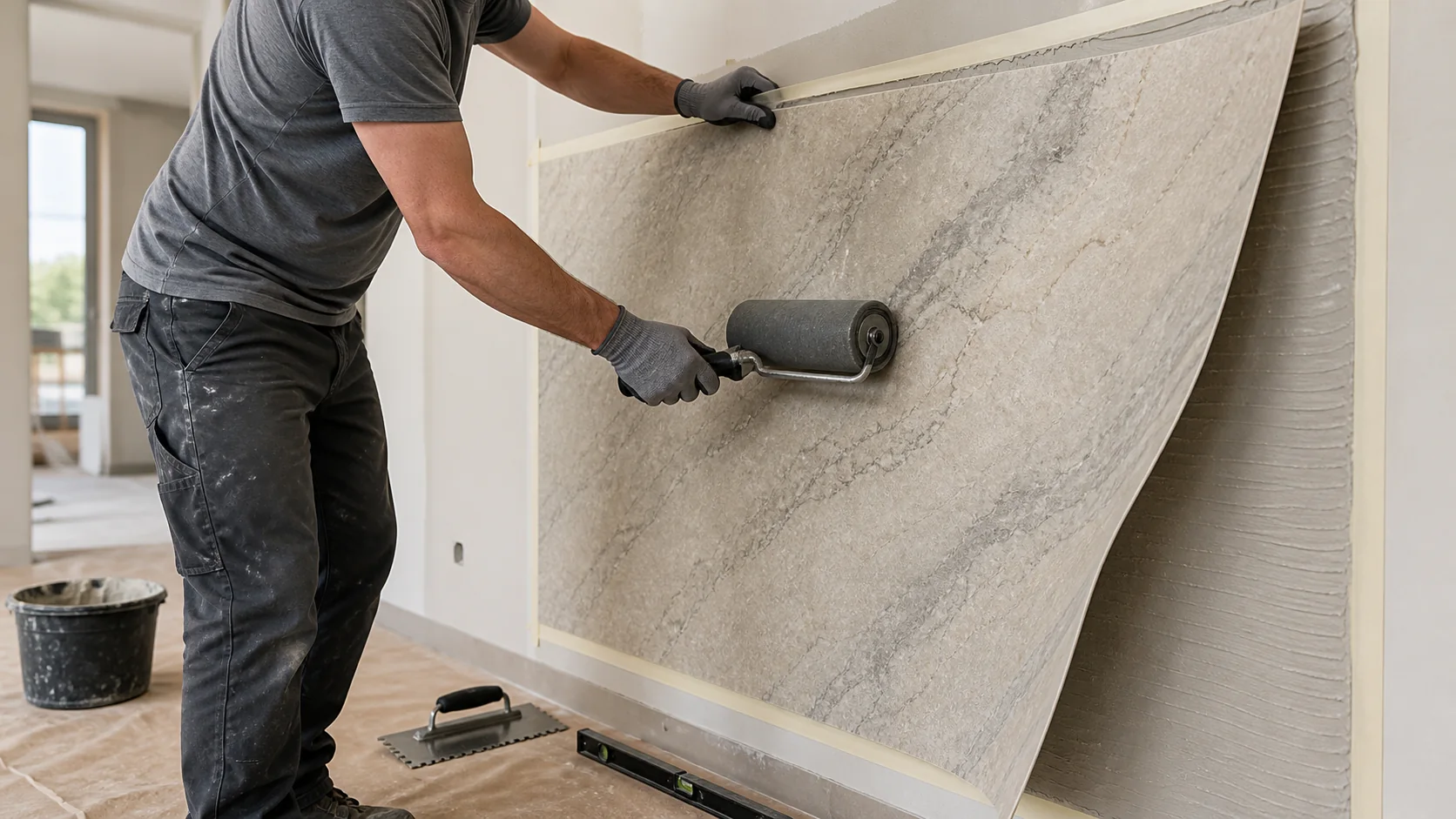
Skin-over bond loss on hot/drafty walls -> Spread only 1-2 sheets ahead; roll center-outward within 15 min using 35-50 lbs J-roller force |
2-Part Polyurethane / Epoxy Reaction Resin (ISO 13007 R2T / ANSI A118.3) |
Exothermic A+B chemical crosslinking (zero water evaporation); shear bond >= 2.0 MPa (>= 290 psi); vertical slip <= 0.5 mm |
Fiberglass-polyester & MCM backings over non-porous glazed tile overlays, primed steel/aluminum, tight radii (R = 150-300 mm), exterior soffits |
4-6 mm square or V-notch + back-butter skim; 25-40 min pot life (2.2-3.0 kg/m²) |
CO2 foaming blisters over damp concrete or off-ratio tacky cure -> Enforce < 2.5% moisture (ASTM F1869 <= 3 lbs); mix full pre-weighed A+B kits with low-speed paddle (<= 300 rpm) |
Highly Deformable Polymer-Modified Mortar (ISO 13007 C2TES1 / C2TES2 & ANSI A118.15) |
Hydraulic cement + redispersible polymer co-matrix; 28-day shear >= 400-450 psi (2.76-3.10 MPa); transverse deformation >= 2.5 mm (S1) or >= 5.0 mm (S2) |
Breathable fleece/MCM backings & factory grit-primed fiberglass sheets over cured concrete (>= 28 d), render, and exterior ASTM C1325 cement board (TCNA W244E) |
6 mm (1/4 in) square-notch + 100% flat back-butter; >= 30 min extended open time (3.5-4.5 kg/m²) |
Interfacial peel off smooth glossy fiberglass or rapid suction dehydration -> Verify rough/grit backing or apply epoxy-sand bridge coat; prime absorptive masonry and achieve >= 95% exterior contact (ANSI A108.5) |
Improved Acrylic Polymer Dispersion (ISO 13007 D2TE / ANSI A136.1 Type I) |
Water evaporation film coalescence; shear bond >= 1.0 MPa (145 psi) dry; vertical slip <= 0.5 mm |
Breathable cotton/textile fleece or thin MCM sheets strictly on dry, absorptive interior walls (ASTM C1396 drywall or porous render) |
3/16 in (4.8 mm) V-notch; 20-30 min open time (1.8-2.4 kg/m²) |
Uncured paste liquefaction & saponification behind vapor-tight sheets -> Never use D1/D2TE dispersion with fiberglass-polyester backings, over glazed tile/metal, or in exterior/humid zones |
Details to review
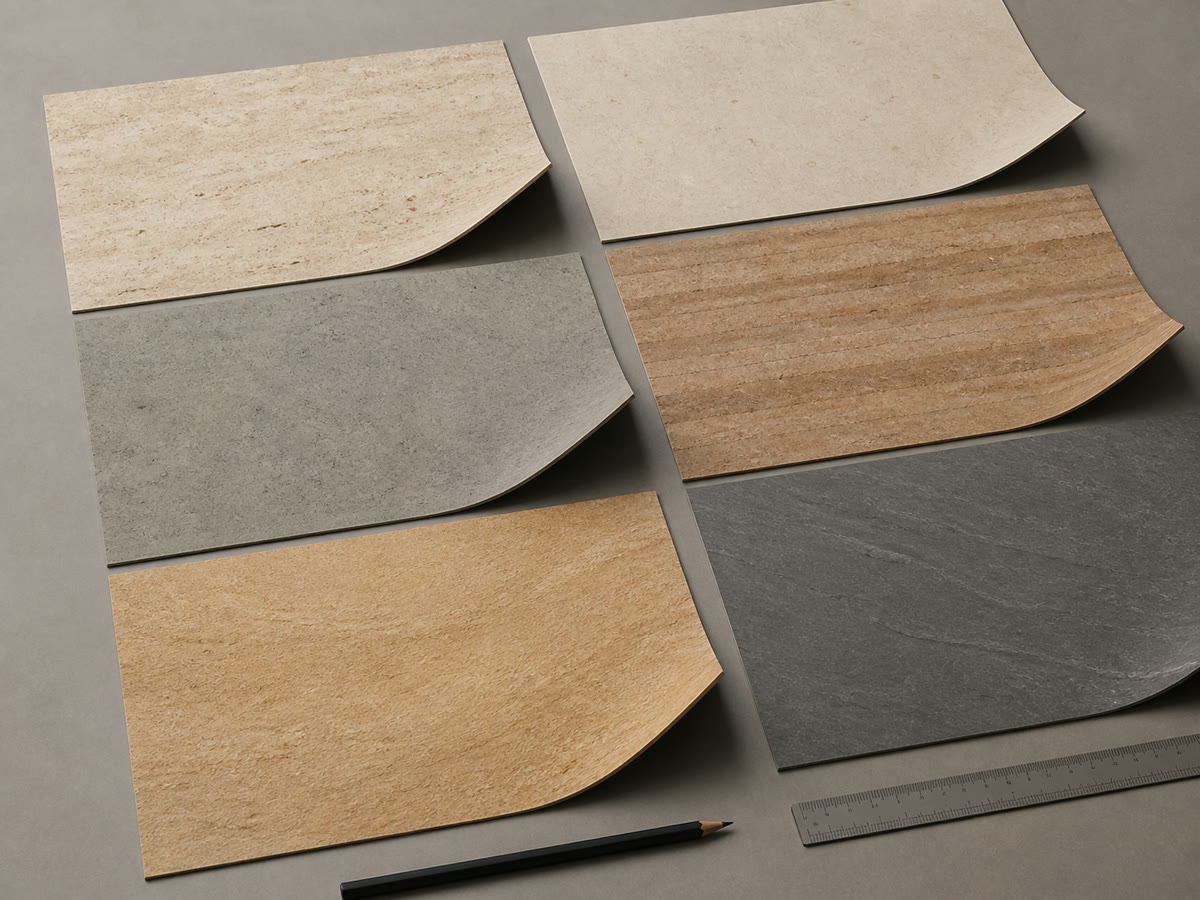
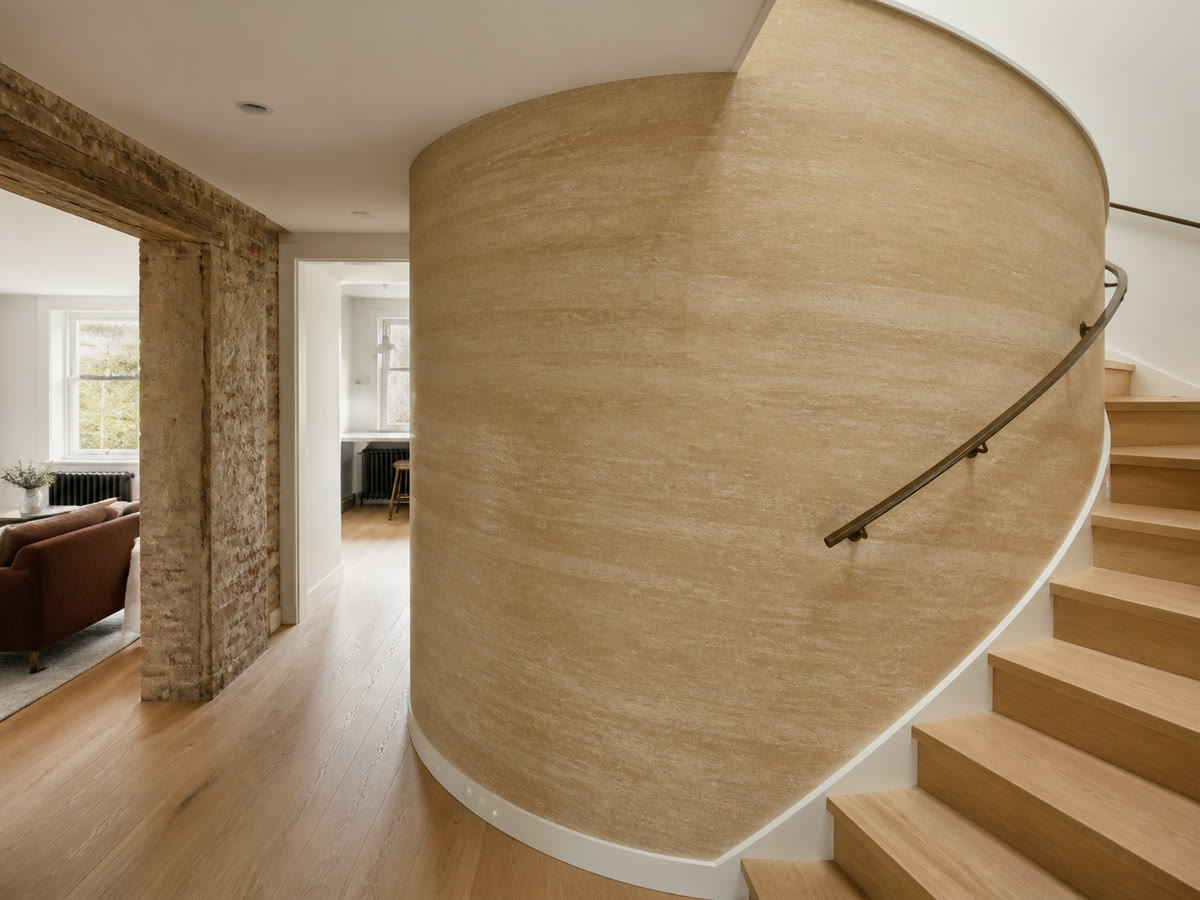
Use these visual references when reviewing the mock-up and work method with the project team.
Site checklist
1. Map Every Substrate Layer, Coating & Framing Span
Document the structural wall base, board thickness, skim coats, paint layers, or glazed tile in Existing Surfaces. Verify framing deflection stays within L/360 (<= 8.3 mm over 3.0 m) for standard stud walls or L/720 (<= 4.2 mm over 3.0 m) for wood-framed stone substrates.
Engineering Rule of Thumb: If an existing painted drywall or plaster surface loses more than 5% of squares in an ASTM D3359 cross-hatch tape pull test, strip the coating mechanically or mechanically fasten ASTM C1325 fiber-cement board-never bond flexible stone to weak paint.
2. Audit Plane Flatness (`ANSI A108.02`) & Moisture (`ASTM F1869`)
Survey the wall with a 10 ft (3 m) straightedge under grazing light (<= 3 mm in 3 m and <= 1.6 mm in 600 mm per ANSI A108.02). Confirm concrete has cured >= 28 days, MVER is <= 3 lbs / 1,000 sq. ft. / 24 h (ASTM F1869), and retained moisture is < 2.5%.
Engineering Rule of Thumb: If substrate moisture sits between 2.5% and 4.0% (or MVER 3-5 lbs) on an interior concrete wall, roll a 2-coat epoxy moisture-vapor barrier primer before bonding with MS-polymer; never apply standard 1-part polyurethane over damp concrete (>= 2.5%), or CO2 gas foaming will blister the sheet.
3. Match Adhesive Cure Mechanism to Backing & Porosity
Cross-check the exact SKU backing in the flexible stone catalog against the adhesive datasheet (ISO 13007 / ANSI A118.15). Obtain written compatibility confirmation covering primer, adhesive, and exposure temperature.
Engineering Rule of Thumb: If both the panel backing (fiberglass-polyester resin) and the receiving wall (glazed ceramic tile, metal, or sealed FRP) are non-porous (< 0.5% absorption), specify a 2-part chemical-cure reaction resin (EN 12004 R2T) or moisture-cure MS-polymer-never use water-based dispersion (D1/D2TE) where trapped water cannot evaporate.
4. Validate Full-Assembly Mock-Up Contact & Pull Strength
Install a 2 to 4 sheet (1.5-3.0 m²) mock-up on the actual wall using the specified primer, notched trowel, adhesive, joint filler, and sealer. Perform a fresh lift check for >= 80% interior / >= 95% exterior contact (ANSI A108.5) and allow full 72-hour cure before sign-off.
Key steps
Step 1: Survey the Substrate Layer Schedule & Structural Stiffness
Record the base wall structure (cast concrete, CMU block, cold-formed steel studs with
ASTM C1396drywall orASTM C1325fiber-cement board, structural plywood, or metal frame) and every retained finish layer (skim plaster, latex/alkyd paint, wallpaper paste, curing membrane, or ceramic tile). Verify framing stiffness meets<= L/360(<= L/720on wood framing) and follow the layer audit protocol in Existing Surfaces.Step 2: Measure Flatness (`ANSI A108.02`), Moisture (`ASTM F1869`) & Joint Layout
Check plane flatness using a
3 m (10 ft)straightedge and feeler gauges under final grazing light angle; grind high ridges and skim hollows exceeding1.6 mm in 600 mmor3 mm in 3 m. Log concrete cure age (>= 28 days), calcium chloride MVER (<= 3 lbs / 1,000 sq. ft. / 24 h), and impedance moisture (< 2.5%). Map all structural control joints andTCNA EJ171movement joints (20-25 ftinterior /8-12 ftexterior) per Joints & Sealing.Step 3: Specify Primer & Compatible Adhesive Class (`ISO 13007` / `ANSI A118.15`)
Select penetrating alkali-resistant acrylic primer (
0.10-0.20 kg/m²) for absorptive drywall/render, quartz-aggregate grip primer (0.25-0.35 kg/m²) for abraded glazed tile, or 2-part epoxy barrier primer for damp concrete (2.5-4.0%moisture). Match the adhesive class (MS-polymer,EN 12004 R2Tpolyurethane/epoxy, orANSI A118.15 / C2TES1-S2mortar) to the exact panel SKU backing and send your submittal pack via Get a Quote or WhatsApp for written review. We reply within 24 hours.Step 4: Execute, Lift-Check & Cure the Full-System Site Mock-Up
Install a
2 to 4 panel(1.5-3.0 m²) mock-up on the prepared wall following Flexible Stone Installation: comb parallel ridges with a4.8 mmV-notch or6 mmsquare-notch trowel, flat back-butter the panel rear (0.5-1.0 mm), and consolidate center-outward with a J-roller. Lift the first wet sheet to verify>= 80%interior or>= 95%exterior contact (ANSI A108.5), then cure72 hoursat40-95°F (4-35°C)before approving scale-up.
Substrate Engineering Matrix: Acceptance Thresholds, Preparation & Failure Prevention
Because flexible stone veneers are 1.5-3.0 mm composite laminates, the receiving substrate governs both structural bond security and visual surface flatness under grazing light. Use this engineering matrix alongside Existing Surfaces and the Wall Load Review Guide to qualify or remediate each wall type before adhesive application:
| Receiving Wall Substrate | Moisture, Cure & Stiffness Thresholds | Required Surface Prep & Primer System | Approved Adhesive Class (ISO 13007 / ANSI) |
Dominant Substrate Failure Mode & Prevention |
|---|---|---|---|---|
Cast Concrete & Masonry Render (ACI 301 / ASTM C926) |
>= 28-day cure; MVER <= 3 lbs / 1,000 sq. ft. / 24 h (ASTM F1869); moisture < 2.5%; flatness <= 3 mm / 3 m |
Grind form fins/laitance; skim hollows > 1.6 mm / 600 mm with polymer cement mortar; roll alkali-resistant primer (0.15 kg/m²) |
Interior: MS-polymer or C2TES1. Exterior: ANSI A118.15 (C2TES1/S2) or 2-part R2T |
Alkaline saponification & vapor blistering (pH 12-13 + MVER > 3 lbs) -> Enforce 28-day cure + alkali-resistant primer; use 2-coat epoxy vapor barrier if MVER is 3-5 lbs |
Interior Gypsum Wallboard (ASTM C1396, >= 12.7 mm / 1/2 in) |
Dry interior only (RH < 70%, board moisture < 1.0%); stud framing <= 400 mm (16 in) o.c.; deflection <= L/360 |
Tape and feather joints to ANSI A108.02 (<= 1.6 mm / 600 mm); vacuum sanding dust; seal with penetrating acrylic primer (0.12-0.18 kg/m²) |
MS-polymer hybrid adhesive (1.5-2.5 MPa) or D2TE dispersion (breathable fleece backing only) |
Paper-face delamination or chalky dust shear at taped joints -> Never bond over unprimed drywall joint compound; verify paper face integrity and prime 100% of board area |
Fiber-Cement Backer Board (ASTM C1325, >= 9-12 mm) |
Interior moisture < 2.5%; exterior on corrosion-resistant studs <= 400 mm o.c. (<= L/360) over weather barrier (TCNA W244E) |
Alkali-resistant fiberglass mesh tape embedded in polymer mortar at board joints; vacuum dust; acrylic or epoxy primer | Interior: MS-polymer or C2TES1. Exterior: ANSI A118.15 (C2TES1/S2) or R2T resin |
Board-joint telegraphing & hairline seam cracking -> Stagger board joints, gap sheets 3 mm, tape with alkali-resistant mesh, and offset stone seams >= 100 mm from board joints |
Interior Structural Plywood / MDF (APA Exterior Grade >= 15-18 mm) |
Strictly dry climate-controlled interior; wood moisture 8-12% WME (<= 2% delta from room equilibrium); deflection <= L/720 |
Countersink screws <= 150 mm edges / 200 mm field; gap boards 3 mm; sand mill glaze; seal with non-water-swelling polyurethane or solvent-free primer |
High-elongation MS-polymer (>= 200% elongation) or 2-part EN 12004 R2T polyurethane |
Hygroscopic wood expansion buckling or water-swollen grain lift -> Never apply water-based D1/D2TE adhesive or unprimed wet thinset directly to bare MDF/plywood; isolate board joints |
| Existing Glazed Ceramic / Porcelain Tile Overlay | 100% acoustic tap-test pass (0% hollow tiles); existing bond pull-off >= 0.5 MPa (72.5 psi); dry interior or sheltered renovation |
Strip hollow tiles & patch flush; alkaline degrease; diamond-grind glaze (80-grit); apply quartz-sand bonding primer (0.25-0.35 kg/m²) |
2-part reaction resin (EN 12004 R2T) or structural MS-polymer (4-6 mm notch + back-butter) |
Smooth-glaze interfacial peel or deep grout-line telegraphing -> Mechanically abrade glaze before quartz primer and skim grout joints > 2 mm deep flush prior to troweling |
| Primed Structural Steel, Aluminum & FRP Panels | Degreased, rust-free (SSPC-SP2/SP3 or solvent wipe); stiffened against oil-canning (<= L/360); thermal swing recorded |
Solvent-wipe with isopropanol/acetone; abrade with 80-120 grit non-woven pad; apply anti-corrosive epoxy metal primer if bare steel |
2-part polyurethane (EN 12004 R2T) or elastic MS-polymer (>= 2.0 MPa lap shear) |
Differential thermal shear (alpha_aluminum = 23 x 10^-6 /°C vs stone) or oil-film release -> Leave 2-3 mm elastic expansion gaps between sheets and bond with flexible R2T PU or MS-polymer |
Engineering Rule of Thumb: If a framed wall spans 3.0 m (10 ft) vertically, standard L/360 deflection allows 8.3 mm of mid-span flex, whereas natural stone over wood framing (L/720) limits flex to 4.2 mm. Whenever framing deflection sits between L/720 and L/360, specify an elastomeric MS-polymer (>= 200% elongation) or ISO 13007 C2TES2 (>= 5.0 mm transverse deformation) adhesive rather than rigid mortar.
Engineering Formulas: Adhesive Consumption, Collapsed Bed Thickness & Bond Safety Factor
Accurate adhesive and skim-coat takeoffs prevent mid-installation batch shortages and quantify the hidden material penalty of out-of-plane walls. Use these three standard engineering equations when preparing project bills of quantities and structural submittals:
1. Total Adhesive Mass: M_adh = A_net * (1 + f_waste) * R_trowel * k_back_butter * (1 + Delta_flatness / d_bed)
2. Effective Collapsed Bed Thickness: t_bed = (h_notch * f_tooth * C_contact) + t_skim
3. Shear / Tensile Bond Safety Factor: SF_bond = (tau_spec * C_contact) / (tau_dead + tau_wind + tau_thermal)
Where:
A_net= net wall area (m²);f_waste= cutting/layout waste (0.08-0.12);R_trowel= baseline notched-trowel rate on a flat wall (2.2 kg/m²for4.8 mmV-notch MS-polymer;2.5 kg/m²for5 mmnotchR2Tpolyurethane;3.8 kg/m²for6 mmsquare-notchC2TES1mortar)k_back_butter=1.15(15%flat rear burnish skim to wet out fiberglass/fleece weave);Delta_flatness= average unskimmed substrate deviation (mm);d_bed= nominal collapsed bed depth (2.2-3.5 mm)h_notch= trowel notch depth (4.8 mmor6.0 mm);f_tooth= solid-to-void notch geometry factor (0.50for square notch,0.45for V-notch);C_contact= verifiedANSI A108.5contact fraction (>= 0.80interior,>= 0.95exterior);t_skim= back-butter thickness (0.5-0.8 mm)tau_spec= rated adhesive shear/tensile strength (MPaorpsiperANSI A118.15/ISO 13007/ASTM C297);tau_dead + tau_wind + tau_thermal= combined gravity, wind-suction, and thermal shear stress
Worked Example 1: 180 m² Commercial Corridor Renovation Over Glazed Tile
Cladding A_net = 180 m² (1,938 sq. ft.) of abraded, quartz-primed ceramic tile (Delta_flatness = 0.4 mm after skimming grout lines, d_bed = 2.5 mm) using 1200 x 600 mm slate panels (f_waste = 0.08) and 2-part EN 12004 R2T polyurethane (R_trowel = 2.5 kg/m², k_back_butter = 1.15):
- Gross Cladding Area:
A_gross = 180 m² * 1.08 = 194.4 m². - Adhesive Mass:
M_adh = 194.4 m² * 2.5 kg/m² * 1.15 * (1 + 0.4 / 2.5) = 558.9 kg * 1.16 = 648.3 kg(65 kitsat10 kgper A+B pail). - Collapsed Bed Thickness (
5 mmsquare notch,f_tooth = 0.50,C_contact = 0.88,t_skim = 0.6 mm):t_bed = (5.0 * 0.50 * 0.88) + 0.6 = 2.8 mm(add2.0 mmpanel thickness =4.8 mmtotal overlay build-up at door frames).
Worked Example 2: Exterior Facade Shear Bond Safety Factor (ANSI A118.15 vs. ANSI A118.4)
An approved exterior fiber-cement facade (C_contact = 0.95 per ANSI A108.5) experiences combined dead, wind-suction, and solar thermal shear demand of 0.18 MPa (26.1 psi). Using an ANSI A118.15 / ISO 13007 C2TES1 mortar (tau_spec = 2.76 MPa / 400 psi porcelain shear baseline; 1.0 MPa / 145 psi EN 12004 C2 freeze-thaw tensile baseline):
- Freeze-Thaw Tensile Safety Factor:
SF_bond = (1.0 MPa * 0.95) / 0.18 MPa = 5.28x(compared to2.38xon an unrolledC1bed with only0.5 MPastrength and85%coverage).
Engineering Rule of Thumb: Attempting to absorb a 3 mm wall hollow with expensive R2T polyurethane or MS-polymer adhesive instead of pre-skimming with cementitious patching mortar increases adhesive consumption by 85-110% and quadruples material cost per square meter.
Why Panel Backing Chemistry Dictates Adhesive & Primer Compatibility
Materials grouped under the market terms "flexible stone", "stone veneer sheet", or "MCM" are manufactured on three distinct backing platforms. Specifying an adhesive without identifying the SKU backing causes interfacial bond failure even when the wall substrate is sound:
- Unsaturated Polyester Resin + Woven Fiberglass Backing (Split Natural Slate, Quartzite, Sandstone, Travertine, Marble):
- Physical Profile: Non-porous (
< 0.3%water absorption), vapor-impermeable (< 0.1 perm), semi-rigid elastic memory when bent belowR = 300 mm. - Adhesive Rule: Requires chemical/mechanical grip via MS-polymer hybrid adhesive or 2-part polyurethane/epoxy reaction resin (
EN 12004 R2T). For exterior cementitious installation withANSI A118.15 / ISO 13007 C2TES1/S2mortars, verify the panels have a factory-rough sanded or silica-grit-broadcast rear surface (or apply a 2-part epoxy-sand bridge coat on site) and flat back-butter100%of the panel rear.
- Physical Profile: Non-porous (
- Mineral-Polymer Composite / Breathable Textile Fleece Backing (
MCM& Modified Clay / Stone Sheets):- Physical Profile: Micro-porous mineral or non-woven fleece rear face (
1.5-2.5 mmthick), low elastic spring-back, allows capillary mechanical interlocking. - Adhesive Rule: Compatible with
ISO 13007 C2TES1 / C2TES2polymer-modified cementitious mortars, MS-polymer adhesives, and (on dry interior absorptive drywall/render only)ISO 13007 D2TEdispersion adhesives.
- Physical Profile: Micro-porous mineral or non-woven fleece rear face (
- Self-Adhesive Peel-and-Stick Acrylic PSA Backing (Light Interior Feature/Joinery Series Only):
- Physical Profile: Factory-applied pressure-sensitive acrylic adhesive protected by a release liner; zero gap-filling capability.
- Adhesive Rule: Restricted strictly to smooth, sealed, dust-free interior drywall, lacquer/melamine millwork, or primed MDF (
ANSI A108.02flatness<= 1.0 mm in 600 mm). Never use peel-and-stick backings on exterior facades, unprimed gypsum dust, rough render, or damp walls; supplement high-stress column edges with beads of neutral MS-polymer if specified.
Check your exact SKU backing construction in Composition & Backing and Testing & Certifications before issuing tender specifications.
TCO Hidden-Cost Ledger & Diagnostic Failure-Mode Matrix
Selecting a cheaper, unverified adhesive or skipping substrate flatness and primer steps shifts small upfront material savings into catastrophic post-installation tear-out, replacement sheet freight, and commercial operational downtime. Compare the total cost of ownership (TCO) impact across these five field failure scenarios and cross-reference Troubleshooting and Corners & Edges:
| Field Failure Scenario | Root Cause in Substrate / Adhesive System | Prevention Cost (Upfront Engineering Baseline) | Failure Rework TCO Impact (Tear-Out + Downtime) |
|---|---|---|---|
| Cohesive Drywall Dust Shear | Skipping penetrating acrylic primer (0.15 kg/m²) over sanded ASTM C1396 gypsum joint compound |
Primer material + 1-coat roll labor (2-4 h tack-free cure hold) |
8x-12x upfront primer cost: panels peel off with chalky paper dust; requires sheet disposal, drywall re-skimming, and batch re-order |
| Vapor-Drive Saponification & Blistering | Bonding fiberglass-backed panels over < 28-day concrete or ASTM F1869 MVER > 3 lbs / 1,000 sq. ft. / 24 h without epoxy barrier |
ASTM F1869 calcium chloride test kit + 2-coat epoxy moisture barrier primer |
10x-15x testing cost: alkaline pore water (pH > 12) emulsifies acrylics or foams 1-part PU; requires mechanical grinding to bare concrete |
| Out-of-Plane Adhesive Bed Overrun | Skipping ANSI A108.02 cementitious skim-coat on a concrete wall with 4-6 mm waves |
Cementitious skimming compound (1/8-1/4 in pass) + 16-24 h cure before layout |
3.5x-4.5x skimming cost: installers double notch depth with expensive MS-polymer/PU (+2.5 kg/m²), yet wall waves still telegraph under cove lighting |
| Exterior Freeze-Thaw Hollow-Pocket Peel | Swirling adhesive ridges or skipping center-outward J-roller consolidation (< 95% exterior contact per ANSI A108.5) |
Unidirectional parallel troweling + 100% back-butter + J-roller lift check on mock-up |
12x-20x labor cost: water trapped in rear voids freezes, expands 9%, and shears panels off high-elevation facades Requiring scaffolding re-erection |
Curved Column Edge Lift (R < 300 mm) |
Using slow-grab cementitious mortar or dispersion glue on tight radii without pre-warming backing (120-140°F) or strapping |
Heat-gun conditioning (50-60°C) + fast-grab R2T PU / MS-polymer + 6-12 h cargo strap hold |
5x-8x column labor: elastic fiberglass spring-back pulls seams open 2-5 mm overnight; cured polyurethane cannot be re-pressed without replacing sheets |
Engineering Rule of Thumb: Never approve production wall installation on a fresh wet mock-up. Cure the full assembly mock-up for 72 hours at project ambient temperature (40-95°F / 4-35°C) and perform an edge-pry / ASTM C297 tensile pull check: a passing system exhibits cohesive failure within the substrate face or adhesive body (>= 0.5 MPa interior / >= 1.0 MPa exterior), never clean interfacial release off the primer or panel back.
Details to Prepare for Engineering & Compatibility Review
Before ordering production sheets or locking the adhesive specification on commercial interiors, hospitality refurbishments, or exterior facades, compile the five project records listed in the What to send us table below and submit them through Get a Quote, Request Samples, or the floating WhatsApp button:
- Panel SKU, Sheet Format & Backing Class: Identify the exact product code (
1200 x 600 mmor2400 x 1200 mm) and rear backing (fiberglass-polyester,textile fleece, orMCM) so we confirm adhesive cure compatibility. - Receiving Substrate Layer Schedule & Stiffness: Document the structural wall base, stud spacing (
L/360vs.L/720), retained paint or tile layers, and pull/tap-test records per Existing Surfaces. - Flatness (
ANSI A108.02) & Moisture (ASTM F1869) Logs: Include straightedge survey notes (<= 3 mm in 3 m), concrete cure age (>= 28 days), calcium chloride MVER (<= 3 lbs), and impedance meter readings (< 2.5%). - Exposure Zone, Curve Radii & Movement Joints (
TCNA EJ171): State interior vs. exterior elevation, solar exposure, minimum column radius (R mm), and required fire submittals (ASTM E84/EN 13501-1adhered assembly reports in Fire, Water & Weather Considerations). - Candidate Primer & Adhesive Data Sheets + Net Area (
m²): Attach local adhesive/primer technical data sheets (ISO 13007/ANSI A118.15) along with your net area schedule and destination port/city. We review your package and reply within 24 hours with sample recommendations, takeoff checks, and quotation scope.
Frequently asked questions
Can standard cementitious tile thinset mortar be used to bond flexible stone panels?
Unmodified dry-set mortar (ANSI A118.1 / ISO 13007 C1) is not suitable because it lacks the polymer resin content and transverse deformability needed to grip low-absorption composite backings (< 0.5% absorption) under thermal shear. For breathable fleece or grit-backed panels over concrete or ASTM C1325 cement board, specify a deformable polymer-modified mortar meeting ANSI A118.15 (>= 400-450 psi shear) and ISO 13007 C2TES1 or C2TES2 (>= 2.5-5.0 mm deformation) with 100% flat back-buttering. For smooth fiberglass-polyester backings, non-porous tile overlays, or curved columns, use an MS-polymer hybrid or 2-part EN 12004 R2T polyurethane/epoxy adhesive.
Is a substrate primer always required before applying flexible stone adhesive?
Primer selection depends on substrate porosity, alkalinity, and surface texture rather than a blanket rule. Absorptive gypsum wallboard (ASTM C1396), skimmed plaster, and porous renders require an alkali-resistant penetrating acrylic primer (0.10-0.20 kg/m², cured 2-4 hours) to bind microscopic sanding dust and prevent premature moisture wicking from the adhesive bed. Non-porous glazed ceramic tile overlays require mechanical diamond abrasion (80-grit) followed by a quartz-sand grip primer (0.25-0.35 kg/m²), while concrete with 2.5-4.0% moisture requires a 2-coat epoxy vapor-barrier primer.
Can flexible stone panels be bonded directly to interior plywood or MDF millwork?
Yes, strictly in climate-controlled dry interiors (RH 35-65%) when framing stiffness meets <= L/720, board thickness is >= 15-18 mm (APA Exterior Grade plywood or high-density architectural MDF), and equilibrium wood moisture is 8-12% WME. Leave a 3 mm expansion gap between wood sheets, sand off surface mill glaze, prime with a non-water-swelling polyurethane or solvent-free primer, and bond panels using a high-elongation (200-300%) MS-polymer hybrid or 2-part EN 12004 R2T polyurethane adhesive. Never use water-based D1/D2TE dispersion adhesives on bare wood or MDF.
How should we handle an unknown existing wall coating or old paint layer during renovation?
Never bond flexible stone over an unidentified coating based on visual inspection alone. Perform an ASTM D3359 cross-hatch tape pull test and a 72-hour full-assembly mock-up pull test at multiple wall locations. If the existing paint chalks, peels (> 5% grid loss), softens under adhesive contact, or sits over weak gypsum skim plaster, mechanically grind or strip the coating down to sound masonry/concrete-or mechanically fasten ASTM C1325 fiber-cement backer board directly into the structural studs per Installing Over Existing Surfaces.
What substrate photos and site records should we send to confirm adhesive compatibility?
Send five records via Get a Quote or WhatsApp: (1) overview and close-up photos of the receiving wall showing board joints, cracks, or tile glaze, (2) a labelled note or core/edge photo showing every retained layer, (3) ANSI A108.02 straightedge flatness deviations (mm per 3 m) and ASTM F1869 moisture / impedance meter readings, (4) the target HeyMaterials SKU code and sheet size, and (5) technical data sheets (ISO 13007 / ANSI A118.15) for the locally available primer and adhesive candidates. We review the package and reply within 24 hours.
Can wall production start before the full-system site mock-up has cured and been approved?
No. Releasing full wall installation before the 72-hour mock-up cure hold expires hides slow-developing failures-including delayed polyurethane moisture foaming, dispersion paste liquefaction behind non-porous fiberglass backings, elastic edge lift on curved columns (R < 300 mm), and sealer color shift on porous travertine or sandstone. Complete both the wet lift check (>= 80% interior / >= 95% exterior contact per ANSI A108.5) and the cured 72-hour bond and grazing-light sign-off before cutting production batches.
Continue planning
Use these related guides before fixing details or releasing material.
Audit existing wall surfaces
Run tap tests, paint pull checks, and overlay build-up audits on tile, drywall, render, and wood before selecting primer.
Read moreExecute the 7-step installation sequence
Apply parallel notched-trowel bedding, back-butter skimming, and center-outward J-roller consolidation on site.
Read moreCoordinate movement joints & sealers
Integrate TCNA EJ171 movement joints, ASTM C920 elastomeric sealants, and breathable impregnating sealers into the mock-up.
Read moreReview superimposed wall load & layers
Calculate combined panel, adhesive, and skim-coat dead load (kg/m²) for consultant and landlord submittals.
Read moreCompare tile overlay vs. strip-out scope
Price diamond abrasion, quartz grip priming, and R2T adhesive against full ceramic tile demolition.
Read moreSubmit wall & adhesive submittal data
Send your SKU, wall buildup, moisture logs, and area schedule for a project-specific quotation and sample pack.
Read moreWhat to send us
Scroll the table horizontally to see all columns.
| Item | Why we need it | Example format |
|---|---|---|
| Panel SKU, sheet format and backing class | Match polymer-fiberglass, textile fleece or MCM backing to adhesive chemistry | Product code, sheet size (1200x600 or 2400x1200 mm) and front/back sample photos |
| Receiving substrate assembly and retained coatings | Verify structural stiffness (L/360 or L/720), porosity and bond-breaker removal | Wall layer schedule, existing tile/paint pull-test notes and labelled survey photos |
| Flatness, cure age and moisture readings | Confirm ANSI A108.02 plane tolerance (<= 3 mm / 3 m) and ASTM F1869 MVER (<= 3 lbs) | Concrete cure days (>= 28 d), impedance moisture % (< 2.5%) and straightedge audit log |
| Exposure zone, thermal swing and movement joints | Select ISO 13007 class (MS-polymer, R2T or C2TES1/S2) and TCNA EJ171 joint spacing | Interior vs exterior elevation, curve radii (R mm), solar exposure and city/climate |
| Proposed primer / adhesive TDS, net area (m2) and destination | Cross-check written compatibility, calculate adhesive takeoff and quote freight scope | Candidate adhesive/primer data sheets, net wall area (m2) and delivery city/port |
We reply within 24 hours.
Send your project details