Hotel Flexible Stone: Phased Refurbishment and Room Release
Updated
Reopening a guestroom before the approved wall system has cured can push that room back into rework and out of use. For hotel flexible stone on dry decorative walls, write the phase and release record before anyone sets a handover date.
Room release record at a glance
A phased refurbishment needs one row for each room or area. The row names the substrate preparation, the actual complete system, the cure document and its conditions, the inspector and the release status. Leave the release date empty until the named person releases that room. File the sheet as the method record for handover. Test reports and engineering approval stay with the appointed reviewers.
Room release record
Scroll the table horizontally to see all columns.
| Column | What to write | Leave blank when |
|---|---|---|
| Room or area | The space taken out of use | The room ID is still unknown |
| Substrate preparation | Layers, defects and the repair decision | The wall survey is unfinished |
| Actual complete system | SKU plus primer, adhesive, joints and any sealer | The mock-up is not accepted |
| Cure document and conditions | The file that governs this assembly, and what it states | That file is not in the room folder |
| Inspector and release status | Who rechecks the room, and whether it is released | No one has been named yet |
Copy one row for every room or area. The date cell stays empty until release.
| Room or area | Substrate preparation | Actual complete system | Cure document and conditions | Inspector | Release status | Release date |
|---|---|---|---|---|---|---|
| To enter | To enter | To enter | To enter | To enter | To enter | |
| To enter | To enter | To enter | To enter | To enter | To enter |
Schedule the rooms that come out of use
The hotel's operating schedule decides which rooms can close and which routes stay open for people passing through. Write the closed room, the route that remains in use, and the work window the hotel allows. Those limits sit beside the cure document. A photograph of a finished wall does not choose the reopening day.
| Planning input | Record on the phase sheet | Why the phase uses it |
|---|---|---|
| Room or area | Identifier, and that it is out of use | The team can see which rooms are closed |
| People passing through | The route that stays open beside the work | Protection has to survive that traffic |
| Operating limits | Work window and access rules from the hotel | The programme follows those limits |
| Release owner | Name of the person who releases the room | The handover has a named owner |
Finish selection and appearance zoning stay on the hotel and commercial interiors page. The product family is flexible stone. This record starts after that selection, when the fit-out has to take rooms out of use and put them back.
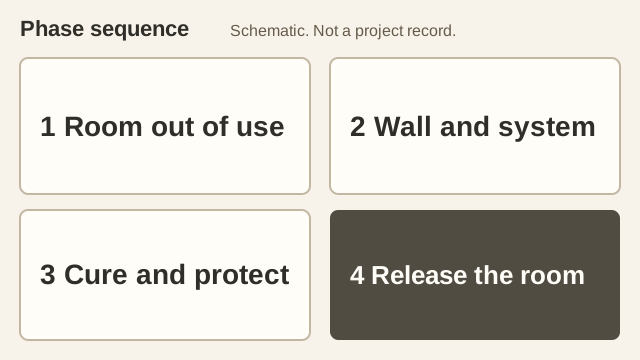
Move a room from closure to release only after the wall system and its cure document are on the row. Schematic, not a project record.
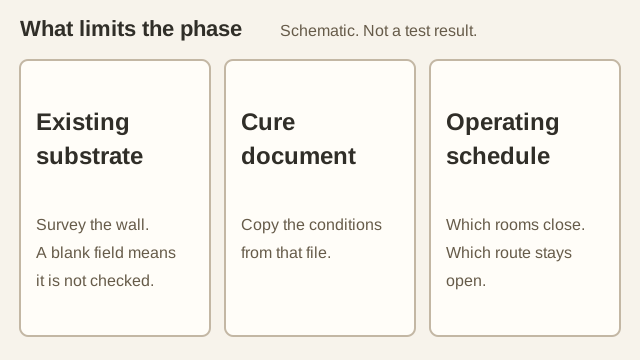
The existing wall, the cure document and the hotel schedule set the phase. Schematic, not a test result.
Survey the wall before that phase starts
Identify the receiving wall before the phase is marked ready. Use the existing-surface review: label the wall, list the layers, and mark hollow, damp, peeling or powdery areas with numbered photos. A sound or a photo is a record for review. It is not an acceptance result.
Consider an overlay on a sound surface after the actual panel, primer and adhesive are confirmed in writing. A substrate name alone does not select an adhesive. Repair or strip hollow, damp or peeling areas first, and record the added thickness at frames, sockets and edges. Widespread hollow tiling, weak render, peeling paint, unresolved moisture or insufficient clearance calls for repair or removal before an overlay. Resolve the source of damp before covering. Blank fields mean the check has not been done. Keep those observations separate from the acceptance decision.
The adhesives and substrates guidance is where the project team confirms the bonding system for the actual panel and wall. This page does not assign an adhesive class from the wall's old name.
Write the actual complete system on the row
Flexible stone installation treats the finish as a thin decorative cladding system. Approval covers the substrate, primer where the system requires it, the adhesive, the joint treatment and any sealer. Match the product code, finish, batch labels and quantity to the approved sample before the production area starts. Condition the panels only when the supplied instructions call for it.
The receiving surface should be stable, sound, clean and sufficiently even for the selected thin cladding. Resolve moisture, movement and contamination before bonding. Use the adhesive and method written for that panel, substrate and exposure, and follow the open time, coverage and curing instructions in those documents. Accept a representative mock-up of that whole system before the production area begins. Panel appearance alone leaves the substrate, adhesive and joints unresolved.
Joints and sealing belong on the same row. Define whether the joints are close, expressed, filled or covered by trim. Test fillers, sealants and any sealer on the actual finish, and accept them after full curing, because they can change colour, sheen or texture. Carry designated movement joints through the finish. Specify a sealer only when it is compatible with the selected panel and the project has a defined need. A sealer does not stand in for a waterproof rating of the assembly.
Panel composition, backing, size, substrate and exposure can change the primer, adhesive, tools and finishing method. A system accepted in one room stays on that room's row. A different wall condition needs its own description.
Record cure conditions and protection
The installation workflow does not set a universal curing time. Follow the supplied product and adhesive instructions for the approved assembly and the site conditions. Protect completed areas from traffic, impact and moisture until that system has cured. If people still walk a corridor beside a closed room, write that route into the protection note so the cure period is not treated as free access.
Joint fillers, sealants and any sealer need full curing on the selected panel before that part of the finish is accepted. Copy the document name into the cure column, then copy the conditions that document states. When the document is missing, leave the conditions empty and leave the release date empty.
Recheck the room and name who releases it
When the cure document's conditions are met, the named inspector rechecks alignment, adhesion, edges and finish under the agreed lighting. Release status stays unresolved, and the date stays empty, until that person releases the room. Mock-up acceptance allows the production area to start. It does not release the other rooms on the floor.
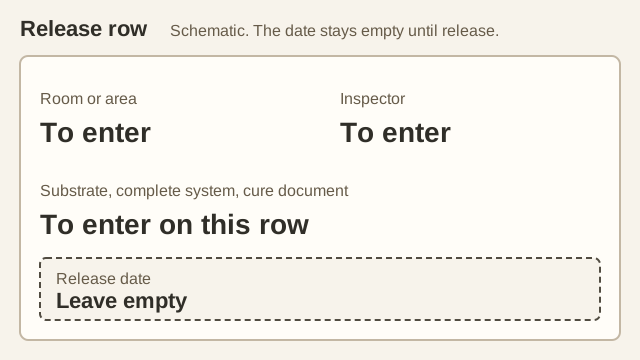
The release date stays empty until the named person releases that room. Schematic, not a customer record.
Keep the room or area list, the wall survey, the SKU, the complete system description, the operating limits, and the name of the person who releases the room.
When this does not apply
This record covers dry decorative walls in a phased hotel refurbishment. Bathrooms, wet areas and fire-egress design stay with the project's designers. The existing-surface review already sets showers, wet zones and floors aside. Finish choice by guestroom, corridor and lobby stays on the hotel interiors page. An office facilities list stays on the office wall specification.
The sheet is a method record for the fit-out team. It is not a test result, an engineering approval or a named hotel's project file. It does not set a cure hour, a noise level or a revenue figure.
Related reading
- Hotel and commercial interiors for finish selection by zone.
- Office wall specification for an occupied office handover, which is a different record.
- Flexible stone installation for mock-up acceptance and protection until cure.
- Existing surfaces for the wall survey that has to precede an overlay.
FAQ
Which cure time applies before a room reopens?
Follow the supplied product and adhesive instructions for the approved assembly and the site conditions. This workflow does not set a universal curing time. If those instructions are not in the room file, leave the release date empty.
Who releases the room back into use?
The person named on that room's row. Until the name is written, the release status stays unresolved and the date stays empty.
What if the wall survey is unfinished?
Leave the substrate preparation and the release date empty. A photo of an intact-looking wall is a record for review, not an acceptance result. Hollow, damp or peeling areas need a repair or removal decision before an overlay is considered.
Does one accepted mock-up release every room?
The mock-up accepts the method for the assembly that was built. Each room still needs its own substrate record, system description, cure document and named release. A different wall condition needs its own row.
Can an existing painted wall be covered in the same phase?
Only after that finish is assessed for stability, bond, flatness, contamination and moisture, and the written system confirms the panel and adhesive for that wall. A check on one patch does not approve the untested parts of the wall. Record the test location, method and result, then obtain the preparation or removal decision.
Method and sources
Prepared from HeyMaterials' published hotel interior guidance, installation workflow, existing-surface review and joints and sealing guidance. The tables organize a phase and release record. They report no cure hour, test result, engineering approval or named hotel project.
What to send us
Scroll the table horizontally to see all columns.
| Item | Why we need it | Example format |
|---|---|---|
| Room or area list | Identify which spaces come out of use | Room schedule with closed rooms and open routes |
| Wall survey | Record layers, defects and the repair decision | Labelled wall notes and photos |
| SKU | Identify the approved finish and batch | Product code and sample reference |
| Complete system description | Name substrate, primer, adhesive, joints and any sealer | System note tied to the room |
| Operating limits | Record work windows and routes that stay open | Hotel access note |
| Person who releases the room | Name the release owner for that room | Name and role on the room row |
We reply within 24 hours.
Send your project details