Flexible Stone Over Tile Cost: Build One Quote-Scope Matrix
Updated
Two quotes for the same old tile wall can look far apart when one prices a cover, the other prices removal, and neither measured the door frame. Covering a failing layer can also move the problem into the new finish. Before you compare a flexible stone over tile cost, put every route for that wall on one survey and one scope matrix. Start from the flexible stone range only once the wall record exists.
Cost scope at a glance
Two quotes for the same dry-area tile wall are comparable only when both use the same survey, the same door, frame and outlet measurements, and the same included, excluded and still-to-measure lines. That holds whether the route is a cover, a local repair, or removal of the old finish followed by a new complete system. There is no universal flexible-stone unit price, so the comparison is between scopes, not between square-metre figures.
Inputs for a comparable quote
Scroll the table horizontally to see all columns.
| Input | Where it comes from | Why it changes the quote |
|---|---|---|
| Wall survey and defect drawing | Site survey of layers, hollow spots, damp and cracks | Decides which route can be priced at all |
| Chosen route | Cover, local repair, or removal plus new system | Changes the repair, haul-off and prep lines |
| Interface sizes | Measured clearances at doors, frames, outlets and edges | Added thickness can force a revised detail |
| Complete finish system | Panel, primer where required, adhesive, joints, any sealer | The panel alone is not the system |
| Quantities | Area for each finish and the total | Finish, format, mix and quantity drive the material quote |
| Destination | City and country, or port | Packing and freight are quoted apart from the wall work |
Why the tile wall alone does not set a price
HeyMaterials publishes no fixed flexible-stone price. The price page explains why: the quote depends on finish, format, quantity, customization, packing and delivery requirements, and a fixed figure would not describe every order. The wall under the finish adds a second set of variables that belong to the contractor's scope, not to the material.
Compare material quotes on the same finish, format, mix and delivery scope. List the area for each finish and the total, so the number of finishes and their share can be reviewed together. Material and freight can be separated when you need a clean comparison.
Size data needs the same care. Flexible stone comes in multiple formats rather than one standard sheet, and dimensions, thickness and weight change by collection, texture, backing and production method. There is no single category-wide thickness. The sizes, thickness and weight guidance treats nominal values as early-planning figures only. Before the quantity take-off is final, confirm manufacturing tolerances, joint widths, edge trimming and the actual coverage per packed unit for the selected product. Ask whether a weight is stated per panel, per square metre or per carton, and whether it includes backing, protective layers or packaging.
The product itself is an engineered modified clay-mineral composite wall finish, not a thin slice of natural stone. Look names such as travertine and concrete describe the visual finish of the composite; they do not claim a quarried natural-stone composition. A quote for peel-and-stick, foam or quarried stone veneer is a different product and does not sit in the same matrix column.
Survey the tile wall before choosing a route
Identify every layer in the wall first. Then record hollow or loose areas, moisture and cracks, and agree on repair or removal before an overlay is considered. The existing-surfaces guidance tells you to assess tile, render, paint and board before deciding whether to cover or remove them.
Label each wall area on a drawing. Mark hollow-sounding spots, cracks, damp patches and peeling paint on that same drawing, with numbered photos. A sound or a photo is a record for review. It is not an acceptance result. Do not turn an informal tape check on one spot into approval of the whole wall; a successful local test does not approve the areas nobody tested.
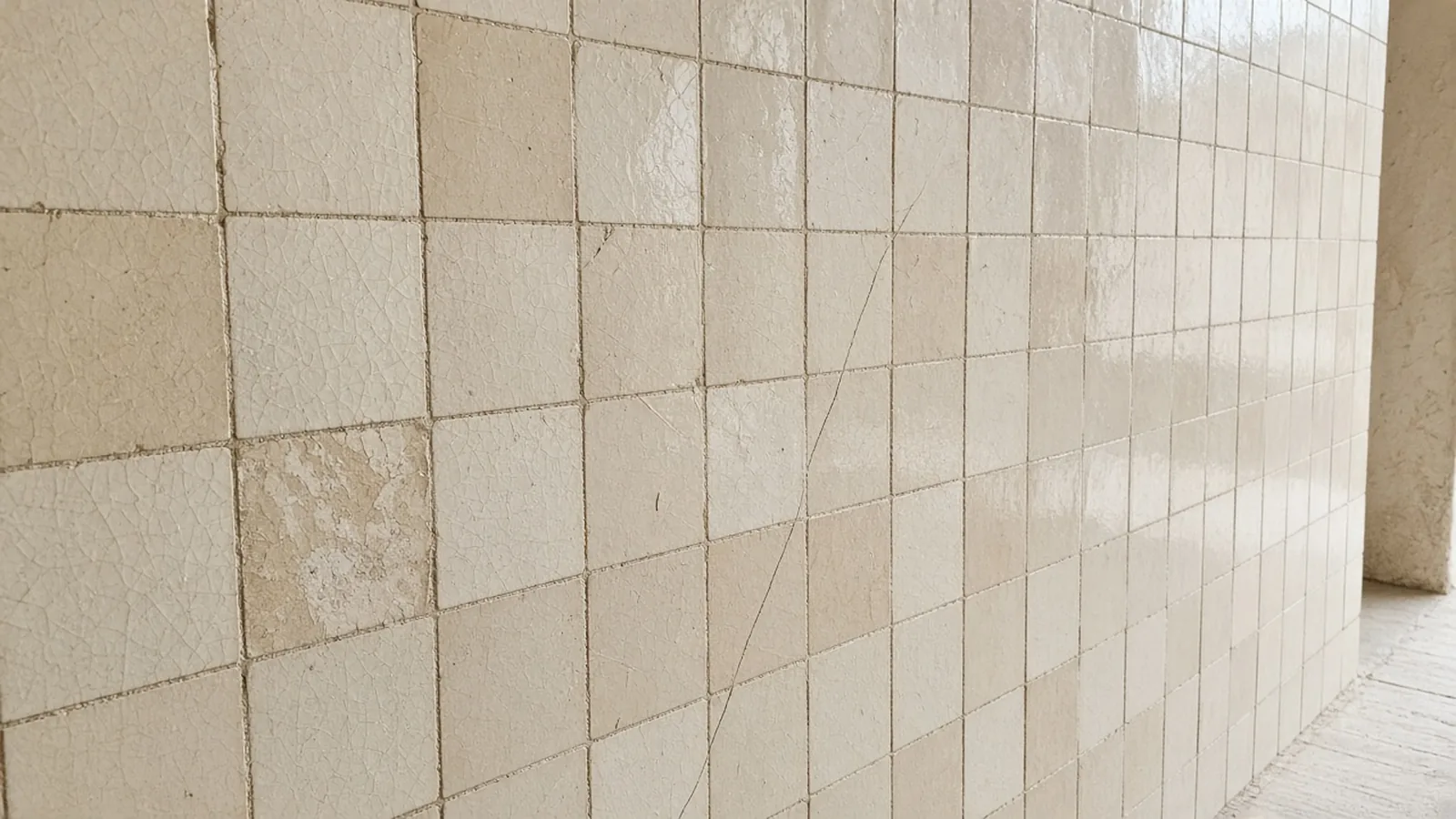
Glazed wall tile in a dry room, with a hairline crack and a worn patch.
Use one survey row per wall area. Blank fields mean the item has not been checked yet.
| Survey field | What to write | Leave blank when |
|---|---|---|
| Wall ID | The area label on the drawing | The drawing is not labelled |
| Original material and layers | Tile, bedding, render, board, paint as found | The layers are not identified |
| Defect location | Position on the drawing | The area is not surveyed |
| Photo number | Matching numbered photo | No photo was taken |
| Inspection method and result | How it was checked and what was found | It has not been checked |
| Proposed repair or removal | The decision for that area | No decision is agreed |
| Reviewer decision | Who decided, and what | Nobody has reviewed it |
| Frame and socket clearances | Measured clearance beside a section sketch | Not measured |
The existing-surfaces record sets no universal test method, adhesive class or acceptance threshold. Testing and acceptance follow the selected product and bonding-system instructions. Keep repair and removal decisions visible in the record; do not cover them as a cosmetic shortcut.
Three routes on the same wall
Flexible stone can sometimes go over an existing finish, but only after that finish is assessed for stability, bond, flatness, contamination and moisture. A site mock-up and a compatible adhesive system are essential. The published condition is "sometimes", and only after that assessment.
The survey sorts the wall into one of three routes:
- Cover. The receiving surface is sound. It is stable, clean and even enough for the selected thin cladding, and moisture, movement and contamination are resolved before bonding.
- Local repair, then cover. Hollow, damp or peeling areas are mapped and limited. Those areas are repaired or stripped first, and the rest of the wall is assessed as a receiving surface.
- Remove the existing finish and install a new complete system. Widespread hollow tiling, weak render, peeling paint, unresolved moisture or insufficient clearance call for repair, removal or a revised detail before an overlay is considered. Here, removal means taking off the old finish. It does not mean structural reconstruction, and the new finish does not strengthen the wall.
Price all three on one wall only when the survey leaves the route open. If the survey already shows widespread defects, a cover quote for that wall should not go into the comparison.
The quote-scope matrix
Use one matrix per wall, with the same rows for every route. In your own quote, mark each cell included, excluded or still to measure. A row that one contractor prices and another leaves out is usually where an apparent price gap comes from.
| Row | Cover | Local repair, then cover | Remove finish, new complete system |
|---|---|---|---|
| Survey | Survey record and defect drawing | Same record and drawing | Same record and drawing |
| Repair | None mapped (only if the survey is complete) | Mapped areas repaired or stripped, extent from the drawing | Condition of the exposed surface: still to measure |
| Haul-off | Not in this route unless the survey adds removal | Stripped material from mapped areas: still to measure | Removed finish: still to measure |
| Prep | Preparation of the retained tile to the system spec | Preparation of repaired and retained areas to the system spec | Preparation of the exposed surface to the system spec |
| Complete finish system | Panel, primer where required, adhesive, joints, any sealer | Same, confirmed for each receiving surface | Same, confirmed for the exposed surface |
| Interfaces | Added thickness over tile at doors, frames, outlets, edges | Same, plus repaired areas | New build-up measured and drawn again after removal |
| Protection | Completed areas until the system has cured | Same | Adjacent work during removal: still to measure; completed areas until cured |
| Inspection | Trial area of the whole system, then completed work | Same | Same, on the new receiving surface |
| Options | Extra finishes or formats, area per finish | Same | Same |
| Still to measure | Every survey field left blank | Same | Same |
Haul-off and protection of adjacent work during removal are lines the contractor prices. HeyMaterials pages do not describe a haul-off, demolition or removal-protection service, so those cells stay "still to measure" until your own site check fills them.
The prep and system rows change between routes because the receiving surface changes. Glazed tile, painted plaster and cement board do not automatically require three different adhesive classes. Confirm a compatible primer and bonding system for the actual substrate and panel, using the written product instructions. Primer is not always required; follow the selected system specification for the substrate condition and porosity.
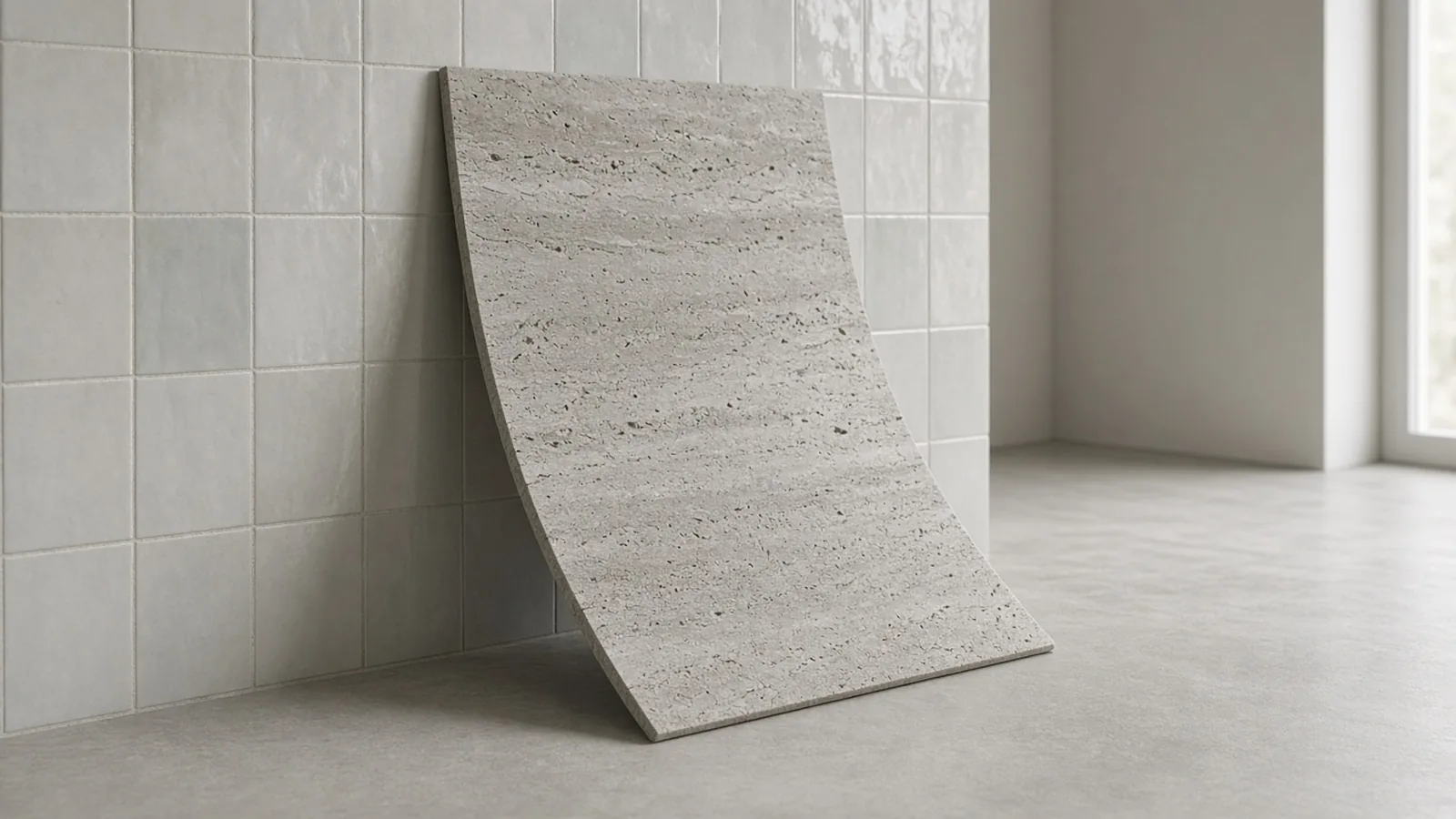
A curved grey stone-look sheet leaning against glazed wall tile.
Doors, frames and outlets
Measure existing clearances and draw the proposed preparation, adhesive and panel build-up at doors, sockets and edges. Record the added thickness at frames, sockets and edges before selecting the finish, and resolve clearances before ordering. HeyMaterials publishes no clearance number, and there is no category-wide thickness to assume. Use the nominal and tolerance values for the selected SKU.
A larger face format does not fix an inadequate clearance at a door frame or socket. When the build-up over retained tile does not fit, the survey points to a revised detail or to removal, and the matrix row for interfaces changes with it. Record the interface the same way in every route so the quotes stay comparable.
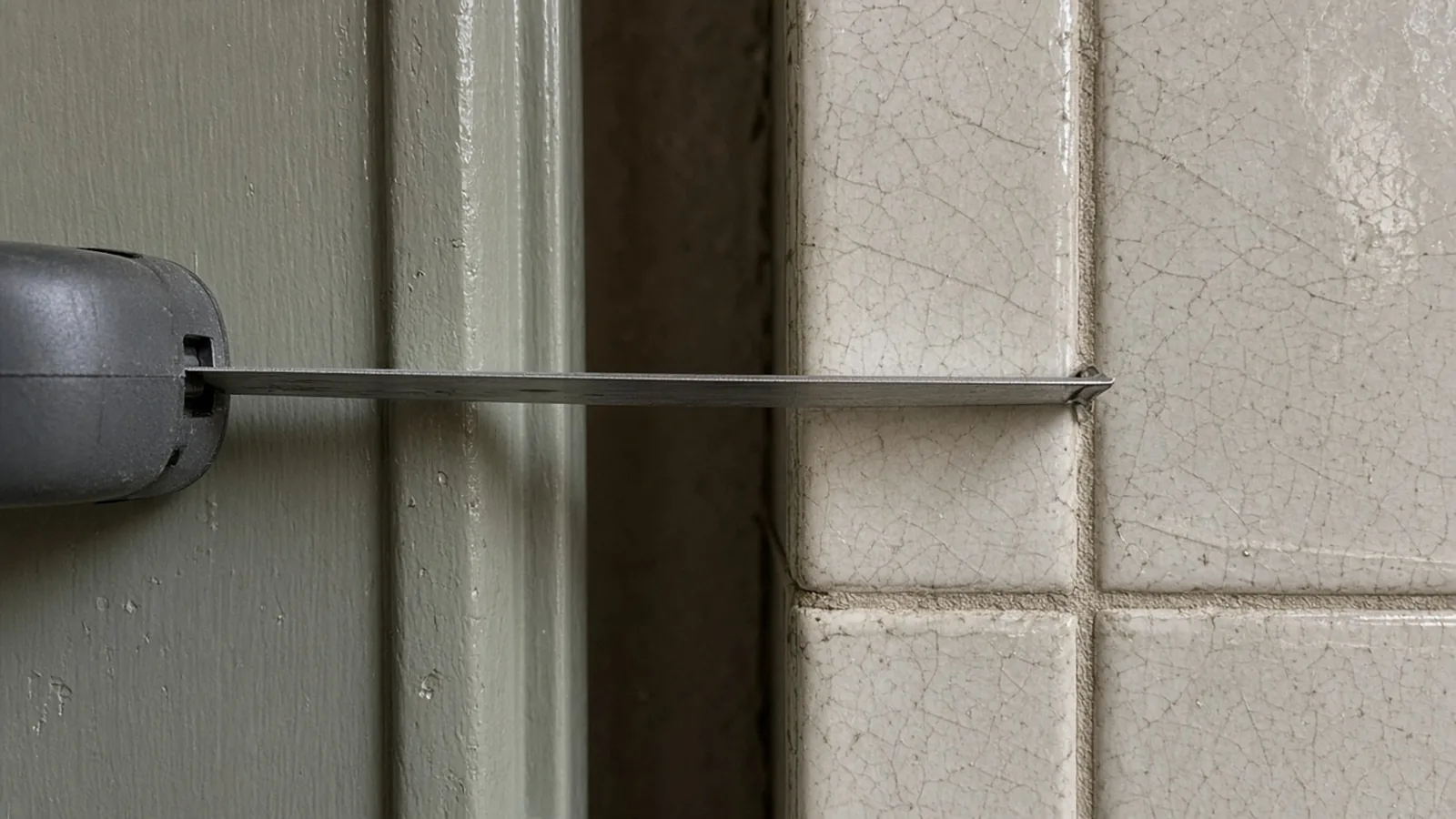
A metal tape stretched from a door frame to the face of glazed wall tile.
Trial area, protection and inspection
Flexible stone is installed as a thin decorative cladding system. Approval should cover the substrate, primer where required, adhesive, joint treatment and any sealer before full installation. Identify every existing layer and confirm the actual panel, primer and adhesive combination in writing; a substrate name alone does not select an adhesive class.
Tile adhesive may be used only if the panel supplier and adhesive manufacturer confirm compatibility for the exact substrate and exposure. Send the wall layers and chosen panel code rather than selecting from the tile label. Adhesive selection is a system decision for the exact supplied panel, because products sold as flexible stone or MCM can use different compositions and backings. The adhesives and substrates guidance covers that compatibility check.
Trial the agreed surface preparation, primer where required, adhesive and panel in a representative area. Trial the whole selected system, not a loose panel, and record which preparation was used in the trial area. Protect completed areas from traffic, impact and moisture until the system has cured. The installation workflow does not set a universal curing time; follow the supplied product and adhesive instructions.
Material, packing and freight stay separate
The wall lines in the matrix are the contractor's scope. Material, packing and freight are a separate quote. Packaging is confirmed against the selected product size and shipping route, and reference packing is not an order guarantee. The packaging and shipping page handles that part. Include the destination and packing requirements so material and freight can be shown apart.
When the finish is not yet approved, start with samples. A quotation needs a quantity and a destination. If the specification is not fixed, state the assumptions rather than expecting a fixed number.
When this does not apply
This matrix covers dry-area interior walls with an existing tile finish. Showers, wet zones, floors and kitchen or high-heat positions are outside it; the existing-surfaces guidance does not specify showers, wet zones or floors. Resolve the source of any damp before covering.
An overlay quotation is not exterior approval, and a sample does not approve exterior use either. State any exterior intent so the product, assembly, exposure and required evidence can be reviewed for the project.
Wall-load questions go to the wall-load review. Room-by-room release in an occupied hotel is covered by the hotel refurbishment phases. Warranty coverage is not inferred from the words "flexible stone" or "MCM"; HeyMaterials presents a warranty period or remedy only when it is written into the quotation, order confirmation or product-specific terms.
What the quotation needs
To get a sample or a project quotation, send the items below through the quote form, or start with samples if the finish is still open. Sample requests run through WhatsApp; the samples page lists no fixed sample price, and the sample contents and shipping option are confirmed for the project before dispatch. We reply within 24 hours.
| Item | Why it is on the request | Format |
|---|---|---|
| Wall survey and defect drawing | Identifies layers and defects before a route is priced | Wall ID, layers, defect locations, photo numbers, inspection method and result; blank means not yet checked |
| Chosen route | Keeps cover, local repair and removal on the same wall | One of the three routes, or a note that the route is undecided |
| Interface sizes | Records the added thickness at doors, frames, outlets, edges | Dimensioned sketch of existing clearance and proposed build-up |
| Priced scope | Shows which matrix rows are included, excluded or open | The matrix with each row marked |
| Quantities | Defines the area without a unit price | Area for each finish, the total, and the format |
| Destination | Separates material from packing and freight | City and country, or port |
Add the target finish or product code if you have one. The reply covers material, samples and the quotation. Installation, removal, haul-off and site protection stay with the contractor's own scope.
Related reading
- Existing surfaces for the survey method and the strip-instead-of-cover conditions.
- Flexible stone installation for the complete system and protection of completed work.
- Flexible stone price for why no unit price is published.
- Sizes, thickness and weight for nominal versus actual dimensions.
FAQ
Is covering tile with flexible stone cheaper than removing it?
This page does not rank the routes by cost, and HeyMaterials publishes no figure that would. The answer depends on what the survey finds and which matrix rows each route needs. Compare the routes only after the same survey, interfaces and scope lines are in every quote.
Why is there no price per square metre for flexible stone over tile?
There is no universal flexible-stone unit price. The material quote depends on finish, format, quantity, customization, packing and delivery, and the wall work depends on repair, haul-off, prep, interfaces and protection on that specific wall.
Can tile adhesive be used to bond flexible stone over tile?
Only if the panel supplier and adhesive manufacturer confirm compatibility for the exact substrate and exposure. Send the wall layers and the chosen panel code instead of choosing from the tile label alone.
Does one tape test or one sound tile approve the whole wall?
No. A sound or a photo is a record for review, and a successful local test does not approve untested areas. Map the wall, then follow the selected system's assessment and acceptance criteria.
Does a quotation approve exterior use?
No. An overlay quotation is not exterior approval. State any exterior intent and have the product, assembly, exposure and required evidence reviewed for the project.
Method and sources
Prepared from HeyMaterials' published existing-surfaces guidance, installation workflow, adhesives and substrates guidance, price page, sizes, thickness and weight guidance, packaging and shipping page and sample request page. The matrix organizes scope lines for comparison. It contains no price, unit rate, coverage rate, test result or customer project.
What to send us
Scroll the table horizontally to see all columns.
| Item | Why we need it | Example format |
|---|---|---|
| Wall survey and defect drawing | Identify layers and defects before a route is priced | Wall ID, layers, defect locations, photo numbers, inspection method and result; blank means not yet checked |
| Chosen route | Keep cover, local repair and removal on the same wall | One of the three routes, or a note that the route is undecided |
| Interface sizes | Record added thickness at doors, frames, outlets and edges | Dimensioned sketch of existing clearance and proposed build-up |
| Priced scope | Show which matrix rows are included, excluded or still to measure | The matrix with each row marked |
| Quantities | Define the area without a unit price | Area for each finish, the total, and the format |
| Destination | Separate material from packing and freight | City and country, or port |
We reply within 24 hours.
Send your project details