Flexible Stone (MCM) vs Ceramic & Porcelain Tile: Wall Cladding Engineering Comparison
Updated
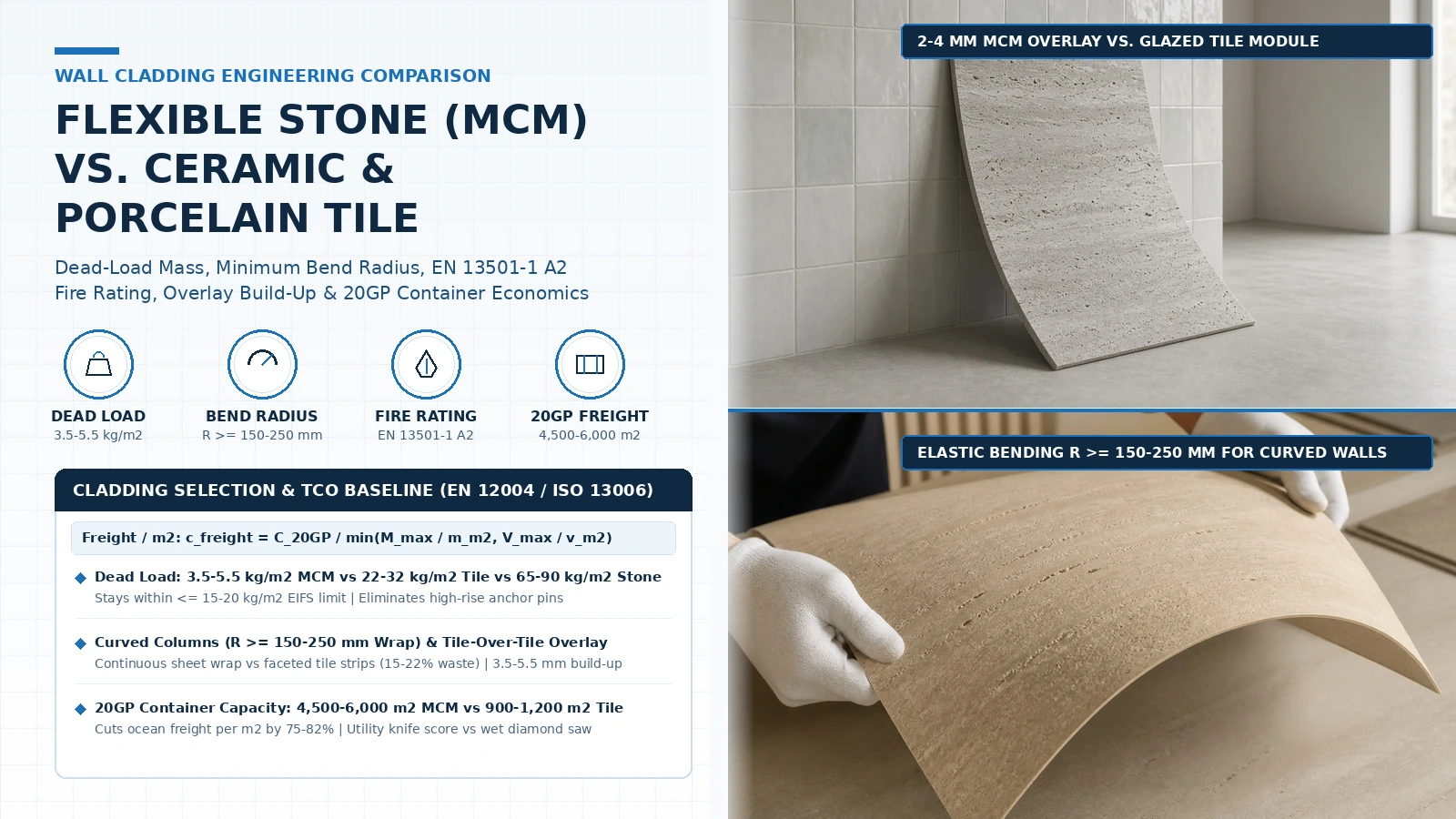
Specifying wall cladding by surface texture alone causes costly rework, EIFS dead-load failures, cracked rigid tiles across curved columns, and wasted demolition on tile-over-tile renovations. Specify 2.0–4.0 mm Modified Clay Material (MCM) flexible stone wall panels when the project requires ultra-light dead load (3.5–5.5 kg/m²), continuous curved wrapping down to R >= 150–250 mm, or direct renovation overlays, and specify 9.0–12.0 mm kiln-fired porcelain or ceramic tile (ISO 13006) when pedestrian floors, submerged wet zones, or rigid vitrified modular grids govern the design.
Under Standard Engineering Baselines (EN 13501-1, ISO 13006, EN 12004, and ASTM C482), 2.0–4.0 mm MCM flexible stone sheets reduce installed cladding dead load from 22–32 kg/m² (standard 9–12 mm porcelain tile plus mortar bed) and 65–90 kg/m² (20–30 mm dimensional granite slabs) down to 3.5–5.5 kg/m² panel mass (5.5–8.5 kg/m² bonded assembly). That 75–82% weight reduction keeps high-rise and insulated EIFS facades below the <= 15–20 kg/m² adhered veneer threshold without penetrating mechanical anchor pins, increases 20GP ocean container loading from 900–1,200 m² to 4,500–6,000 m², and allows utility-knife score-and-snap fabrication over curved columns (R >= 150–250 mm) and sound existing tile (3.5–5.5 mm total overlay build-up).
Comparison framework at a glance
| Engineering Parameter | MCM Flexible Stone (2.0–4.0 mm Sheet) | Porcelain / Ceramic Wall Tile (9.0–12.0 mm ISO 13006) | Why It Governs Wall Selection & Failure Prevention |
|---|---|---|---|
| Core composition & manufacturing | 70–85% inorganic mineral powder (clay, quartz, stone dust) cross-linked with 15–30% waterborne elastomer on fiberglass mesh (composition guide) | Kiln-sintered (1,200–1,250°C) vitrified clay/feldspar/quartz body (ISO 13006 Group BIa E_b <= 0.5%; Group BIII ceramic E_b > 10%) | Determines elastic flexibility vs. brittle fracture (ISO 10545-4 modulus of rupture >= 35 N/mm²) |
| Nominal thickness & installed mass | 2.0–4.0 mm panel (3.5–5.5 kg/m² sheet; 5.5–8.5 kg/m² with adhesive) (sizes & weight) | 9.0–12.0 mm tile (19–25 kg/m² tile; 22–32 kg/m² with 5–7 mm mortar bed) | Stays within <= 15–20 kg/m² EIFS/insulation dead-load cap; eliminates overhead rigid slab fall hazard |
Curved column & arch radius (R_min) | Continuous elastic cold/warm wrap down to R >= 150–250 mm (1,200 x 600 or 2,400 x 1,200 mm sheets) | 0 mm elastic bend; requires 40–75 mm wet-sawn faceted strips or mosaics on curves R <= 1,500 mm | Eliminates polygonal chord joints and 15–22% strip-cutting kerf waste on curved walls and columns |
| Fire & weather standards | Euroclass EN 13501-1 A2-s1,d0 / ASTM E84 Class A (mineral matrix); EN 1348 >= 1.0 MPa tensile bond | Euroclass A1 non-combustible; ISO 10545-12 frost resistance (Group BIa porcelain only) | Both meet high-rise non-combustibility baselines when paired with certified adhesives (fire performance) |
| Cutting & MEP penetration tooling | Utility knife score-and-snap (2–3 mm sheets) or dry carbide/diamond shear; 0% water slurry (cutting guide) | Water-cooled bridge diamond wet saw and diamond core bits; high silica slurry & corner spalling risk | Cuts interior fit-out dust/noise and speeds electrical box cutouts by 2.5–3.5x |
| Renovation tile-over-tile overlay | Direct 3.5–5.5 mm total build-up over sound tile primed with quartz-grit bridge primer (existing surfaces) | 14–18 mm build-up (often forces jackhammer demolition and door/casing trimming) | Preserves existing door architraves and saves $38–$55/m² in tear-out, haul-off, and re-rendering |
| 20GP ocean container capacity | 4,500–6,000 m² per 20GP (4.2–5.2 kg/m² packed mass; volume/weight balanced) | 900–1,200 m² per 20GP (hits 22,000–24,000 kg road payload cap at < 45% container volume) | Reduces ocean freight and port drayage cost per square meter by 75–82% (packaging & shipping) |
| Dominant failure mode & prevention | Adhesive ridge skinning (f_void > 15%) or edge curl on unprimed walls → Prime substrate, back-butter EN 12004 C2TE S1, roll with 35–50 kg J-roller (>= 80–95% transfer), leave 0.5–1.5 mm seams | Shear debonding of heavy vitrified slabs or brittle corner cracking → Back-butter 100% with C2TE S1/S2, install mechanical safety clips above 3–6 m facade height, isolate every 2.4–3.6 m (TCNA EJ171) | Matches bonding chemistry and movement joint geometry to panel modulus (troubleshooting guide) |
How do MCM flexible stone, porcelain tile, natural stone, and ACM/WPC panels compare across failure modes?
Architects and quantity surveyors frequently evaluate Architectural Texture Series MCM and Natural Stone Texture Series MCM alongside large-format porcelain wall tile (ISO 13006), quarried dimensional stone (ASTM C615 / C1527), and sub-framed ACM / WPC panels. Searching for "flexible ceramic tile" or "soft porcelain tile" often leads to specification mismatches: MCM is an unfired inorganic mineral-elastomer composite sheet (2.0–4.0 mm), whereas porcelain tile is a rigid kiln-vitrified ceramic plate (9.0–12.0 mm). Writing tile joint modules, wet-saw tolerances, or cement-slurry grouting rules onto an MCM drawing—or assuming a rigid tile can wrap a tight column without faceting—creates avoidable site rework.
| Cladding System | Nominal Thickness & Installed Mass | Minimum Curve Radius & Sub-Framing | Fire & Adhesion Baseline | Dominant Field Failure Mode & Engineering Prevention |
|---|---|---|---|---|
MCM Flexible Stone (Architectural & Stone Series) | 2.0–4.0 mm (4.5–7.0 mm deep relief); 3.5–5.5 kg/m² panel (5.5–8.5 kg/m² bonded) | Cold wrap R >= 200–250 mm; warm thermoformed wrap R >= 150 mm; direct adhesive bond (zero rail sub-frame) | EN 13501-1 A2-s1,d0 / ASTM E84 Class A; EN 1348 >= 1.0 MPa tensile; ASTM C482 >= 0.35–0.50 MPa shear | Skinned mortar ridges (f_void > 15%), alkaline efflorescence, or zero-joint thermal tenting → Embed within EN 1346 open time (<= 20–30 min), consolidate with 35–50 kg J-roller (ANSI A108.5 >= 80% interior / >= 95% exterior), seal with EN 1504-2 Class I breathable silane-siloxane, and maintain TCNA EJ171 movement joints |
Porcelain & Ceramic Wall Tile (ISO 13006 BIa / BIII) | 9.0–12.0 mm standard (6.0 mm gauged slab); 22–32 kg/m² installed with mortar bed | 0 mm elastic bend; requires faceted strip cuts (40–75 mm) on curves R <= 1,500 mm; mechanical clips above 3–6 m facade height | Euroclass A1 non-combustible; requires EN 12004 C2TE S1/S2 deformable adhesive on BIa (E_b <= 0.5%) backs | Interfacial shear debonding on low-porosity BIa backs, overhead rigid slab fall hazard, or hole-saw corner fracture → Back-butter 100% of tile back with C2TE S1/S2 mortar, add stainless-steel safety clips on high-rise elevations, and wet-core MEP openings before mounting |
Dimensional Natural Stone (20–30 mm Granite / Travertine) | 20–30 mm quarried slab; 65–90 kg/m² installed with mortar or SS 304/316L rail anchors | 0 mm bend; requires CNC carving from thick solid blocks for curved column shells; mandatory metal sub-frame on facades | Euroclass A1; ASTM C1354 anchor pull-out strength & L/600–L/720 backup stiffness required | Structural backup overload, kerf-anchor slot spalling under wind suction (ASTM E330), and natural iron/salt staining → Engineer structural steel/concrete backup, use SS 316L undercut anchors, and pre-seal all 6 slab faces with non-staining ASTM C1248 sealants |
ACM & WPC Wall Panels (4 mm ACM / 12–25 mm WPC) | 4.0 mm aluminum composite or 12–25 mm wood-plastic; 9.0–14.5 kg/m² including furring rails | ACM requires roll-bending equipment; WPC is limited to flat planes or wide gentle arcs; steals 45–85 mm interior floor space | Standard PE/PVC cores rate Class B/C with high smoke; mineral-core FR A2 required for high-rise escape routes | High thermal expansion (alpha = 23–65 x 10^-6 /°C) buckling seams, hollow acoustic drumming, and UV print fade → Install slotted floating sub-frame clips, mineral-wool cavity batts, and specify fluorocarbon PVDF / mineral-core A2 grades |
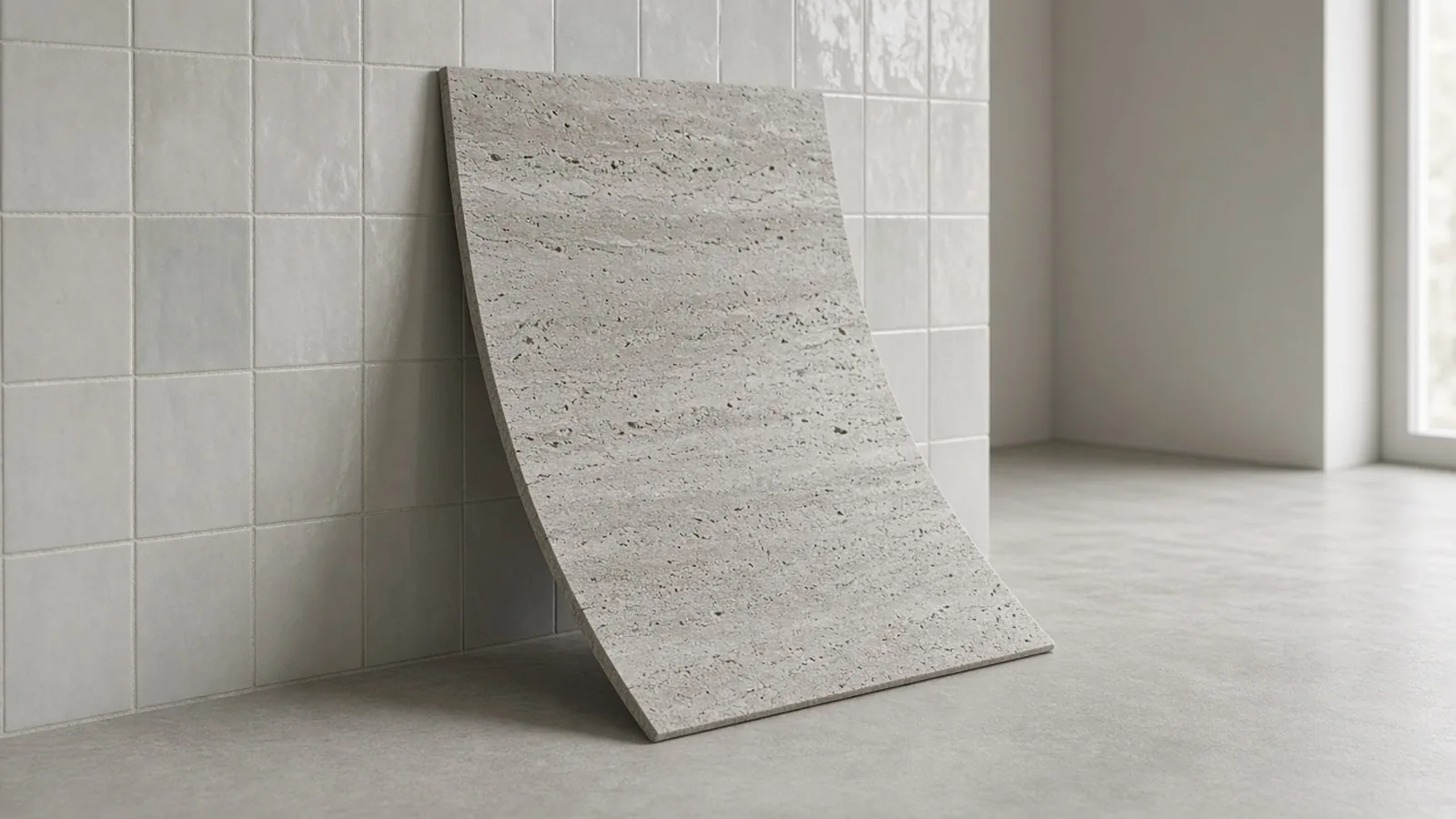
Physical geometry comparison: a 2.5 mm flexible stone sheet (3.5–5.5 kg/m²) flexes continuously across wall contours and bonds over sound existing tile with a 3.5–5.5 mm total build-up, whereas rigid ceramic and porcelain tiles enforce a fixed modular joint grid and 14–18 mm overlay thickness.
Rule-of-Thumb 1 (EIFS & Insulated Facade Dead-Load Threshold): If an exterior wall assembly or curtain-wall spandrel caps adhered dead load at <= 15–20 kg/m² (3.0–4.0 lb/ft²)—such as Exterior Insulation and Finish Systems (EIFS), mineral-wool/EPS continuous insulation, or light-gauge steel stud sheathing—prioritize 2.0–4.0 mm MCM flexible stone (5.5–8.5 kg/m² total bonded mass) because 9–12 mm porcelain tile (22–32 kg/m²) and 20–30 mm natural stone (65–90 kg/m²) exceed the insulation lamina shear limit and force expensive penetrating rail sub-framing.
How do you calculate structural dead-load reduction on high-rise and EIFS facades?
On multi-story exterior walls and seismic retrofits, every additional kilogram per square meter multiplies gravity shear stress at the bonding interface (tau_gravity = m_sys * g) and seismic overturning mass. While IBC Section 1404 and TMS 402 permit adhered veneers up to prescriptive weight limits when bonded to structural masonry or concrete, installing rigid 9–12 mm ISO 13006 Group BIa porcelain tiles (22–32 kg/m²) overhead creates a severe rigid-fragment impact hazard if thermal cycling or moisture freeze-thaw (ISO 10545-12) degrades mortar contact. Consequently, many municipal building authorities mandate secondary stainless-steel mechanical clips or back-ventilated sub-frames for rigid tiles above 3.0–6.0 m (10–20 ft) elevation.
Because 2.0–4.0 mm MCM flexible stone combines low areal mass (3.5–5.5 kg/m²) with an integral fiberglass-elastomer carrier that resists brittle shattering, full-surface chemical bonding with EN 12004 C2TE S1 polymer-modified mortar (EN 1348 tensile adhesion >= 1.0 MPa; ASTM C482 shear bond >= 0.35–0.50 MPa / 50+ psi) achieves a static gravity shear safety factor exceeding SF > 1,000 without mechanical anchor pins. Review our wall-load review guide and water and weather resistance data when preparing structural submittals.
Structural Dead-Load Mass & High-Rise Facade Reduction Formula
M_sys = A_wall * (m_panel + m_adh + m_subframe) ; Delta_M_saved = A_wall * (m_sys_tile - m_sys_MCM)
- Worked Arithmetic Example (
1,200 m²Commercial High-Rise / EIFS Facade Retrofit): Given net facade areaA_wall = 1,200 m², a2.5 mmMCM flexible stone system with panel massm_panel = 4.2 kg/m²,EN 12004 C2TE S1adhesive massm_adh = 2.3 kg/m², and sub-frame massm_subframe = 0 kg/m²(m_sys_MCM = 6.5 kg/m², safely below the<= 15–20 kg/m²EIFS limit) versus a10 mmISO 13006 BIaporcelain tile system with tile massm_panel = 22.5 kg/m²and mortar bedm_adh = 5.5 kg/m²(m_sys_tile = 28.0 kg/m²) →M_sys_MCM = 1,200 * 6.5 = 7,800 kg(7.8 metric tons) versusM_sys_tile = 1,200 * 28.0 = 33,600 kg(33.6 metric tons), eliminating25,800 kg(25.8 metric tonsor76.8%) of suspended facade dead load (and eliminating91,800 kg/91.8 metric tonscompared against25 mmgranite slabs at83.0 kg/m² = 99,600 kg).
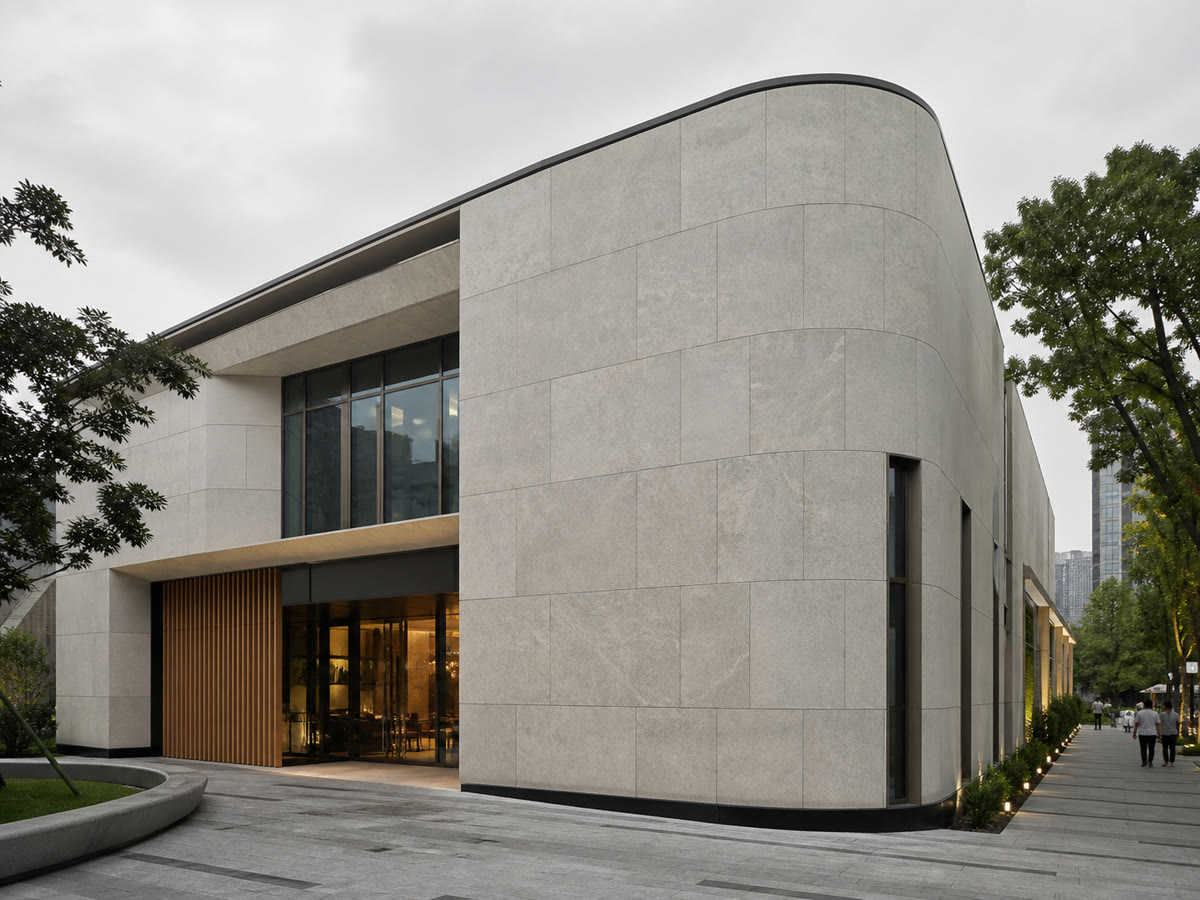
Exterior facade application: 2.0–4.0 mm MCM panels (5.5–8.5 kg/m² total bonded assembly) transition seamlessly from flat elevations across radiused building corners while staying within adhered EIFS dead-load limits (<= 15–20 kg/m²).
When do curved walls and columns rule out rigid ceramic or porcelain tile?
On curved walls and columns, material flexural mechanics dictate both visual continuity and site labor cost. Kiln-sintered porcelain and ceramic tiles are brittle elastic solids (0 mm cold bending capability). When a lobby pillar, reception desk, vaulted ceiling, or curved corridor wall has a radius R <= 1,500 mm, standard 600 x 1,200 mm tiles cannot conform to the arc. Tile installers must either substitute small mosaic sheets (25 x 25 mm to 50 x 50 mm, multiplying grout lines by 15–25x) or wet-saw large tiles into narrow 40–75 mm vertical strips. Faceting a curve with narrow tile strips produces visible polygonal chord steps, lippage under grazing downlights, 15–22% diamond-blade kerf and breakage waste, and 3.5–5.0x slower installation labor.
By contrast, 2.0–4.0 mm MCM sheets flex elastically around convex and concave substrates down to a minimum bending radius of R >= 200–250 mm at ambient temperature (15–35°C), and down to R >= 150 mm when gently pre-warmed to 50–70°C with a hot-air gun during corner forming (see our corners and edges engineering guide).
Curve Radius Range (R) | MCM Flexible Stone (2.0–4.0 mm Sheet) | Porcelain / Ceramic Tile (9.0–12.0 mm Rigid) | Visual & Labor Outcome |
|---|---|---|---|
Tight Columns & Bullnose Returns (R = 150–250 mm) | Continuous wrap with 50–70°C controlled thermoforming on eligible 2.0–3.0 mm SKUs; full back-buttering + clamping batten during cure | Impossible with large-format tile; requires custom factory-molded ceramic specials (8–12 week lead time) or 25 mm mosaic strips | MCM preserves unbroken stone/travertine vein flow with 1–2 hair-line vertical seams |
Architectural Pillars & Reception Curves (R = 250–1,500 mm) | Direct ambient cold-wrapping (15–35°C) along the 1,200 mm or 2,400 mm panel axis; 4–6% offcut waste | Requires wet-sawing tiles into 40–75 mm faceted vertical strips; 15–22% cutting/breakage waste + dense vertical grout joints | MCM eliminates polygonal faceting steps and cuts curved-wall installation labor by 60–75% |
Sweeping Curved Walls (R > 1,500–3,000 mm) | Full-width 600 x 1,200 mm or 1,200 x 2,400 mm sheets laid directly with standard EN 12004 C2TE S1 notched trowel and J-roller | 300 x 600 mm tiles can approximate the arc only by widening wedge-shaped grout joints (3–6 mm) across chord segments | MCM delivers a true continuous radius without stepped chord tangents |
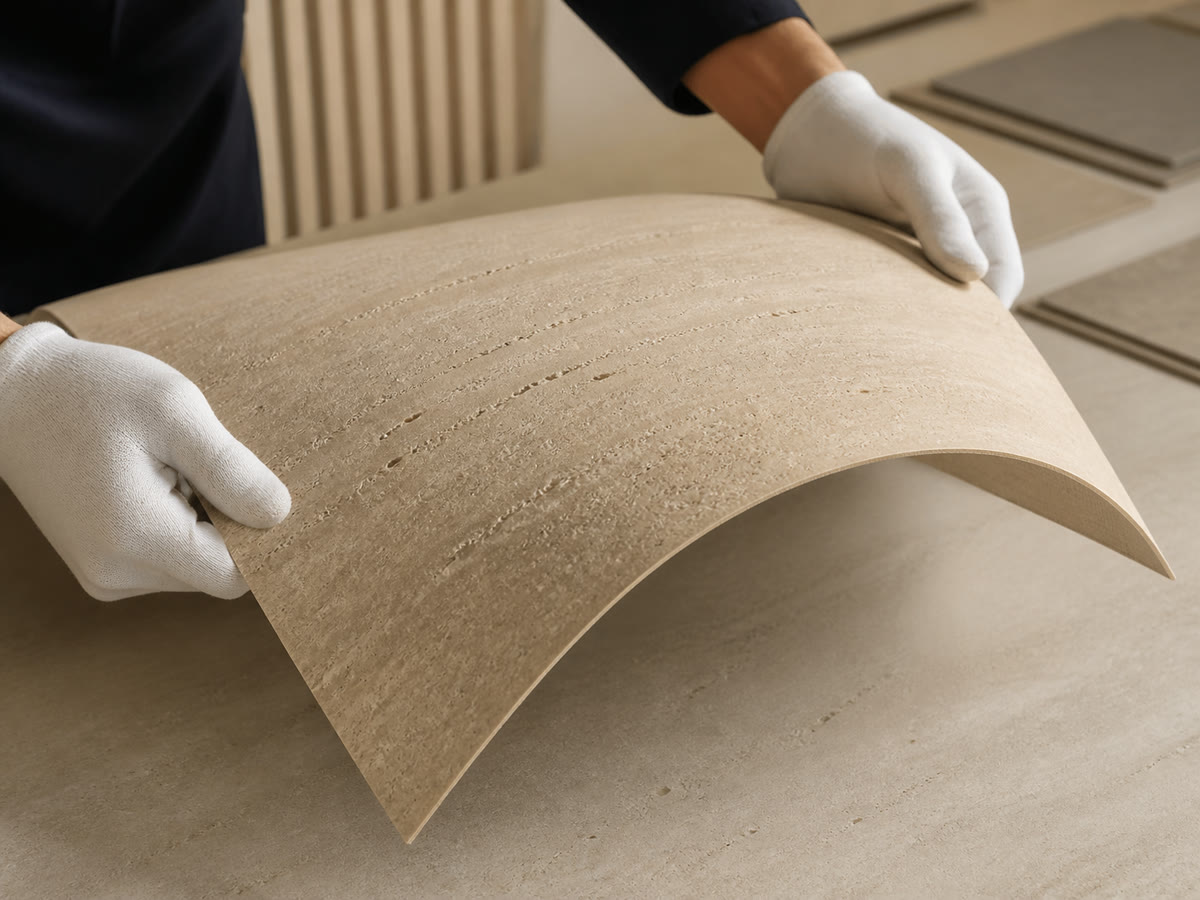
Elastic bending baseline: 2.0–4.0 mm Architectural and Travertine MCM sheets bend cold to R >= 200–250 mm (and R >= 150 mm with 50–70°C warm forming), wrapping cylindrical columns without faceted tile strip cuts.
Rule-of-Thumb 2 (Curved Column & Arch Radius Threshold): If a wall elevation includes curved pillars, arched reveals, or wave partitions with radius R <= 1,500 mm (down to R >= 150–250 mm depending on SKU thickness), prioritize continuous MCM flexible stone sheets oriented parallel to the cylinder circumference because rigid ISO 13006 porcelain tile forces faceted strip cutting (15–22% waste) and stepped grout chords. Always confirm the exact SKU's minimum cold/warm bend radius and grain direction with a project mock-up before full production.
How do renovation tile-over-tile overlays compare on thickness, door clearances, and payback?
In occupied hotel and commercial interior refurbishments, demolishing existing ceramic wall tile generates 25–35 kg/m² of rubble, silica dust (OSHA 1926.1153), jackhammer noise across adjacent guest rooms, and 2–4 days of cement re-rendering cure time before new finishes can be applied. While tile-over-tile installation is technically possible with rigid porcelain, bonding a 9–12 mm tile plus a 5–6 mm mortar bed adds 14–18 mm of thickness—which projects past existing door architraves, window casings, and NEC 314.20 electrical box setbacks (<= 6.0 mm maximum non-combustible surface setback), forcing carpentry tear-out of door frames.
As detailed in our existing-surfaces overlay guide and flexible stone over tile cost scope guide, bonding a 2.0–3.5 mm MCM sheet over sound existing tile using a quartz-grit bridge primer (0.15–0.25 kg/m²) and a 1.5–2.0 mm EN 12004 C2TE S1 or MS-polymer bed adds only T_build = 3.5–5.5 mm of total thickness. That slim profile tucks cleanly inside standard 6–10 mm door casing reveals without removing architraves.
Rule-of-Thumb 3 (Renovation Tile-Over-Tile Overlay Threshold): If an existing interior glazed tile wall exhibits < 5% hollow area by acoustic tap-testing, ASTM D4541 tensile pull-off strength >= 0.5–1.0 MPa, substrate moisture <= 4.0% CM, and door/frame reveal clearance >= 5.0 mm, prioritize direct 3.5–5.5 mm MCM flexible stone overlay over quartz-grit bridge primer rather than demolishing the existing tile or adding 14–18 mm of porcelain tile-over-tile thickness.
Renovation Tile-Over-Tile Direct Cost Savings Formula
Delta_C_reno = A_wall * (c_demo + c_haul + c_rerender + Delta_c_lab - c_primer_skim)
- Worked Arithmetic Example (
450 m²Commercial Lobby & Corridor Refurbishment over Sound Glazed Tile): Given net wall areaA_wall = 450 m², mechanical tile demolition and rubble haul-offc_demo + c_haul = $24.00/m², cementitious scratch/float re-renderingc_rerender = $14.00/m², wet-saw porcelain installation labor premiumDelta_c_lab = $16.00/m², minus alkaline degreasing + quartz-grit bridge primer +C2TE S1flush grout-line skim coatc_primer_skim = $6.50/m²→Delta_C_reno = 450 * (24.00 + 14.00 + 16.00 - 6.50) = 450 * $47.50 = $21,375.00(saving$47.50/m²in direct site construction cost while compressing room turnaround by8–12 working days).
How do ocean container freight capacity and 5-year TCO compare?
When importing wall cladding internationally, unit ex-works (EXW / FOB) material prices tell less than half the story. Standard 20-foot General Purpose (20GP) ocean containers have an internal usable palletized volume of V_max = 26.0–28.0 m³ and a maximum safe highway/carrier net cargo payload of M_max = 22,000–24,000 kg. Because 9–12 mm porcelain wall tiles weigh 21–26 kg/m² including wooden pallets, a 20GP container hits the 22,500 kg road weight cap at just 900–1,200 m², leaving more than 50% of the container volume empty ("shipping air" due to dead weight). Conversely, 2.0–4.0 mm MCM flexible stone (4.2–5.2 kg/m² packed in fumigated plywood crates) packs 4,500–6,000 m² per 20GP container, slashing ocean freight, customs clearance, and inland drayage cost per square meter by 75–82%. See flexible stone pricing inputs and packaging and shipping specifications for crate dimensions.
20GP Ocean Container Freight Cost per Square Meter Formula
Q_20GP = min(M_max / m_packed_m2, V_max / v_packed_m2) ; c_freight_m2 = C_20GP / Q_20GP
- Worked Arithmetic Example (
$3,600All-In20GPContainer Ocean Freight & Port Drayage): Given net cargo payload limitM_max = 22,500 kg, usable palletized volumeV_max = 27.0 m³, and all-in container freight rateC_20GP = $3,600:- MCM Flexible Stone (
2.5 mm,m_packed_m2 = 4.5 kg/m²,v_packed_m2 = 0.0050 m³/m²):Q_20GP_MCM = min(22,500 / 4.5, 27.0 / 0.0050) = min(5,000, 5,400) = 5,000 m²/20GP→c_freight_MCM = $3,600 / 5,000 = $0.72/m². - Porcelain Wall Tile (
10 mm,m_packed_m2 = 22.5 kg/m²,v_packed_m2 = 0.014 m³/m²):Q_20GP_tile = min(22,500 / 22.5, 27.0 / 0.014) = min(1,000, 1,928) = 1,000 m²/20GP→c_freight_tile = $3,600 / 1,000 = $3.60/m²(5.0xhigher freight cost per m², saving$2.88/m²or$14,400per5,000 m²shipment).
- MCM Flexible Stone (
Rule-of-Thumb 4 (Container Freight & Wet/Floor Boundary Threshold): If an export order exceeds 1,000 m², compare landed CIF/DDP cost per square meter rather than ex-factory unit rates because MCM's 4,500–6,000 m²/20GP packing density saves $2.50–$4.50/m² in ocean freight; however, if the surface is a pedestrian floor, commercial kitchen washdown zone, or submerged pool/shower pan, specify ISO 13006 Group BIa porcelain tile because MCM flexible stone is engineered strictly for vertical walls, columns, and ceilings.
5-Year Wall Cladding TCO & Hidden-Cost Ledger (1,000 m² Commercial Project Baseline: 800 m² Flat Wall + 200 m² Curved Columns)
Cost Component (1,000 m² Scope) | MCM Flexible Stone (2.5 mm Bonded System) | Porcelain Wall Tile (10 mm ISO 13006 BIa) | Natural Stone Slab (25 mm Mechanically Anchored) | Primary Engineering Driver & Failure Prevention |
|---|---|---|---|---|
| Cladding material + offcut waste allowance | $18,000–$32,000 (4–6% utility-knife waste on flat + curved zones) | $16,000–$34,000 (8% flat waste + 18–22% strip-cut waste on 200 m² curves) | $48,000–$85,000 (12–18% slab sawing & vein-matching waste) | Continuous MCM sheet wrapping avoids faceted strip-cutting loss on curved columns |
Ocean freight & port drayage ($3,600 / 20GP baseline) | $720 (0.20 x 20GP container; 4,500 kg net mass) | $3,600 (1.0 x 20GP container; 22,500 kg payload limit reached) | $12,600 (3.5 x 20GP containers; 78,750 kg mass) | 4,500–6,000 m²/20GP packing density cuts freight cost by 80% vs. porcelain |
| Adhesive, primer, sub-framing & mechanical anchors | $4,500–$6,800 (acrylic/quartz primer + 2.3 kg/m² EN 12004 C2TE S1 + EN 1504-2 sealer; $0 sub-frame) | $8,500–$14,000 (5.5 kg/m² C2TE S1/S2 mortar + stainless safety clips above 3–6 m elevation) | $28,000–$45,000 (SS 304/316L rail sub-framing, undercut anchors & structural brackets) | 3.5–5.5 kg/m² MCM dead load eliminates metal sub-framing and high-rise anchor pins (adhesives guide) |
| Installation & curved-column fabrication labor | $16,000–$26,000 (1.8–2.5x faster handling; utility-knife score & continuous column wrap) | $34,000–$52,000 (bridge wet-sawing, 200 m² faceted strip cutting & multi-pass grouting) | $55,000–$88,000 (crane/scaffold rigging, kerf slotting & mechanical bolt torqueing) | Dry/low-dust scoring and lightweight 1,200 x 600 mm sheets cut site labor hours by 40–55% |
| 5-year maintenance & single-panel repair reserve | $800–$1,500 (breathable EN 1504-2 top-up at Year 5; $105/panel surgical cut-out replacement if damaged) | $2,500–$5,500 (grout joint scrubbing, efflorescence cleaning & high-noise chisel replacement of cracked tiles) | $4,500–$9,000 (periodic sealant joint replacement & natural stone poultice stain removal) | Surgical single-sheet replacement (troubleshooting) avoids jackhammer vibration damage to adjacent panels |
Estimated 5-Year Complete Installed TCO (1,000 m²) | $40,020–$67,020 ($40–$67/m²) | $64,600–$109,100 ($65–$109/m²) | $148,100–$239,600 ($148–$240/m²) | 36–42% total installed TCO reduction vs. porcelain tile (and 65–72% vs. natural stone) |
Note: Cost ranges represent Standard Engineering Baselines compiled from international commercial fit-out norms ($3,600/20GP freight baseline); local labor rates, scaffold access, and custom SKU selections must be verified against project drawings.
When does this comparison not apply?
Specify each material strictly within its verified physical boundary:
- Pedestrian floors, vehicular ramps, and heavy rolling loads: Do not specify MCM flexible stone on floors. Its
2.0–4.0 mmelastomeric composite matrix conforms to point impacts rather than resisting concentrated caster or stiletto compression; specifyISO 13006 Group BIaporcelain floor tile (>= 10 mm) or natural stone pavers. - Submerged pool basins, steam rooms, and shower pans: Do not install MCM in continuously submerged water or pressurized steam rooms; use vitrified porcelain or glass mosaic over
ANSI A118.10waterproof membranes. - Commercial kitchen grease/acid washdown walls: Where walls undergo daily high-pressure hot alkaline/acid scrubbing, glazed ceramic or unglazed
ISO 13006 BIaquarry/porcelain tile provides superior chemical abrasion resistance. - Architectural aesthetics requiring glossy specular glazes: MCM delivers matte, mineral, cleft-stone, travertine, rammed-earth, wood-grain, and woven architectural reliefs (joints and sealing guide); projects requiring high-gloss mirror-polished ceramic glazes should evaluate fired porcelain slabs.
To compare an exact MCM SKU against a porcelain tile specification for your project, send the five engineering inputs listed in the What to send us table below through our project quote form, or order physical verification swatches via request samples. We reply within 24 hours with SKU mass data (kg/m²), minimum bend radius (R_min), adhesive compatibility (EN 12004 C2TE S1 / R2T / MS-polymer), and a separated material-plus-20GP freight quotation.
Related reading
- MCM vs PU stone comparison — compare
EN 13501-1 A2-s1,d0mineral-matrix MCM against molded polyurethane (PU) foam panels on fire rating, UV stability, and thermal expansion. - Flexible stone vs natural stone veneer — evaluate dead-load limits (
3.5–5.5 kg/m²vs35–80 kg/m²) and sub-frame elimination. - Flexible stone over tile cost scope — build a line-by-line renovation scope matrix comparing direct overlay against tile demolition.
- Adhesives and substrates engineering guide — match
EN 12004 C2TE S1,R2T, andMS-polymeradhesives to concrete, render, EIFS, and existing tile.
FAQ
Is "flexible ceramic tile" or "soft porcelain tile" actually kiln-fired ceramic?
No. Search terms such as "flexible ceramic tile" and "soft porcelain tile" refer commercially to Modified Clay Material (MCM) flexible stone—an unfired composite of 70–85% inorganic mineral powder cross-linked with 15–30% waterborne elastomer (2.0–4.0 mm thick, 3.5–5.5 kg/m²). True porcelain tile (ISO 13006 Group BIa) is kiln-sintered at 1,200–1,250°C into a rigid, brittle plate (9–12 mm, 22–32 kg/m² installed) that cannot bend.
Why can 2–4 mm MCM flexible stone be installed on high-rise and EIFS facades without mechanical anchor pins?
High-rise mechanical clips are required on 9–12 mm porcelain (22–32 kg/m²) and 20–30 mm stone (65–90 kg/m²) because their high dead load exceeds the <= 15–20 kg/m² shear limit of EIFS/insulated renders and poses a lethal rigid-slab fall hazard if mortar debonds. MCM weighs 3.5–5.5 kg/m² (5.5–8.5 kg/m² with adhesive) and is reinforced with fiberglass mesh, achieving >= 1.0 MPa tensile bond (EN 1348) with zero brittle fragmentation risk.
What is the minimum curved column radius MCM flexible stone can wrap compared to porcelain tile?
Standard 2.0–3.5 mm MCM sheets cold-wrap convex or concave curves down to R >= 200–250 mm at ambient temperature (15–35°C) and down to R >= 150 mm using 50–70°C hot-air thermoforming on eligible SKUs. Rigid porcelain tile (0 mm bend) cannot curve; columns with R <= 1,500 mm require wet-sawing tiles into 40–75 mm faceted vertical strips, generating 15–22% cutting waste and polygonal joint lines.
Can MCM flexible stone be bonded directly over existing ceramic or porcelain wall tile?
Yes, on dry interior walls where an acoustic tap survey confirms < 5% hollow tile area, ASTM D4541 pull-off adhesion is >= 0.5–1.0 MPa, substrate moisture is <= 4.0% CM, and door/frame reveals provide >= 5.0 mm clearance. After alkaline degreasing, carbide scuff-sanding, and applying a quartz-grit bridge primer (0.15–0.25 kg/m²), MCM bonds with EN 12004 C2TE S1 or MS-polymer adhesive in a 3.5–5.5 mm total build-up, saving $38–$55/m² in tile demolition.
How much ocean freight cost does MCM save per square meter in a 20GP container versus porcelain tile?
A standard 20GP container (22,500 kg safe road payload, 27 m³ palletized volume) holds only 900–1,200 m² of 9–12 mm porcelain tile (~22.5 kg/m² packed) before hitting maximum weight limits. The same 20GP container loads 4,500–6,000 m² of 2.0–4.0 mm MCM flexible stone (~4.5 kg/m² packed). At a $3,600/20GP freight rate, ocean shipping drops from $3.60/m² for porcelain tile to $0.72/m² for MCM—an 80% ($2.88/m²) landed freight reduction.
Which adhesive class is required for MCM flexible stone versus ISO 13006 BIa porcelain tile?
Both materials reject basic EN 12004 C1 sand-cement mortar. ISO 13006 Group BIa porcelain (E_b <= 0.5% water absorption) requires EN 12004 C2TE S1 or S2 polymer-modified mortar to bond to its non-porous vitrified back. MCM flexible stone likewise uses EN 12004 C2TE S1 (>= 1.0 MPa tensile bond, <= 0.5 mm vertical slip, >= 30 min open time) on primed mineral substrates, or EN 12004 R2T polyurethane / MS-polymer adhesive on metal, wood, and tight curved returns.
What to send us
Scroll the table horizontally to see all columns.
| Item | Why we need it | Example format |
|---|---|---|
| Target cladding SKU, surface texture & sheet format (L x W x t_panel mm) | Compare 2–4 mm MCM flexible stone against 9–12 mm ISO 13006 porcelain tile or 20–30 mm stone | SKU code (e.g., Architectural Texture or Travertine 1200x600 / 2400x1200 mm) and sample photo |
| Wall elevation, dead-load limit (kg/m2) & receiving substrate stack | Verify <= 15–20 kg/m2 EIFS/insulation dead-load cap vs 22–32 kg/m2 tile & select EN 12004 C2TE S1 adhesive | Dimensioned PDF elevation, substrate layer schedule (concrete, render, EIFS, existing tile) and height (m) |
| Curved wall / column radii (R mm) & TCNA EJ171 movement joint layout | Check continuous cold/warm wrap (R >= 150–250 mm) vs faceted tile strip cutting and corner details | Plan drawing marking column diameters/radii (mm), external corners and control joint bays (2.4–3.6 m) |
| Renovation tile-over-tile survey (hollow %, ASTM D4541 pull-off & frame clearances) | Confirm direct 3.5–5.5 mm overlay eligibility vs tear-out and check door/socket reveal depth | Acoustic tap-test map (< 5% hollow), pull-off log (>= 0.5–1.0 MPa) and casing clearance photos |
| Net wall area (m2), fire rating requirement (EN 13501-1 A2) & destination port | Calculate gross sheet takeoff, pallet/crate count and 20GP container freight per m2 | Area schedule per finish (m2), authority fire submittal checklist and delivery city/port |
We reply within 24 hours.
Send your project detailsWhat to send us
Scroll the table horizontally to see all columns.
| Item | Why we need it | Example format |
|---|---|---|
| Target cladding SKU, surface texture & sheet format (L x W x t_panel mm) | Compare 2–4 mm MCM flexible stone against 9–12 mm ISO 13006 porcelain tile or 20–30 mm stone | SKU code (e.g., Architectural Texture or Travertine 1200x600 / 2400x1200 mm) and sample photo |
| Wall elevation, dead-load limit (kg/m2) & receiving substrate stack | Verify <= 15–20 kg/m2 EIFS/insulation dead-load cap vs 22–32 kg/m2 tile & select EN 12004 C2TE S1 adhesive | Dimensioned PDF elevation, substrate layer schedule (concrete, render, EIFS, existing tile) and height (m) |
| Curved wall / column radii (R mm) & TCNA EJ171 movement joint layout | Check continuous cold/warm wrap (R >= 150–250 mm) vs faceted tile strip cutting and corner details | Plan drawing marking column diameters/radii (mm), external corners and control joint bays (2.4–3.6 m) |
| Renovation tile-over-tile survey (hollow %, ASTM D4541 pull-off & frame clearances) | Confirm direct 3.5–5.5 mm overlay eligibility vs tear-out and check door/socket reveal depth | Acoustic tap-test map (< 5% hollow), pull-off log (>= 0.5–1.0 MPa) and casing clearance photos |
| Net wall area (m2), fire rating requirement (EN 13501-1 A2) & destination port | Calculate gross sheet takeoff, pallet/crate count and 20GP container freight per m2 | Area schedule per finish (m2), authority fire submittal checklist and delivery city/port |
We reply within 24 hours.
Send your project details