Flexible Stone (MCM) vs Real Stone Veneer: Engineering & Cost Comparison
Updated
Treating engineered Modified Clay Material (MCM) flexible stone and 1.5–3.0 mm fiberglass-backed natural stone veneer as interchangeable wall finishes leads to high-rise fire code rejections (EN 13501-1 Class C-s3,d0 / E vs A2-s1,d0), $5.50–$9.50/m² unbudgeted EN 12004 R2T polyurethane/epoxy adhesive overruns, exterior vapor-trap blistering (S_d >= 15–40 m), solar UV resin yellowing, and 1.5–3.5 mm butt-joint lippage across uncalibrated slate clefts. Specify 1.5–3.0 mm real peeled stone veneer (or 1.5–2.0 mm translucent stone veneer) when the architectural brief mandates a genuine quarried slate/mica/quartzite split face, one-of-a-kind geological foliation, or 15–35% LED backlighting transmittance; specify HeyMaterials Architectural Texture Series or Natural Stone Texture Series MCM (2.5–4.5 mm standard; 2.3–9.5 mm across 3D textures) when the project requires EN 13501-1 A2-s1,d0 non-combustibility, ISO 7783 vapor breathability (S_d <= 0.3–0.8 m), standard $2.50–$4.50/m² EN 12004 C2TE S1 cementitious bonding, ±0.3 mm back calibration for tight 1–2 mm seams, or Delta E <= 1.5–2.0 multi-batch color repeatability.
Under Standard Engineering Baselines (EN 13501-1, ASTM E84, ISO 7783, EN 12004, and ASTM C1670), HeyMaterials MCM flexible mineral stone (>= 85–90% inorganic modified clay and stone powder cross-linked with waterborne elastomer on alkali-resistant fiberglass mesh) achieves Euroclass A2-s1,d0 non-combustibility (PCS <= 3.0 MJ/kg), S_d <= 0.3–0.8 m water-vapor permeability, and ±0.3 mm molded back tolerance—bonding directly with $2.50–$4.50/m² EN 12004 C2TE S1 cementitious mortar. By contrast, 1.5–3.0 mm fiberglass-backed natural stone veneer bonds a 0.3–1.0 mm split slate/mica peel onto 60–75% organic unsaturated polyester (UP) or epoxy resin (PCS = 18–25 MJ/kg), dropping fire performance to DIN 4102-1 Class B2 (EN 13501-1 Class C-s3,d0 / D / E), trapping substrate moisture (S_d >= 15–40 m), fluctuating 1.2–5.0 mm across natural cleft peaks, and requiring $8.00–$14.00/m² EN 12004 R2T reactive polyurethane/epoxy adhesive.
HeyMaterials manufactures engineered MCM flexible mineral wall cladding and does not supply quarried peeled stone veneer. This engineering guide defines the exact physical, fire, adhesive, and geometric boundaries between the four competing stone-veneer categories so specifiers can lock the correct material schedule before issuing an RFQ.
Comparison framework at a glance
| Engineering Parameter | MCM Flexible Mineral Stone (2.5–4.5 mm Standard; 2.3–9.5 mm Series) | Fiberglass-Polyester Real Stone Veneer (1.5–3.0 mm Peeled Slate/Mica) | Why It Governs Wall Selection & Failure Prevention |
|---|---|---|---|
| Material matrix & carrier composition | >= 85–90% (70–90% across deep 3D reliefs) inorganic modified clay, quartz & stone powder cross-linked with 10–15% waterborne elastomer on fiberglass mesh (composition) | 0.3–1.0 mm genuine split slate, mica schist, or quartzite layer delaminated onto 1.0–2.0 mm carrier of 60–75% organic unsaturated polyester (UP) or epoxy resin + E-glass mat | Separates genuine geological rock cleavage from engineered mineral-elastomer sheet uniformity |
| Fire reaction & smoke toxicity | Euroclass EN 13501-1 A2-s1,d0 / ASTM E84 Class A (PCS <= 3.0 MJ/kg per EN ISO 1716, FIGRA <= 120 W/s, minimal smoke s1, zero flaming droplets d0) | DIN 4102-1 Class B2 ("normally flammable") or EN 13501-1 Class C-s3,d0 / D / E (PCS = 18–25 MJ/kg polyester resin fuels flame spread and dense black styrene smoke s2/s3) | Mandatory A2-s1,d0 fire codes bar standard polyester-backed stone veneers from high-rise facades and egress corridors (fire performance) |
| Caliper tolerance & seam geometry | Mold-calibrated flat back (±0.3 mm thickness tolerance); supports 1.0–2.0 mm tight/butt seams or micro-grouted joints without edge step lippage | Uncalibrated natural cleft foliation fluctuates 1.2–5.0 mm (±1.5–2.5 mm peak-to-valley variance); butt joints expose 1.5–3.5 mm step lippage unless spaced with 3–6 mm grouted joints | Prevents raking-light seam shadows and rough exposed fiberglass-resin edge steps (joints & sealing) |
Adhesive class (EN 12004) & cost | Porous mineral back keys into standard EN 12004 C2TE S1 deformable cementitious mortar (>= 1.0–1.5 MPa per EN 1348; $2.50–$4.50/m²) | Non-porous hydrophobic polyester resin back (< 0.2% porosity) debonds from cement mortar; requires EN 12004 R2T 2-part reactive polyurethane/epoxy or MS-polymer ($8.00–$14.00/m²) | Saves $5.50–$9.50/m² in adhesive chemistry and prevents cohesive slab-off from cement mortar (adhesives & substrates) |
Vapor permeability (ISO 7783 S_d) | Breathable micro-porous mineral body (S_d <= 0.3–0.8 m, ISO 7783 Class I, vapor flux > 40–70 g/(m²·day)) vents residual wall moisture safely | Vapor-impermeable cured polyester/epoxy resin film (S_d >= 15–40 m, vapor flux < 1.5 g/(m²·day)) traps moisture behind the sheet (Delta_P_vapor = 15–28 kPa at 65°C) | Eliminates exterior hydrostatic vapor blistering and freeze-thaw delamination on concrete/render walls (weather resistance) |
Exterior UV stability (ASTM G154) | Inorganic iron/titanium oxide mineral pigments resist solar UV (3,000 h QUV Delta E* <= 1.0–1.5); zero polymeric yellowing or chalking | Aromatic unsaturated polyester resin photo-oxidizes under 290–400 nm solar UV, causing resin bleed yellowing (Delta E* > 4.0–8.0), micro-crazing, and flake shedding within 2–4 years | Restricts standard resin-backed stone veneer from sunlit South/West facades without recurring $4.50–$7.50/m² aliphatic PU topcoats |
| Optical backlighting & batch shade | Opaque mineral matrix (0% light transmission); closed-loop pigment dosing holds Delta E <= 1.5–2.0 across 5,000+ m² multi-phase rollouts | Translucent polyester-backed variants transmit 15–35% LED light (3000K–4000K); opaque veneers exhibit natural quarry block color/vein drift (10–15% visual culling waste) | Specify translucent real stone veneer for backlit bars/counters; specify MCM for multi-site color repeatability |
| Dominant failure mode & prevention | Adhesive ridge skinning (f_void > 15%) or specifying MCM where genuine quarried cleavage / LED backlighting is mandatory → Back-butter C2TE S1 within 20 min, roll with 35–50 kg J-roller, verify brief | High-rise fire rejection, cohesive debonding from C2 cement mortar, exterior vapor blistering, and cleft lippage → Restrict to Class B2/C interior walls, bond exclusively with R2T / MS-polymer, leave 3–6 mm grout joints | Matches binder chemistry, fire rating, and vapor physics to project exposure (troubleshooting) |
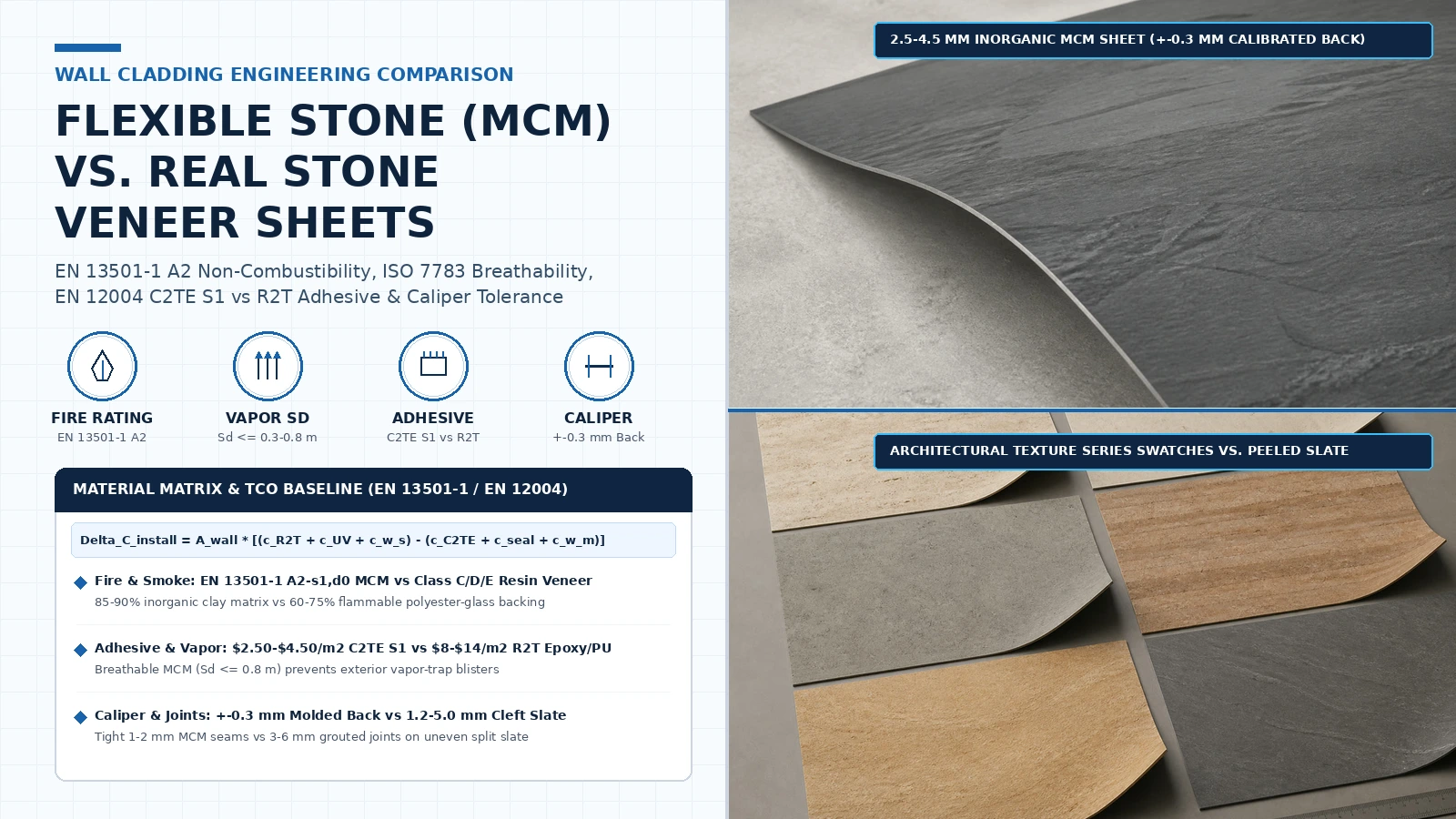
How do MCM flexible mineral stone, fiberglass-polyester stone veneer, cotton/translucent micro-stone, and cast concrete MSV compare across failure modes?
Online listings routinely group four fundamentally different wall claddings under the umbrella phrases "flexible stone", "thin stone veneer", or "manufactured stone veneer". Specifying the wrong category introduces incompatible fire ratings, adhesive chemistries, and structural dead loads:
- MCM Flexible Mineral Stone (
2.5–4.5 mmStandard;2.3–9.5 mmArchitectural Texture Series): An inorganic modified-clay mineral composite (>= 85–90%mineral powder on flat panels,70–90%across deep architectural reliefs) cured at low temperature (< 120°C) on an alkali-resistant fiberglass mesh with a mold-calibrated±0.3 mmback. - Fiberglass-Polyester Peeled Natural Stone Veneer (
1.5–3.0 mmSliced Slate / Mica / Quartzite): Produced by pouring liquid unsaturated polyester (UP) or epoxy resin (60–75%of total sheet weight) and chopped E-glass fibers onto a heated natural slate or schist block and stripping away a0.3–1.0 mmstone layer along its natural geological cleavage plane. - Cotton / Fleece-Backed Micro-Stone (
0.8–1.2 mm) & Translucent Backlit Stone Veneer (1.5–2.0 mm): Ultra-thin0.2–0.4 mmslate/marble skins laminated onto woven cotton fabric (R >= 15–30 mmfor interior cabinetry/joinery) or0.5–1.0 mmsplit quartzite/slate bonded to optical-grade clear polyester resin transmitting15–35%LED light. - Cast Concrete Manufactured Stone Veneer (
MSV,25–45 mmASTM C1670 / C1670MUnits): Rigid molded lightweight Portland cement and pumice/shale aggregate masonry units (35–65 kg/m²dry unit weight;55–90 kg/m²installed overASTM C847expanded metal lath and a15–25 mmcement scratch/mortar bed perASTM C1780).
| Cladding System | Composition, Caliper Tolerance & Installed Mass | Fire Class (EN 13501-1 / ASTM E84) & Vapor Diffusion (S_d) | Mandatory Adhesive (EN 12004) & Minimum Curve Radius (R_min) | Dominant Field Failure Mode & Engineering Prevention |
|---|---|---|---|---|
MCM Flexible Mineral Stone (2.5–4.5 mm Standard; 2.3–9.5 mm Architectural Series) | >= 85–90% inorganic clay/stone powder + 10–15% waterborne elastomer; ±0.3 mm calibrated back; 3.5–5.5 kg/m² sheet (5.5–8.5 kg/m² bonded; up to 10.6 kg/m² on 9.5 mm 3D relief) | EN 13501-1 A2-s1,d0 (PCS <= 3.0 MJ/kg) / ASTM E84 Class A; breathable S_d <= 0.3–0.8 m (ISO 7783 Class I) | EN 12004 C2TE S1 deformable cementitious mortar ($2.50–$4.50/m²); cold wrap R >= 200–250 mm, warm wrap R >= 150 mm (50–70°C) | Adhesive ridge skinning (f_void > 15%), alkaline efflorescence on unprimed render, or raw 3 mm corner edges → Prime wall (0.15–0.25 kg/m²), back-butter C2TE S1 within 20 min (EN 1346), consolidate with 35–50 kg J-roller (>= 80–95% coverage), seal with EN 1504-2 Class I, and bevel 43.5° miters |
Fiberglass-Polyester Peeled Natural Stone Veneer (1.5–3.0 mm Slate/Mica Laminate) | 0.3–1.0 mm split slate/mica face on 1.0–2.0 mm 60–75% polyester/epoxy resin + E-glass back; 1.2–5.0 mm uncalibrated cleft peaks; 1.5–3.0 kg/m² sheet (3.5–5.5 kg/m² bonded) | DIN 4102-1 B2 / EN 13501-1 Class C-s3,d0 / D / E (PCS = 18–25 MJ/kg, dense styrene smoke s2/s3); vapor trap S_d >= 15–40 m | EN 12004 R2T 2-part reactive PU/epoxy or MS-polymer ($8.00–$14.00/m²; cement mortar debonds); bends to R >= 200–300 mm | High-rise fire rejection, cohesive fall-off from C2 cement mortar, exterior UV resin yellowing/blistering, and 1.5–3.5 mm butt-joint lippage → Restrict to non-A2 interior walls, solvent-wipe resin back, bond with R2T PU/epoxy + temporary clamping, space 3–6 mm grouted joints, and apply aliphatic PU UV topcoats |
Cotton / Fleece Micro-Stone (0.8–1.2 mm) & Translucent Stone Veneer (1.5–2.0 mm) | 0.2–0.4 mm stone on woven cotton (0.8–1.3 kg/m²) or 0.5–1.0 mm stone on clear optical polyester resin (1.6–1.8 kg/m², 15–35% light transmittance) | EN 13501-1 Euroclass D/E (ASTM E84 Class B/C); cotton backing absorbs > 6–10% moisture; optical resin S_d >= 20 m | Contact neoprene, dispersion PU, or clear R2T epoxy / optical silicone; cotton bends to R >= 15–30 mm, translucent to R >= 250–400 mm | Hygroscopic cotton rot/edge curling in humid zones, LED diode hot-spotting (cavity < 50 mm), and yellowing of clear polyester resin → Restrict cotton-backed sheets strictly to dry interior joinery/furniture, and engineer diffused LED plenums with cavity-to-pitch ratio D : Pitch >= 1.2 : 1 (D >= 50–80 mm) |
Cast Concrete Manufactured Stone Veneer (MSV, 25–45 mm ASTM C1670 / C1780 Units) | Molded Portland cement + lightweight aggregate (<= 67 mm max average thickness, >= 15 MPa per ASTM C39); 35–65 kg/m² dry unit (55–90 kg/m² installed with lath & mortar bed) | Euroclass A1 non-combustible concrete unit; ASTM C666 Procedure A freeze-thaw <= 1.5% mass loss; ASTM C157 shrinkage <= 0.10% | Mechanically stapled ASTM C847 metal lath + 15–25 mm cement scratch & setting bed (ASTM C482 >= 0.35 MPa shear); 0 mm elastic bend | EIFS dead-load overload (55–90 kg/m² vs <= 15–20 kg/m² cap), trapped moisture freeze-thaw spalling, lath rust failure, and ASTM C1585 efflorescence → Install dual WRB + 6–10 mm ventilated drainage mat (ASTM C1780), cap adhered height at <= 3.6–6.0 m (IBC Section 1404), or switch to 3.5–5.5 kg/m² MCM |
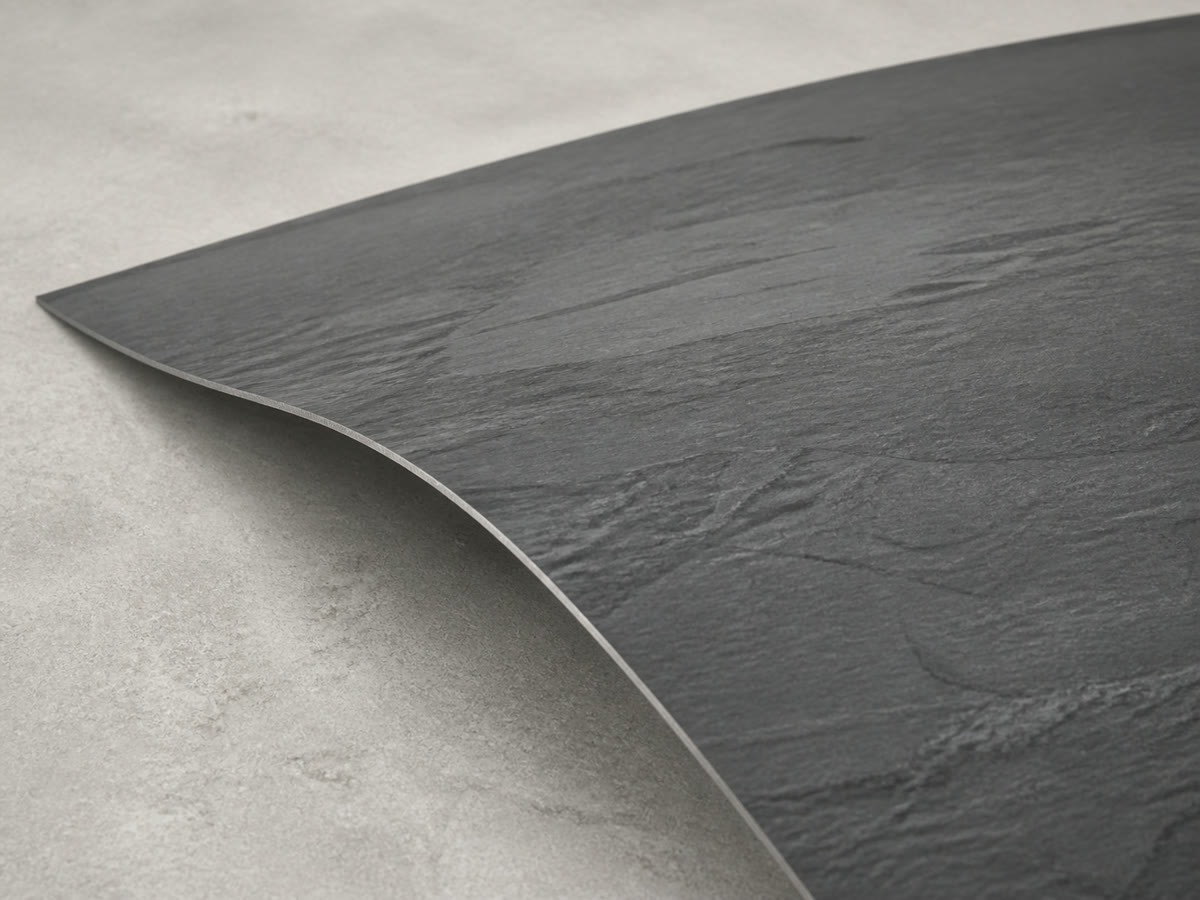
Engineered mineral consistency vs. resin-peeled slate: HeyMaterials Slate-Look MCM (FS-AT-03, 2.3–2.8 mm, 3.5–3.9 kg/m²) combines an >= 85–90% inorganic clay-mineral matrix (EN 13501-1 A2-s1,d0) with a ±0.3 mm mold-calibrated back for tight 1–2 mm seams and direct EN 12004 C2TE S1 mortar bonding.
Rule-of-Thumb 1 (High-Rise & Egress Corridor Fire Code Rejection Threshold): If a wall specification governs a high-rise exterior facade (> 18 m), hotel elevator lobby, hospital corridor, airport concourse, or stairwell egress route requiring EN 13501-1 Euroclass A2-s1,d0 (PCS <= 3.0 MJ/kg per EN ISO 1716 or ASTM E84 Class A) non-combustible cladding, prioritize >= 85–90% inorganic mineral-matrix MCM flexible stone and reject 1.5–3.0 mm fiberglass-polyester peeled stone veneers because their 60–75% organic unsaturated polyester/epoxy resin backing (PCS = 18–25 MJ/kg) ignites under sustained flame, releases dense black styrene smoke (s2/s3), and rates DIN 4102-1 Class B2 or EN 13501-1 Class C-s3,d0 / D / E.
Why do adhesive chemistry (EN 12004 C2TE S1 vs R2T), vapor permeability (ISO 7783), and exterior UV exposure separate MCM from resin-backed stone veneer?
Contractors who price 1.5–3.0 mm fiberglass-backed natural stone veneer using standard tile-mortar assumptions routinely suffer two catastrophic field failures: cohesive sheet detachment from cement mortar on interior and exterior walls, and hydrostatic vapor blistering combined with UV resin yellowing on exterior facades.
1. Adhesive Interface Physics (EN 12004 C2TE S1 Cementitious Mortar vs. R2T Reactive Polyurethane/Epoxy)
- Why Fiberglass-Polyester Stone Veneer Rejects Standard Cement Mortar: The rear face of a
1.5–3.0 mmpeeled stone veneer is not stone—it is a cured, smooth, hydrophobic sheet of unsaturated polyester (UP) or epoxy resin reinforced with E-glass (open porosity < 0.2%). Standard water-hydrated cementitious tile adhesives (EN 12004 C1 / C2) rely on capillary crystal migration into micro-pores to form a mechanical lock. Against slick polyester resin—which also expands and contracts atalpha_resin = 55–80 x 10^-6 /°C(5x–7xthe thermal expansion rate of concrete at10–12 x 10^-6 /°C)—cement mortar dries without interfacial cross-linking and shears clean off the resin backing during seasonal temperature swings. - Mandatory
$8.00–$14.00/m²EN 12004 R2T/MS-PolymerRequirement on Resin Veneer: To bond fiberglass-resin stone veneer safely, installers must solvent-wipe or mechanically sand the polyester back and apply a 2-component reactive polyurethane or epoxy adhesive (EN 12004 R2T, shear adhesion>= 2.0 MPaperEN 12003) or high-modulus silyl-modified polymer (MS-polymer) at1.8–2.8 kg/m². That specialty reactive adhesive costs$8.00–$14.00/m²(3x–4xthe cost of cementitious mortar) and requires temporary bracing or clamping while the resin cures. - Direct
$2.50–$4.50/m²EN 12004 C2TE S1Bonding on MCM: Because HeyMaterials MCM is an inorganic mineral-clay composite with a micro-textured, hydrophilic mineral back, it bonds directly with single-componentEN 12004 C2TE S1deformable polymer-modified cementitious mortar (2.5–3.5 kg/m²at$2.50–$4.50/m²), achievingEN 1348tensile pull-off strength>= 1.0–1.5 MPawith cohesive failure occurring inside the substrate rather than at the bond line. See our adhesives and substrates engineering guide for substrate-by-substrate mortar pairings.
Quantitative Adhesive System, UV Topcoat & Cleft-Waste Cost Differential Formula
Delta_C_install = A_wall * [(c_panel_slate * w_slate + c_R2T + c_UV_coat + c_clamp) - (c_panel_mcm * w_mcm + c_C2TES1 + c_sealer)]
- Worked Arithmetic Example (
500 m²Commercial Wall Scope): Given net wall areaA_wall = 500 m², comparing1.5–3.0 mmfiberglass-polyester peeled slate veneer (c_panel_slate = $32.00/m²with natural foliation/delamination cull wastew_slate = 0.12=$3.84/m²waste; mandatoryEN 12004 R2T2-part polyurethane adhesivec_R2T = $11.00/m²; 2-coat aliphatic UV-blocking polyurethane topcoatc_UV_coat = $5.50/m²; solvent-prep and clamping labor premiumc_clamp = $6.50/m²) against2.5–3.5 mmMCM flexible stone (c_panel_mcm = $22.00/m²with calibrated utility-knife offcut wastew_mcm = 0.05=$1.10/m²waste;EN 12004 C2TE S1mortar + acrylic primerc_C2TES1 = $4.00/m²; breathableEN 1504-2 Class Isilane-siloxane sealerc_sealer = $1.80/m²) →Delta_C_install = 500 * [($3.84 + $11.00 + $5.50 + $6.50) - ($1.10 + $4.00 + $1.80)] = 500 * ($26.84 - $6.90) = 500 * $19.94 = $9,970.00(saving$19.94/m²in auxiliary adhesive, UV coating, clamping, and waste costs alone, plus$10.00/m²in base panel cost for a total savings of$29.94/m²or$14,970across500 m²).
2. Vapor Diffusion Physics (ISO 7783 S_d <= 0.3–0.8 m vs. S_d >= 15–40 m Blister Trap) & Exterior UV Degradation
On exterior facades, parapet walls, and ground-floor masonry subject to capillary moisture or rain drive, cladding breathability under ISO 7783 (Paints and varnishes — Determination of water-vapor transmission properties) determines whether residual wall moisture escapes or blisters the cladding off the substrate:
- Breathable Inorganic MCM (
S_d <= 0.3–0.8 m,ISO 7783Class I): MCM's cross-linked mineral-clay capillary network exhibits an equivalent air-layer thickness of justS_d = 0.3–0.8 m(well below theEN 1062-1 / EN 1504-2 Class Ihigh-breathability threshold ofS_d < 5.0 m). When paired with a breathableEN 12004 C2TE S1mortar andEN 1504-2 Class Ihydrophobic silane-siloxane impregnator, liquid rainwater beads off the exterior face (w <= 0.1 kg/(m²·h^0.5)) while interior substrate water vapor diffuses outward freely. - Vapor-Impermeable Polyester Resin Backing (
S_d >= 15–40 m) & UV Yellowing: A1.0–2.0 mmfiberglass-polyester resin sheet acts as a continuous plastic vapor barrier (S_d >= 15–40 m). When direct sunlight heats a dark slate facade toT_wall = 65–75°C, moisture trapped inside the concrete or render behind that impermeable resin sheet vaporizes and builds15–28 kPa(2.2–4.1 psior1,530–2,855 kgf/m²) of outward saturated vapor pressure at the exact moment the polyester resin softens above its glass-transition onset (T_g = 55–70°C), forcing hollow blisters and freeze-thaw delamination. Simultaneously, solar UV radiation (290–400 nm) cleaves aromatic ester bonds in unsaturated polyester resin that bleeds through micro-fissures in the0.5 mmslate skin, turning the surface chalky yellow-brown within18–36 months.
Vapor Diffusion Flux (ISO 7783) & Exterior Solar Vapor-Trap Blister Pressure Formula
g_vapor = (Delta_p_v * delta_air) / S_d ; Delta_P_blister = P_sat(T_wall) - P_sat(T_ambient)
- Worked Arithmetic Example (Sunlit South/West Concrete Facade at
T_wall = 65°C, Vapor Pressure DriveDelta_p_v = 2,000 Pa): Given water-vapor permeability of stagnant airdelta_air = 0.01728 g/(m·day·Pa):- Breathable MCM Cladding (
S_d_MCM = 0.50 m): Daily outward moisture vapor fluxg_vapor_MCM = (2,000 * 0.01728) / 0.50 = 69.1 g/(m²·day)—venting substrate moisture50xfaster than resin veneer and preventing pressure accumulation (Delta_P_blister ~ 0 kPa). - Fiberglass-Polyester Stone Veneer (
S_d_resin = 25.0 m): Outward vapor flux is throttled tog_vapor_resin = (2,000 * 0.01728) / 25.0 = 1.38 g/(m²·day). As solar radiation heats damp wall pores fromT_ambient = 20°C(P_sat = 2.34 kPa) toT_wall = 65°C(P_sat = 25.02 kPa), trapped water vapor generatesDelta_P_blister = 25.02 - 2.34 = 22.68 kPa(2,313 kgf/m²outward blister uplift) directly behind the softened resin backing.
- Breathable MCM Cladding (
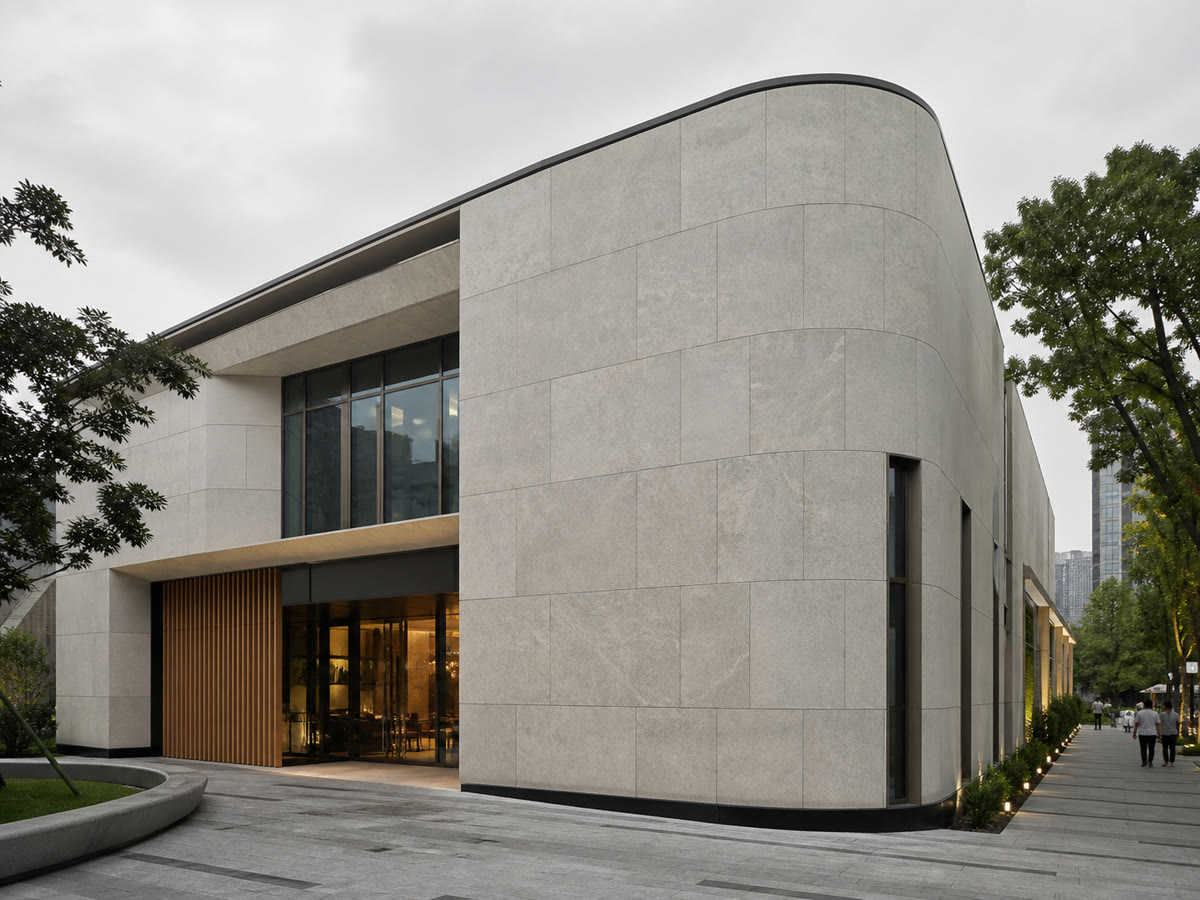
Exterior facade breathability and UV stability: inorganic MCM panels (ISO 7783 S_d <= 0.3–0.8 m, ASTM G154 3,000 h QUV Delta E* <= 1.0–1.5) vent substrate moisture through EN 12004 C2TE S1 mortar, avoiding the 15–28 kPa vapor-trap blisters and polyester UV yellowing seen on resin-backed stone veneers.
Rule-of-Thumb 2 (Adhesive Chemistry & Exterior Vapor/UV Exposure Threshold): If a project installs over concrete, cement render, or EIFS / ETICS substrates with residual moisture > 2.5–3.0% CM or involves exterior solar UV and freeze-thaw exposure, prioritize breathable 2.5–4.5 mm MCM (S_d <= 0.3–0.8 m) bonded with $2.50–$4.50/m² EN 12004 C2TE S1 cementitious mortar; if specifying 1.5–3.0 mm fiberglass-polyester stone veneer on an interior wall, never use standard cement mortar—mandate $8.00–$14.00/m² EN 12004 R2T 2-part polyurethane/epoxy or MS-polymer adhesive on a dry (<= 2.0% CM) primed substrate.
How do thickness caliper tolerance (±0.3 mm vs 1.2–5.0 mm cleft peaks), sheet formats, and Architectural Texture Series weights compare?
1. Caliper Tolerance & Seam Lippage (±0.3 mm Molded MCM Back vs. 1.2–5.0 mm Natural Slate Foliation)
Because real flexible stone veneer is stripped physically from layered sedimentary or metamorphic rock (slate, mica schist, quartzite), the stone splits along natural geological foliation planes. Even on a nominal "1.5–2.0 mm" sheet, a micrometer caliper check around the 1,220 x 610 mm perimeter typically measures 1.2 mm in cleft valleys and 3.5–5.0 mm across raised stone laminations (±1.5–2.5 mm thickness variance). When two sheets are butt-jointed edge-to-edge under grazing ceiling downlights, a 1.3 mm valley meeting a 4.2 mm peak produces a 2.9 mm exposed step lippage revealing the raw dark fiberglass-resin carrier edge. Consequently, natural cleft stone veneers require either 3.0–6.0 mm wide grouted joints (ISO 13007-3 CG2WA or RG epoxy grout piped carefully after pre-sealing the stone face) or labor-intensive diamond edge grinding.
HeyMaterials MCM sheets are cast and roller-calibrated against precision molds that hold rear-surface flatness and edge caliper within ±0.3 mm across standard 2.5–4.5 mm panels. That calibrated back allows installers to execute 1.0–2.0 mm tight butt seams or uniform micro-chamfered joints with consistent adhesive bed depth (4.0–6.0 mm notched trowel) across 600 x 1,200 mm and 1,200 x 2,400 mm (4 x 8 ft-class) sheets.
2. Verified Sheet Size, Thickness, Weight & Failure Prevention Across the Architectural Texture Series (FS-AT-03 to FS-AT-42)
The Architectural Texture Series is HeyMaterials' engineered MCM wall-cladding range comprising 30 published products (FS-AT-03 to FS-AT-42). Because deep 3D fluted, chiseled, and mosaic profiles carry significantly more mineral mass than thin slate-look sheets, dimensions and weights are published per SKU (590 x 1,200 mm to 1,200 x 3,300 mm sheet formats; 2.3 mm to 9.5 mm thickness; 3.5 kg/m² to 10.6 kg/m² panel mass). Selected products are supplied in 4 x 8 ft-class formats (1,200 x 2,400 mm in metric catalog terms).
The table below documents six representative Architectural Texture Series SKUs alongside their calculated panel areal density (kg/m²), complete bonded wall load (kg/m² including EN 12004 C2TE S1 adhesive), minimum bending radius, and dominant field failure mode prevention. See sizes, thickness and weight for complete series tolerances.
| Architectural Texture SKU & Product Link | Sheet Format L x W (mm) & Area (m²) | Calibrated Thickness Range (mm) | Published Sheet Mass (kg) | Panel Planning Mass m_panel (kg/m²) | Bonded Wall Load m_installed (kg/m²) | Curve Radius R_min & Dominant Field Failure Mode / Prevention |
|---|---|---|---|---|---|---|
| FS-AT-03 Slate Stone | 600 x 1,200 (0.72 m²) | 2.3–2.8 mm (±0.3 mm back) | 2.5–2.8 kg | 3.5–3.9 kg/m² | 6.0–6.4 kg/m² (with 2.5 kg/m² C2TE) | R >= 150–200 mm; Trowel ridge telegraphing or hollow spots (f_void > 15%) → Use 6 x 6 mm notch trowel, back-butter panel, and roll with 35–50 kg J-roller |
| FS-AT-06 Rough Rammed Earth | 1,200 x 2,400 (2.88 m², 4x8 ft) | 2.5–3.0 mm (±0.3 mm back) | 12.5–13.0 kg | 4.3–4.5 kg/m² | 6.8–7.3 kg/m² (with 2.5–2.8 kg/m²) | R >= 200–250 mm; Horizontal strata grain mismatch across adjacent 4x8 ft sheets → Follow back directional arrows, dry-lay sequence before mixing C2TE S1, and seal with EN 1504-2 |
| FS-AT-11 Cast Concrete | 1,220 x 2,930 (3.575 m²) | 2.5–3.5 mm (±0.3 mm back) | 17.0 kg | 4.8 kg/m² | 7.3–7.8 kg/m² (with 2.5–3.0 kg/m²) | R >= 250–300 mm; Air pocket entrapment behind 3.57 m² oversized sheet → Apply directional parallel trowel ridges on wall + panel back (>= 90% contact) and work from center outward |
| FS-AT-32 Chiseled Stone | 1,200 x 2,400 (2.88 m², 4x8 ft) | 3.5–5.5 mm (chiseled relief) | 20.0 kg | 6.9 kg/m² | 9.9–10.4 kg/m² (with 3.0–3.5 kg/m²) | R >= 350–500 mm; Grout/adhesive smear trapped in deep chiseled flutes → Pre-seal face with EN 1504-2 release coat before installation and use 8 x 8 mm notch C2TE S1 non-slip mortar |
| FS-AT-36 Oman Linear Stone | 1,200 x 2,400 (2.88 m², 4x8 ft) | 4.5–8.0 mm (deep rib relief) | 23.0 kg | 8.0 kg/m² | 11.0–11.5 kg/m² (with 3.0–3.5 kg/m²) | R >= 400–600 mm (bend parallel to ribs); Cross-rib cracking if bent tight against 8 mm ribs → Orient linear ribs parallel to cylinder axis on tight curves and align rib pitch |
| FS-AT-42 3D Block Mosaic | 1,160 x 2,975 (3.451 m²) | 4.0–9.5 mm (3D block relief) | 36.5 kg | 10.6 kg/m² | 13.8–14.4 kg/m² (with 3.2–3.8 kg/m²) | R >= 600–800 mm; Vertical creep (> 0.5 mm slip) of 36.5 kg sheet during cure → Mandate thixotropic EN 12004 C2TE S1 (T <= 0.5 mm slip) and temporary bottom ledger support bar |
Panel Areal Density & Installed Wall Dead-Load Conversion Formula
m_panel = M_sheet / (L_sheet * W_sheet) ; m_installed = m_panel + m_adhesive
- Worked Arithmetic Example (
FS-AT-06 Rough Rammed Earth1,200 x 2,400 mmSheet vs.ASTM C1670Cast Concrete MSV): Given sheet lengthL_sheet = 2.40 m, widthW_sheet = 1.20 m(sheet areaA_sheet = 2.40 * 1.20 = 2.88 m²), nominal sheet weightM_sheet = 12.8 kg, andEN 12004 C2TE S1adhesive massm_adhesive = 2.50 kg/m²→ Panel planning massm_panel = 12.8 / 2.88 = 4.44 kg/m²(4.3–4.5 kg/m²catalog range) and total bonded wall dead loadm_installed = 4.44 + 2.50 = 6.94 kg/m². Compared against25–45 mmASTM C1670cast concrete Manufactured Stone Veneer (43.0 kg/m²concrete stone units +25.0 kg/m²metal lath and15–25 mmmortar bed =68.0 kg/m²installed),FS-AT-06reduces total wall dead load by61.06 kg/m²(89.8%lighter)—staying well below the<= 15–20 kg/m²adhered limit for wall-load reviews onEIFS / ETICSand drywall partitions.
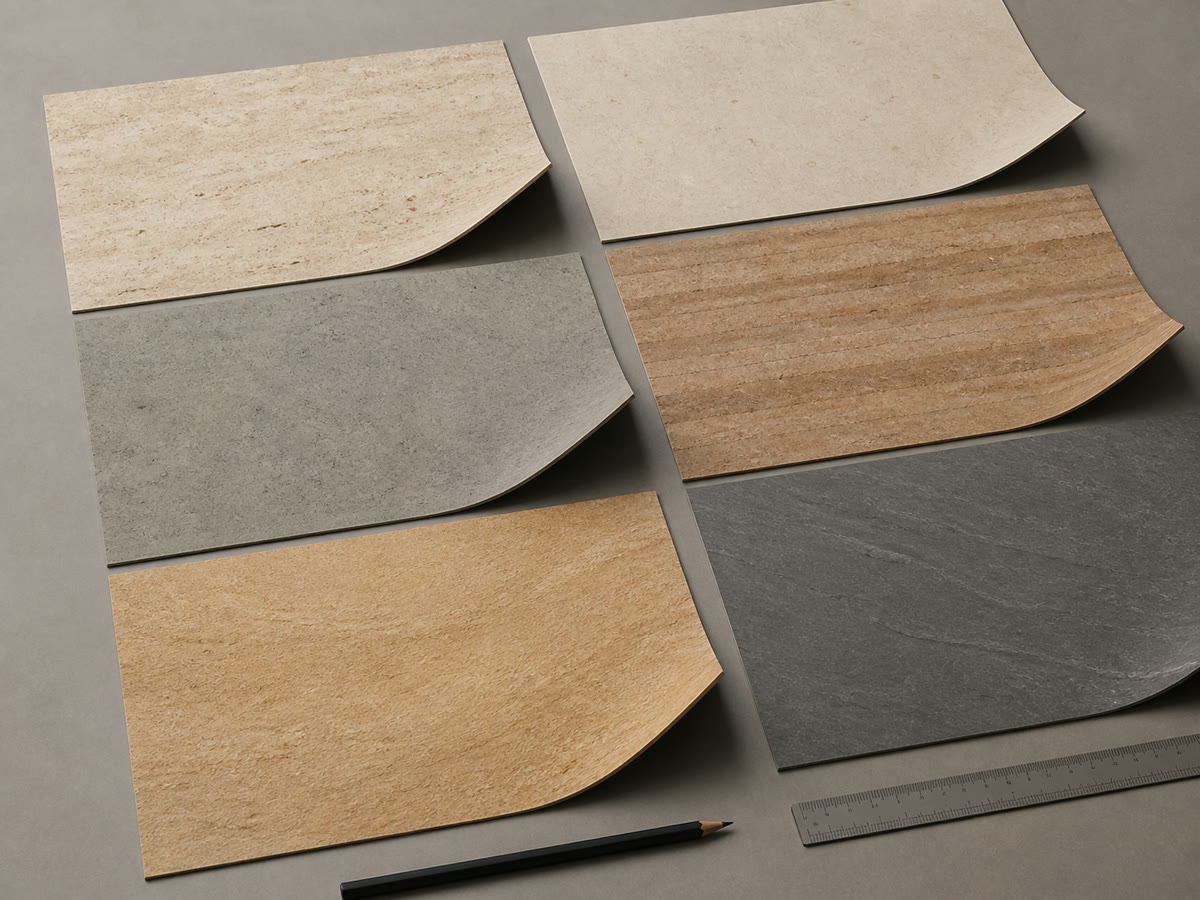
Finish taxonomy and batch control: HeyMaterials groups MCM finishes by visual character—travertine, limestone, concrete, rammed earth, sandstone, and slate—holding ±0.3 mm back calibration and Delta E <= 1.5–2.0 pigment repeatability across physical approval samples.
Rule-of-Thumb 3 (Caliper Tolerance & Tight Butt-Seam vs. Grouted Joint Threshold): If the interior or exterior elevation requires 1.0–2.0 mm tight butt seams or flush mitered corners (43.5°–44.5° back-bevel) under grazing architectural lighting without 1.5–3.5 mm edge step shadows, prioritize ±0.3 mm mold-calibrated MCM panels (FS-AT-03, FS-AT-06, FS-AT-11); if installing 1.5–3.0 mm peeled natural slate/mica veneer (1.2–5.0 mm cleft caliper range), specify 3.0–6.0 mm grouted joints filled with ISO 13007-3 CG2WA or RG epoxy grout.
Rule-of-Thumb 4 (Genuine Quarried Cleavage & Translucent Backlighting vs. Multi-Site Batch Repeatability Threshold): If the design brief mandates a 100% quarried geological stone split face or 15–35% optical light transmittance for an LED-backlit bar front, reception desk, or feature ceiling (3000K–4000K, Ra > 90, optical cavity depth D >= 1.2 * Pitch >= 50–80 mm), specify genuine peeled or translucent stone veneer; if the project is an opaque wall, column, or facade requiring Delta E <= 1.5–2.0 shade consistency across 500–5,000+ m² without 10–15% quarry foliation culling waste, prioritize HeyMaterials MCM across our travertine, limestone, concrete, rammed earth, sandstone, and slate collections.
5-Year Exterior UV-Yellowing Delamination, R2T Epoxy Adhesive Premium & Fire-Code Rejection TCO Ledger
To evaluate complete installed cost rather than ex-factory sheet price alone, the ledger below models a 500 m² commercial hospitality & retail project (350 m² interior lobby/corridor feature walls + 150 m² curved columns and exterior entrance canopy) over a 5-year operating horizon:
Cost & Risk Component (500 m² Net Wall Scope) | MCM Flexible Mineral Stone (2.5–3.5 mm Architectural Series) | Fiberglass-Polyester Natural Stone Veneer (1.5–3.0 mm Peeled Slate) | Cotton / Translucent Micro-Stone Veneer (0.8–2.0 mm Sheet) | Cast Concrete Manufactured Stone Veneer (MSV, 25–45 mm ASTM C1670) |
|---|---|---|---|---|
Cladding panels + offcut / cleft-culling waste (500 m²) | $10,500–$16,800 ($20–$32/m² + 4–6% utility-knife offcut waste; Delta E <= 1.5–2.0 batch match) | $16,200–$25,200 ($29–$45/m² + 10–14% waste from diamond sawing & natural slate delamination culls) | $21,500–$36,000 ($38–$65/m² + 10–12% waste; optical-grade clear resin or cotton carrier) | $18,000–$29,500 ($30–$48/m² + 15–22% waste on flat walls; cannot bend around R = 250 mm columns) |
| Adhesive, primer, lath & joint grouting system | $2,000–$3,100 ($4.00–$6.20/m² for acrylic primer + EN 12004 C2TE S1 mortar + tight-seam grout) | $5,500–$8,000 ($11.00–$16.00/m² for solvent prep + mandatory EN 12004 R2T 2-part PU/epoxy + 3–6 mm RG grout) | $6,000–$9,500 (clear optical epoxy / R2T PU adhesive + diffused LED cavity framing on backlit zones) | $8,500–$14,000 ($17–$28/m² for dual WRB, 6–10 mm drainage mat, ASTM C847 metal lath & 20 mm mortar) |
| Site cutting, curved-column wrapping & clamping labor | $8,500–$13,500 (score-and-snap cutting; direct C2TE S1 wrap on R >= 150–250 mm columns; no clamping) | $11,500–$17,500 (wet diamond/carbide sawing with resin dust extraction + clamping during R2T PU cure) | $12,000–$19,000 (precision joinery bonding; strictly barred from 150 m² exterior canopy zone) | $19,000–$28,500 (lath stapling, scratch-coat cure delay, individual block buttering & faceted column cuts) |
Ocean container freight & drayage ($3,600 / 20GP baseline) | $360–$500 (0.10–0.14 x 20GP; 2,250–3,500 kg packed crate weight) | $320–$420 (0.09–0.12 x 20GP; 1,250–1,600 kg packed weight) | $300–$400 (0.08–0.11 x 20GP; 900–1,100 kg packed weight) | $3,200–$4,500 (0.9–1.25 x 20GP; 22,500–32,500 kg packed concrete stone weight) |
| 5-year UV recoating, vapor-blister & fire-retrofit reserve | $450–$800 (EN 1504-2 Class I breathable sealer refresh at Year 5; A2-s1,d0 fire pass) | $4,500–$9,500 (Year 2 & Year 4 aliphatic PU UV topcoats + exterior vapor-blister & Class B2/C fire retrofit risk) | $5,000–$11,000 (cotton moisture edge-peel repairs in humid zones + Euroclass D/E fire code rejection) | $2,200–$4,800 (ASTM C1585 lime efflorescence acid/poultice cleaning & mortar joint repointing) |
Estimated 5-Year Complete Installed TCO (500 m²) | $21,810–$34,700 ($44–$69/m²) | $38,020–$60,620 ($76–$121/m²) | $44,800–$75,900 ($90–$152/m²; interior dry/backlit only) | $50,900–$81,300 ($102–$163/m²; requires structural backup) |
Note: Cost figures represent Standard Engineering Baselines under Reference Conditions (500 m² commercial interior + curved column/canopy scope, $3,600/20GP ocean freight baseline); project quotations are order-specific based on selected SKU, sheet format, finish mix, and destination port.
When should a project specify real flexible stone veneer or cast concrete MSV instead of MCM?
Specify genuine peeled stone veneer, translucent stone veneer, cotton-backed micro-stone, or ASTM C1670 cast concrete MSV when your project crosses these verified physical boundaries:
- Mandatory quarried natural-stone face or named geological lot: When the client or conservation brief explicitly requires a split layer of quarried slate, mica schist, or quartzite with non-repeating geological strata on every sheet, source
1.5–3.0 mmreal stone veneer from a natural veneer supplier and pair it withEN 12004 R2Treactive adhesive on fire-compliant interior walls. - LED-backlit translucent hospitality bars, reception counters, and luminous feature walls: HeyMaterials MCM is an opaque
>= 85–90%mineral composite (0%light transmission). When the design requires15–35%light transmission for3000K–4000KLED backlighting, specify1.5–2.0 mmoptical-polyester translucent stone veneer over a diffused lighting plenum (D : Pitch >= 1.2 : 1, minimum50–80 mmcavity depth). - Ultra-tight
R = 15–30 mminterior furniture, cabinet doors, and millwork wraps: While2.3–3.5 mmMCM cold-wraps architectural columns down toR >= 200–250 mm(andR >= 150 mmwith50–70°Cwarm thermoforming; see curved walls and columns), wrapping18–25 mmMDF cabinet edges or tight furniture profiles requires0.8–1.2 mmcotton/fleece-backed micro-stone in strictly dry interior environments. - Deep
25–45 mmrusticated dry-stack ledge stone shadow lines on low-rise masonry walls: Where the facade design demands30–45 mmprojecting rubble or ledge-stone shadow relief below3.6–6.0 melevation (and structural dead load permits55–90 kg/m²), specifyASTM C1670cast concrete MSV or quarried ledge stone installed over a6–10 mmventilated drainage mat perASTM C1780. - Floors, stairs, worktops, and firebox interiors: Neither MCM nor fiberglass-polyester stone veneer is a structural floor paver or firebox lining. Never install MCM on pedestrian floors, countertops, submerged pools, or inside open-flame fireboxes. See interior walls, hotel and commercial interiors, retail and restaurant walls, renovation, and the Flexible Stone Technical Center.
Ready to evaluate an Architectural Texture Series MCM sample against a stone veneer schedule? Send your target texture or SKU (FS-AT-03 to FS-AT-42), wall area (m²), substrate stack, curve radii (R mm), and fire rating requirement through our project quote page or order physical verification swatches via request samples. We reply within 24 hours with SKU sheet mass (kg/m²), permitted bend radius (R_min), EN 13501-1 fire test documentation, and an order-specific ex-works plus freight quotation.
Related reading
- Flexible Stone vs Natural Stone — engineering comparison of
2.5–4.5 mmMCM (3.5–5.5 kg/m²) against20–30 mmEN 1469/ASTM C615quarried stone slabs onSS316Ldry-hang sub-framing and20GPcontainer payload. - Flexible Stone vs Ceramic & Porcelain Tile — compare
2–4 mmMCM against9–12 mmISO 13006porcelain tile on EIFS dead load, curved columns, and3.5–5.5 mmtile-over-tile renovation overlays. - MCM vs PU Stone, Porcelain, Natural Stone and WPC — cross-material screening across fire reaction (
EN 13501-1 A2vs polyurethaneClass E), UV stability, and acoustic hollowness. - Flexible Stone Adhesives & Substrates — match
EN 12004 C2TE S1,R2T, andMS-polymeradhesives to concrete, render,EIFS / ETICS, drywall, and existing tile substrates.
FAQ
Is HeyMaterials MCM flexible stone the same product as fiberglass-backed natural stone veneer?
No. Real flexible stone veneer (1.5–3.0 mm) splits a 0.3–1.0 mm layer of quarried slate, mica schist, or quartzite onto a 1.0–2.0 mm backing of 60–75% organic unsaturated polyester (UP) or epoxy resin and fiberglass. HeyMaterials MCM (Modified Clay Material, 2.5–4.5 mm standard / 2.3–9.5 mm across the Architectural Texture Series) is an engineered mineral composite containing >= 85–90% inorganic modified clay, crushed stone powder, and mineral oxide pigments cross-linked with 10–15% waterborne elastomer on an alkali-resistant fiberglass mesh. HeyMaterials supplies engineered MCM cladding and does not sell quarried peeled stone veneer.
Why do fiberglass-polyester stone veneers fail EN 13501-1 A2 high-rise fire codes that MCM passes?
Although the 0.3–1.0 mm surface skin of real stone veneer is mineral slate, 60–75% of the composite sheet mass consists of organic unsaturated polyester or epoxy resin (PCS = 18–25 MJ/kg gross heat of combustion). In EN 13823 (Single Burning Item) and DIN 4102-1 testing, that polyester backing ignites under sustained flame and emits dense black styrene smoke (s2/s3), rating DIN 4102-1 Class B2 ("normally flammable") or EN 13501-1 Class C-s3,d0 / D / E. HeyMaterials' inorganic mineral-matrix MCM (PCS <= 3.0 MJ/kg per EN ISO 1716) achieves EN 13501-1 Euroclass A2-s1,d0 (ASTM E84 Class A), meeting high-rise facade and public egress corridor codes.
Why does fiberglass-backed stone veneer require $8–$14/m² EN 12004 R2T adhesive while MCM bonds with $2.50–$4.50/m² C2TE S1 mortar?
The rear face of a fiberglass-polyester stone veneer is a smooth, non-porous cured polymer film (open porosity < 0.2%) with high thermal expansion (alpha_resin = 55–80 x 10^-6 /°C). Standard water-based cementitious tile mortars (EN 12004 C1/C2) cannot mechanically key into slick polyester resin and shear off during thermal cycling; manufacturers mandate solvent wiping followed by 2-component reactive polyurethane/epoxy (EN 12004 R2T, >= 2.0 MPa shear) or MS-polymer adhesive ($8.00–$14.00/m²). MCM has a micro-porous hydrophilic mineral back that keys directly into standard EN 12004 C2TE S1 deformable cementitious mortar ($2.50–$4.50/m², >= 1.0–1.5 MPa tensile bond per EN 1348).
What causes fiberglass-polyester stone veneer to blister and yellow on exterior walls?
Two mechanisms drive exterior failure in resin-backed stone veneer: (1) Vapor-trap blistering (ISO 7783): Cured polyester/epoxy resin is vapor-impermeable (S_d >= 15–40 m, vapor transmission < 1.5 g/(m²·day)). When sunlight heats a damp exterior concrete or render wall to 65°C, trapped moisture generates 22.7 kPa (2,313 kgf/m²) of outward vapor pressure against thermally softened resin, blistering and delaminating the sheet. Breathable MCM (S_d <= 0.3–0.8 m, > 65 g/(m²·day)) vents moisture continuously. (2) UV photo-oxidation: Solar UV (290–400 nm) degrades unsaturated polyester resin bleeding through thin slate fissures, causing yellow-brown chalking within 2–4 years, whereas MCM uses UV-inert inorganic oxide pigments (ASTM G154 3,000 h QUV Delta E* <= 1.0–1.5).
How does sheet thickness variance affect butt seams on peeled slate veneer versus MCM?
Natural slate cleaves along geological foliation layers, causing a nominal 1.5–2.0 mm peeled stone veneer sheet to fluctuate between 1.2 mm in cleft valleys and 3.5–5.0 mm at foliated peaks (±1.5–2.5 mm variance). Butt-jointing two sheets creates 1.5–3.5 mm step lippage that exposes the dark resin edge unless 3.0–6.0 mm grouted joints (ISO 13007-3 CG2WA / RG) are used. Standard MCM sheets are mold-calibrated on the back to ±0.3 mm, enabling clean 1.0–2.0 mm tight butt seams and 43.5°–44.5° mitered outside corners.
How do I convert Architectural Texture Series sheet weights into kg/m² for wall-load planning?
Divide the published sheet weight (M_sheet in kg) by the sheet area (L_sheet * W_sheet in m²) to obtain panel planning mass (m_panel), then add 2.5–3.8 kg/m² for the EN 12004 C2TE S1 adhesive bed (m_installed = m_panel + m_adhesive). Across the 30-product Architectural Texture Series (FS-AT-03 to FS-AT-42), panel planning mass runs from 3.5–3.9 kg/m² on FS-AT-03 Slate Stone (600 x 1,200 mm, 2.3–2.8 mm) and 4.3–4.5 kg/m² on FS-AT-06 Rough Rammed Earth (1,200 x 2,400 mm 4x8 ft-class, 2.5–3.0 mm) up to 10.6 kg/m² on deep-relief FS-AT-42 3D Block Mosaic (1,160 x 2,975 mm, 4.0–9.5 mm).
Can MCM flexible stone be backlit with LEDs like translucent stone veneer?
No. HeyMaterials MCM is an opaque >= 85–90% inorganic clay-mineral composite (0% optical light transmission). When a hospitality bar front, reception desk, or feature ceiling requires 15–35% light transmittance from 3000K–4000K LED arrays, specify 1.5–2.0 mm translucent natural stone veneer (split quartzite/slate on clear optical polyester resin) installed over a diffused lighting cavity (D : Pitch >= 1.2 : 1, minimum 50–80 mm depth).
Can MCM or flexible stone veneer be installed over existing ceramic tile?
Yes, provided the existing tile assembly passes a pre-overlay structural survey: < 5% hollow-sounding area by acoustic tap test, >= 0.5–1.0 MPa tensile pull-off strength (ASTM D4541), mechanical diamond-cup grinding or quartz-grit priming (0.15–0.25 kg/m²) of the glaze, and a full-coverage EN 12004 C2TE S1 (for MCM) or R2T / MS-polymer (for resin stone veneer) bonding bed. Hollow or delaminating tiles must be stripped first, and a cured 72-hour site mock-up must be approved before full wall production. See installing over existing surfaces and flexible stone over tile cost scope.
What to send us
Scroll the table horizontally to see all columns.
| Item | Why we need it | Example format |
|---|---|---|
| Genuine stone cleavage vs MCM requirement, target SKU & sheet format (L x W x t_panel mm) | Confirm whether peeled slate/translucent backlighting is mandatory or match Architectural Texture MCM (FS-AT-03 to FS-AT-42) | Yes/no on real stone face or LED backlighting + target SKU (e.g., FS-AT-06 1200x2400 mm) and reference photo |
| Fire code classification (EN 13501-1 A2-s1,d0 vs Class C/D/E) & authority submittal list | Screen out flammable 60–75% polyester-resin stone veneers in high-rise facades, hotel lobbies, and egress corridors | Required fire rating (EN 13501-1 A2-s1,d0 or ASTM E84 Class A), building height (m), and occupancy zone |
| Receiving substrate stack, moisture state (% CM) & EN 12004 adhesive class (C2TE S1 vs R2T) | Match porous mineral MCM back to $2.50–$4.50/m2 C2TE S1 mortar and prevent S_d >= 15–40 m resin vapor blisters | Substrate layers (concrete, render, EIFS, drywall, old tile), moisture reading (% CM), and interior/exterior exposure |
| Curved wall / column radii (R mm), joint width target (1–2 mm butt vs 3–6 mm grouted) & corner detail | Leverage ±0.3 mm calibrated MCM back for tight seams vs 1.2–5.0 mm cleft slate lippage and verify R_min bend radius | Plan drawing with column radii (mm), target seam width (mm), and 43.5° miter / thermoformed wrap / metal trim selection |
| Net wall area (m2), finish mix, sample box address & destination port | Calculate gross sheet count, panel planning mass (kg/m2), crate count, and 20GP / courier freight | Area schedule per SKU (m2), courier address for physical sample approval, and delivery city or port |
We reply within 24 hours.
Send your project detailsWhat to send us
Scroll the table horizontally to see all columns.
| Item | Why we need it | Example format |
|---|---|---|
| Genuine stone cleavage vs MCM requirement, target SKU & sheet format (L x W x t_panel mm) | Confirm whether peeled slate/translucent backlighting is mandatory or match Architectural Texture MCM (FS-AT-03 to FS-AT-42) | Yes/no on real stone face or LED backlighting + target SKU (e.g., FS-AT-06 1200x2400 mm) and reference photo |
| Fire code classification (EN 13501-1 A2-s1,d0 vs Class C/D/E) & authority submittal list | Screen out flammable 60–75% polyester-resin stone veneers in high-rise facades, hotel lobbies, and egress corridors | Required fire rating (EN 13501-1 A2-s1,d0 or ASTM E84 Class A), building height (m), and occupancy zone |
| Receiving substrate stack, moisture state (% CM) & EN 12004 adhesive class (C2TE S1 vs R2T) | Match porous mineral MCM back to $2.50–$4.50/m2 C2TE S1 mortar and prevent S_d >= 15–40 m resin vapor blisters | Substrate layers (concrete, render, EIFS, drywall, old tile), moisture reading (% CM), and interior/exterior exposure |
| Curved wall / column radii (R mm), joint width target (1–2 mm butt vs 3–6 mm grouted) & corner detail | Leverage ±0.3 mm calibrated MCM back for tight seams vs 1.2–5.0 mm cleft slate lippage and verify R_min bend radius | Plan drawing with column radii (mm), target seam width (mm), and 43.5° miter / thermoformed wrap / metal trim selection |
| Net wall area (m2), finish mix, sample box address & destination port | Calculate gross sheet count, panel planning mass (kg/m2), crate count, and 20GP / courier freight | Area schedule per SKU (m2), courier address for physical sample approval, and delivery city or port |
We reply within 24 hours.
Send your project details