Flexible Stone (MCM) vs Natural Stone Cladding: Engineering & Cost Comparison
Updated
Treating Modified Clay Material (MCM) flexible stone and quarried natural stone as interchangeable line items on a wall schedule leads to structural dead-load rejections on EIFS facades, $35–$65/m² unbudgeted stainless-steel dry-hang sub-framing, high-rise fire code failures from resin-backed stone veneers, and polygonal kerf-cutting waste on curved columns. Specify 2.5–4.5 mm Architectural Texture Series or Natural Stone Texture Series MCM panels when the wall requires ultra-light adhered dead load (3.5–5.5 kg/m²), EN 13501-1 A2-s1,d0 non-combustibility, continuous curved wrapping down to R >= 150–250 mm, or 5,000 m²/20GP export container efficiency; specify 20–30 mm quarried dimensional stone (EN 1469, ASTM C615 granite, ASTM C568 limestone, or ASTM C503 marble) when the architecture demands exposed solid-stone slab edges, carved load-bearing masonry, or natural geological block variation.
Under Standard Engineering Baselines (EN 1469, ASTM C615 / C568 / C503, EN 13501-1, and EN 12004), 2.5–4.5 mm MCM flexible stone sheets reduce cladding panel mass by 92–94%—dropping from 55–85 kg/m² for 20–30 mm quarried stone slabs (67–103 kg/m² including SS304/SS316L dry-hang rails) down to 3.5–5.5 kg/m² (5.5–8.5 kg/m² bonded with EN 12004 C2TE S1 adhesive). That dead-load reduction keeps exterior insulated facades (EIFS / ETICS) below the <= 15–20 kg/m² adhered shear threshold without $35–$65/m² mechanical dry-hang anchors above 3.6–6.0 m, preserves EN 13501-1 A2-s1,d0 fire compliance where 1.5–3.0 mm fiberglass-polyester stone veneers drop to Class B/C (D/E), wraps curved columns down to R >= 150–250 mm, and increases 20GP container capacity 12.5x–15x (5,000 m² vs 320–400 m²).
Comparison framework at a glance
| Engineering Parameter | MCM Flexible Mineral Stone (2.5–4.5 mm Sheet) | Quarried Dimensional Natural Stone (20–30 mm EN 1469 Slab) | Why It Governs Wall Selection & Failure Prevention |
|---|---|---|---|
| Material identity & binder matrix | 70–85% crushed inorganic mineral powder (clay, quartz, stone dust) cross-linked with 15–30% waterborne elastomer on fiberglass mesh (composition guide) | 100% quarried geological rock (ASTM C615 granite 2,650–2,750 kg/m³, ASTM C568 limestone 2,200–2,500 kg/m³, ASTM C503 marble 2,600–2,700 kg/m³) | Determines elastic sheet bending vs. brittle crystalline fracture (ASTM C880 flexural strength 7.0–12.0 MPa) |
| Nominal thickness & installed mass | 2.5–4.5 mm panel (3.5–5.5 kg/m² sheet; 5.5–8.5 kg/m² bonded with EN 12004 C2TE S1) (sizes & weight) | 20–30 mm slab (55–85 kg/m² stone alone; 67–103 kg/m² with 12–18 kg/m² SS304/316L dry-hang rails or thick mortar) | 92–94% lighter panel stays within <= 15–20 kg/m² EIFS/ETICS adhered dead-load cap |
High-rise fixing above 3.6–6.0 m | Direct full-surface chemical bond (EN 12004 C2TE S1, EN 1348 >= 1.0 MPa tensile, ASTM C482 >= 0.35–0.50 MPa shear); $0 mechanical sub-frame | Mandatory SS304 / SS316L (ASTM A666) channels, brackets & EN 13364 kerf/undercut pins ($35–$65/m² hardware + 80–150 mm cavity loss) | Eliminates structural curtain-wall bracket penetrations and seismic rigid-slab fall hazards (wall load review) |
| Fire reaction & smoke toxicity | Euroclass EN 13501-1 A2-s1,d0 / ASTM E84 Class A (PCS <= 3.0 MJ/kg per EN ISO 1716, minimal smoke s1, zero droplets d0) | Euroclass A1 non-combustible monolithic mineral slab (note: 1.5–3.0 mm fiberglass-polyester stone veneers drop to Class B/C or D/E) | Both meet high-rise facade & egress corridor fire codes; rejects flammable polyester-resin veneers (fire performance) |
Curved column & arch radius (R_min) | Continuous cold wrap R >= 200–250 mm; 50–70°C warm thermoformed wrap down to R >= 150 mm (4–6% offcut waste) | 0 mm elastic bend; requires solid-block CNC carving (25–40% stone waste) or segmented 50–100 mm faceted strips on R <= 1,500 mm | Eliminates polygonal chord joints and CNC radial stone fabrication lead times on curved walls |
| Batch color control & edge expression | Controlled mineral pigment dosing (Delta E <= 1.5–2.0 across 5,000+ m² lots); 2.5–4.5 mm edge requires mitered/trimmed corners (corners & edges) | Authentic geological vein/fossil variation (subject to quarry bench drift); supports exposed 20–30 mm bullnose, chamfered, and quirk-mitered slab edges | Choose stone when thick exposed slab edges or unique geological veining govern; choose MCM for multi-site shade consistency |
| 20GP ocean container capacity | 4,500–6,000 m² per 20GP (5,000 m² baseline at 4.5 kg/m² packed in fumigated crates; $0.72/m² at $3,600/20GP) | 320–400 m² per 20GP (360 m² baseline at 62.5 kg/m² packed on timber A-frames; hits 22,500 kg road limit at < 35% volume; $10.00/m²) | Cuts international ocean freight and port drayage cost per square meter by 92.8% (13.9x capacity) (packaging & shipping) |
| Dominant failure mode & prevention | Adhesive ridge skinning (f_void > 15%) or raw 3 mm edge exposure at un-mitered corners → Prime wall, back-butter C2TE S1, roll with 35–50 kg J-roller (>= 80–95% coverage), bevel 43.5° miters | Kerf-slot anchor breakout (EN 13364) under wind suction (ASTM E330), backup frame overload, or iron oxidation staining → Engineer L/600–L/720 backup, use SS316L undercut anchors, seal 6 faces (ASTM C1248) | Aligns structural backup stiffness, anchor metallurgy, and corner detailing with material physics (troubleshooting) |
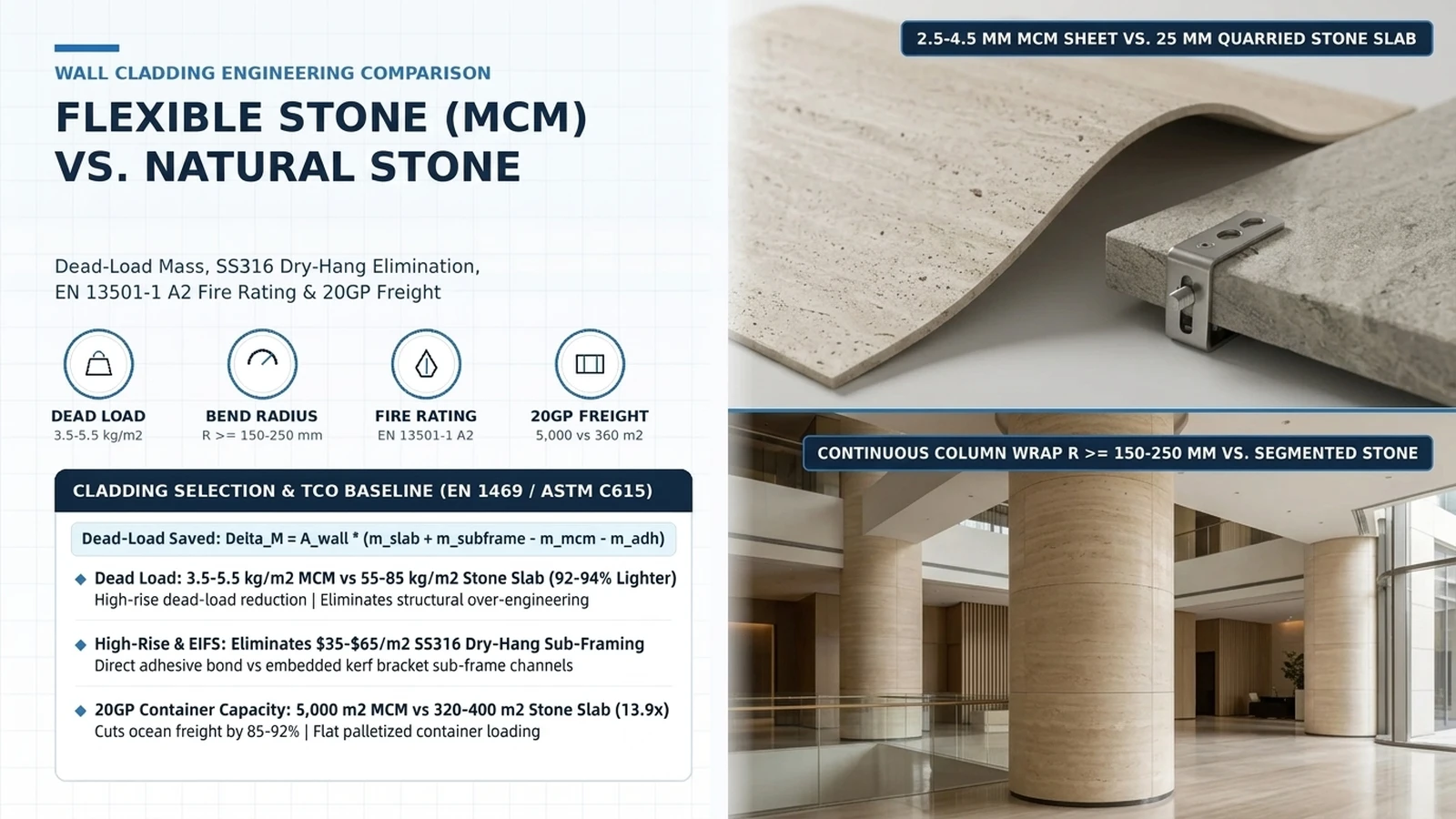
How do MCM flexible stone, 20–30 mm dimensional stone, fiberglass-resin stone veneer, and wet-mortared ledge stone compare across failure modes?
Project specifications frequently conflate four distinct stone-look wall cladding technologies under generic terms like "flexible stone", "thin stone veneer", or "stone wall panels". On this website, MCM denotes an engineered Modified Clay Material (70–85% inorganic clay/stone powder cross-linked with 15–30% waterborne elastomer)—never a metal composite (ACM) and never a resin-peeled slate laminate. Meanwhile, products marketed elsewhere as flexible stone veneer consist of a 0.5–1.0 mm split layer of real slate or schist bonded to a 1.0–2.0 mm fiberglass and unsaturated polyester (UP) or epoxy resin backing. Reviewing the composition and manufacturing process alongside the four-system failure matrix below prevents mismatched structural, fire, and adhesive submittals.
| Cladding System | Nominal Thickness & Installed Mass | Fixing Method & Minimum Curve Radius | Fire & Structural Standard Baseline | Dominant Field Failure Mode & Engineering Prevention |
|---|---|---|---|---|
MCM Flexible Mineral Stone (2.5–4.5 mm Architectural & Stone Series) | 2.5–4.5 mm sheet (3.5–5.5 kg/m² panel; 5.5–8.5 kg/m² bonded assembly) | Direct EN 12004 C2TE S1 adhesive bond ($0 sub-frame); cold wrap R >= 200–250 mm, warm wrap R >= 150 mm (50–70°C) | EN 13501-1 A2-s1,d0 (PCS <= 3.0 MJ/kg); ASTM E84 Class A; EN 1348 >= 1.0 MPa tensile; ASTM C482 >= 0.35–0.50 MPa shear | Adhesive ridge skinning (f_void > 15%), alkaline efflorescence, or un-planned 3 mm corner edges → Embed within EN 1346 open time (<= 20–30 min), press with 35–50 kg J-roller (ANSI A108.5 >= 80% interior / >= 95% exterior), seal with EN 1504-2 Class I silane-siloxane, and detail 43.5°–44.5° miters or trims |
Dimensional Natural Stone Slab (20–30 mm EN 1469 / ASTM C615 Granite / C568 / C503) | 20–30 mm quarried slab (55–85 kg/m² stone + 12–18 kg/m² SS304/316L rails = 67–103 kg/m² total) | Mechanical dry-hang SS304/SS316L brackets & EN 13364 kerf/undercut pins above 3.6–6.0 m; 0 mm bend (requires CNC solid-block carving) | Euroclass A1; EN 1469 slab tolerances; ASTM C880 flexural (>= 7.0–8.27 MPa); ASTM C1354 anchor pull-out; L/600–L/720 stiffness | Kerf-slot edge spalling under ASTM E330 wind suction, EIFS dead-load overload, iron rust bleeding, and quarry vein drift → Design structural concrete/steel backup, replace kerf pins with SS316L undercut anchors in seismic/high-wind zones, 6-side dip-seal (ASTM C1248), and dry-lay 100% of quarry blocks pre-shipment |
Fiberglass-Polyester Resin Natural Stone Veneer (1.5–3.0 mm Sliced Stone Laminate) | 1.5–3.0 mm (0.5–1.0 mm real slate/mica peel on 1.0–2.0 mm fiberglass-polyester backing); 1.5–3.0 kg/m² | Reactive EN 12004 R2T polyurethane or MS-polymer adhesive (standard cement mortar debonds from slick polyester resin); bends to R >= 200–300 mm | 35–50% organic polyester/epoxy resin binder rates Class B/C (DIN 4102-1 B2 / Euroclass D/E) with high styrene smoke (s2/s3) | High-rise fire inspection rejection, UV resin yellowing/chalking on exterior facades, and cohesive delamination from cement mortar → Restrict standard polyester-backed laminates to low-risk interior feature walls, demand verified EN 13501-1 certificates for the exact resin lot, and bond exclusively with R2T or MS-polymer |
Wet-Mortared Natural Ledge Stone / Split-Face Veneer (25–45 mm on Metal Lath) | 25–45 mm hand-split stone (60–110 kg/m² installed including 15–25 mm cement scratch coat & galvanized lath) | Expanded metal lath (ASTM C847) mechanically stapled/bolted over weather barrier + thick mortar bed; 0 mm bend (faceted dry-stack joints) | Euroclass A1; restricted by IBC Section 1404 & TMS 402 adhered height limits (<= 3.6–6.0 m without steel shelf angles) | Cohesive mortar-bed shear failure, trapped cavity moisture freeze-thaw spalling, and heavy white lime efflorescence (ASTM C1585) → Install dual weather-resistive barriers with a 6–10 mm ventilated drainage mat, cap height at <= 3.6–6.0 m, and substitute polymer-modified C2TE S1 low-efflorescence mortar |
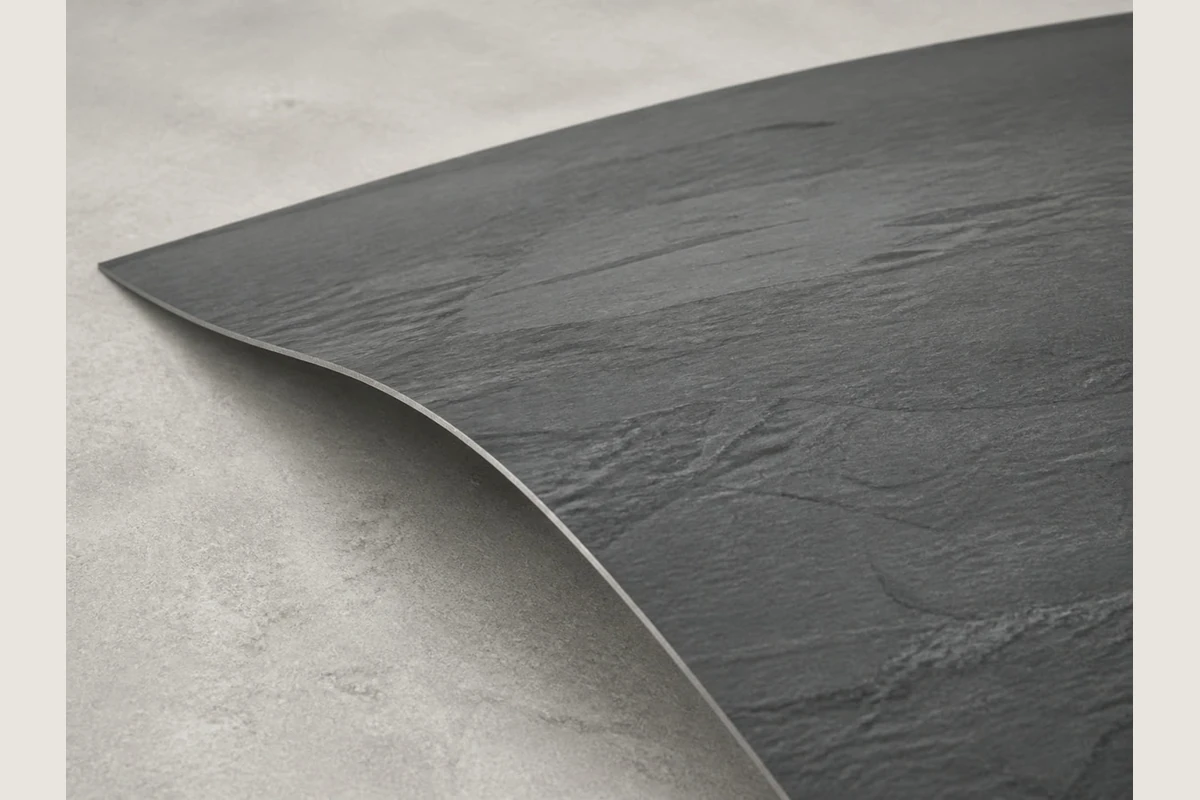
Cross-sectional mass and edge comparison: a 2.5–4.5 mm MCM flexible stone sheet weighs 3.5–5.5 kg/m² and flexes across curved substrates, whereas 20–30 mm EN 1469 natural stone slabs weigh 55–85 kg/m² and require mechanical dry-hang kerf or undercut anchors above 3.6–6.0 m elevation.
Rule-of-Thumb 1 (High-Rise Dry-Hang Elimination & EIFS Dead-Load Threshold): If an exterior facade elevation exceeds 3.6–6.0 m (12–20 ft) height or mounts over Exterior Insulation and Finish Systems (EIFS / ETICS), mineral-wool continuous insulation, or light-gauge steel studs with a maximum adhered dead-load rating of <= 15–20 kg/m², prioritize 2.5–4.5 mm MCM flexible stone (5.5–8.5 kg/m² total bonded mass) because 20–30 mm dimensional stone (67–103 kg/m² with rails) is 92–94% heavier per panel and forces $35–$65/m² in penetrating SS304/SS316L mechanical dry-hang sub-framing.
How do facade dead load, high-rise dry-hang sub-framing, and EIFS shear limits compare quantitatively?
Under EN 1469 (Natural stone products — Slabs for cladding) and North American IBC Section 1404 / TMS 402 masonry veneer codes, quarried 20–30 mm granite (ASTM C615, density 2,650–2,750 kg/m³), limestone (ASTM C568, 2,200–2,500 kg/m³), and marble (ASTM C503, 2,600–2,700 kg/m³) slabs cannot be relied upon to hold overhead via mortar adhesion alone on high-rise elevations. Thermal cyclic shear, freeze-thaw moisture expansion (EN 12371), and wind suction (ASTM E330) degrade rigid slab-to-mortar interfaces, creating a lethal falling-slab hazard during seismic drift. Consequently, building codes mandate secondary mechanical dry-hang systems—comprising extruded aluminum or SS304 / SS316L stainless-steel vertical C-channels, L-brackets, expansion anchors, and edge kerf slots (EN 13364) or back-conical undercut anchors (ASTM C1354)—for dimensional stone above 3.6–6.0 m.
That mechanical dry-hang sub-frame adds 12–18 kg/m² of parasitic steel weight, consumes 80–150 mm (3.1–6.0 in.) of building perimeter or interior floor footprint, punctures exterior thermal insulation with cold-bridging steel brackets, and adds $35–$65/m² in stainless hardware plus $30–$50/m² in specialized rigging and slot-cutting labor.
By contrast, 2.5–4.5 mm MCM flexible stone (3.5–5.5 kg/m²) is reinforced with an internal alkali-resistant fiberglass mesh and elastomeric binder that prevents brittle shattering. Full-coverage chemical bonding (ANSI A108.5 >= 95% exterior contact) using EN 12004 C2TE S1 deformable polymer-modified mortar achieves EN 1348 tensile bond strength >= 1.0 MPa (145 psi) and ASTM C482 shear bond >= 0.35–0.50 MPa (50+ psi)—delivering a static gravity shear safety factor exceeding SF > 1,000 directly over structural concrete, cement render, or reinforced EIFS / ETICS base coats without sub-framing. For project structural calculations, see our wall-load review guide, exterior walls application guide, and water and weather resistance documentation.
Quantitative Facade Dead-Load & Dry-Hang Subframe Cost Savings Formula
Delta_M_facade = A_wall * (m_slab + m_subframe - m_mcm - m_adh) ; Delta_C_subframe = A_wall * (c_ss316 + c_rigging - c_c2te)
- Worked Arithmetic Example (
1,000 m²Commercial High-Rise Facade Above6.0 mElevation): Given net facade areaA_wall = 1,000 m², comparing a25 mmASTM C615granite slab (m_slab = 68.0 kg/m²) mounted on anSS316Lmechanical dry-hang rail sub-frame (m_subframe = 14.0 kg/m², total stone assembly82.0 kg/m²) against a3.0 mmMCM flexible stone panel (m_mcm = 4.5 kg/m²) bonded withEN 12004 C2TE S1adhesive (m_adh = 2.5 kg/m², total MCM assembly7.0 kg/m²) →Delta_M_facade = 1,000 * (68.0 + 14.0 - 4.5 - 2.5) = 1,000 * 75.0 = 75,000 kg(eliminating75.0 metric tonsor91.5%of total suspended facade dead load, and93.4%of panel weight). In direct fixing hardware and installation structure, replacing$48.00/m²ofSS316Lbrackets/pins (c_ss316) and$34.00/m²of crane/scaffold kerf-pin rigging labor (c_rigging) with$6.50/m²of acrylic primer andC2TE S1mortar (c_c2te) yieldsDelta_C_subframe = 1,000 * (48.00 + 34.00 - 6.50) = $75,500(saving$75.50/m²in sub-frame hardware and rigging before counting stone slab or freight costs).
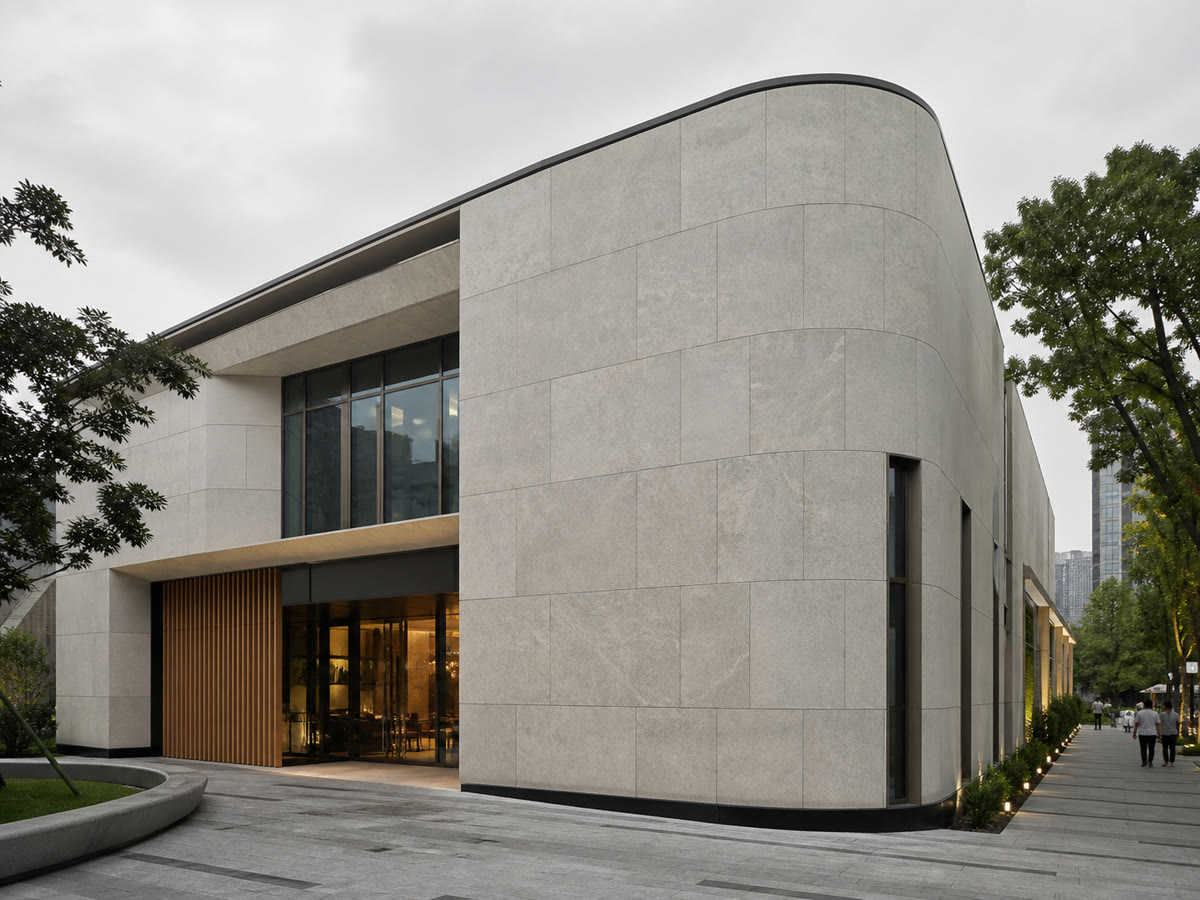
High-rise and insulated facade compliance: 2.5–4.5 mm MCM panels (5.5–8.5 kg/m² bonded assembly) adhere directly to primed concrete and EIFS base coats (<= 15–20 kg/m² limit), eliminating $35–$65/m² in SS304/316L dry-hang sub-framing and 80–150 mm of wall cavity projection.
Why does EN 13501-1 A2-s1,d0 fire performance separate MCM from fiberglass-polyester resin stone veneers?
When buyers search for "flexible natural stone sheets", they frequently encounter 1.5–3.0 mm sliced stone laminates (often sold as real stone veneer on a fiberglass backing). While the top 0.5–1.0 mm skin of those laminates is genuine split slate, mica schist, or sandstone, the structural carrier holding that stone peel together is 1.0–2.0 mm of chopped-strand fiberglass saturated with 35–50% organic unsaturated polyester (UP) or epoxy resin.
Under European EN 13501-1 (EN ISO 1716 gross heat of combustion and EN 13823 Single Burning Item) and North American NFPA 285 / ASTM E84 fire safety codes for high-rise exterior walls, hotel corridors, airport terminals, and public egress routes:
- Inorganic Mineral MCM (
EN 13501-1 Euroclass A2-s1,d0/ASTM E84 Class A): Because HeyMaterials MCM contains70–85%non-combustible inorganic mineral aggregate (quarried clay, quartz sand, mineral oxides) bound with a low-calorific waterborne elastomer (PCS <= 3.0 MJ/kg), A2-certified MCM series passEN 13501-1 Class A2-s1,d0—producing negligible heat release (FIGRA <= 120 W/s), minimal smoke opacity (s1), and zero flaming droplets (d0). - Fiberglass-Polyester Resin Stone Veneer (
Class B/CorEuroclass D/ECombustible Binder): Organic polyester and epoxy resins carry a high gross calorific value (PCS = 18–25 MJ/kg). Under fire exposure, standard polyester-backed stone veneers ignite, delaminate from the wall, and release dense black styrene smoke (s2/s3), typically ratingDIN 4102-1 B2orEN 13501-1 Euroclass D/E(orClass B/Cunless heavily brominated/phosphorus flame-retarded). In addition, solar UV radiation (290–400 nm) photo-oxidizes unsaturated polyester resin on exterior walls, causing yellowing, micro-crazing, and delamination of the thin slate peel within2–4 years.
Rule-of-Thumb 2 (High-Rise Fire Code & Exterior UV Stability Threshold): If a building specification mandates EN 13501-1 Euroclass A2-s1,d0 (or ASTM E84 Class A) non-combustible cladding—such as high-rise exterior facades above 18 m, hotel elevator lobbies, hospital corridors, or stairwell egress routes—or involves direct exterior solar UV exposure, prioritize 70–85% inorganic mineral-matrix MCM flexible stone over 1.5–3.0 mm fiberglass-polyester resin stone veneers (35–50% combustible organic resin binder). See our fire performance technical page and flexible stone vs stone veneer comparison for submittal verification checklists.
How do curved columns, quarry batch drift, and edge detailing govern architectural selection?
Even when structural dead load and fire codes are satisfied on interior walls, three geometric and visual parameters separate 2.5–4.5 mm MCM from 20–30 mm quarried natural stone:
1. Curved Columns & Arch Radii (R >= 150–250 mm Continuous Wrap vs. Solid-Block CNC or Segmented Faceting)
Quarried 20–30 mm stone slabs are brittle crystalline solids (0 mm elastic bend). Cladding a cylindrical column, curved reception desk, or arched soffit with radius R <= 1,500 mm in natural stone forces one of two high-cost routes:
- CNC Solid-Block Radial Carving: Sawing curved arc segments (
30–50 mmthick shells) out of solid quarry blocks on a 5-axis CNC wire/bridge saw, which wastes25–40%of the raw stone block as kerf slurry, requires6–12 weeksof factory lead time, and costs$180–$350/m²for the curved stone shells alone. - Segmented Polygonal Kerf Cutting: Wet-sawing flat
20 mmslabs into narrow50–100 mmvertical staves around the column perimeter, creating visible polygonal facet lines, wide mortar chords, and15–22%cutting waste.
By contrast, 2.5–4.5 mm MCM flexible stone sheets (600 x 1,200 mm or 1,200 x 2,400 mm) wrap continuously around convex and concave radii down to R >= 200–250 mm at ambient site temperatures (15–35°C), and down to R >= 150 mm when gently pre-warmed to 50–70°C with a hot-air gun during installation (see our curved walls and columns guide and cutting and drilling guide).
Curved Column Fabrication & Material Waste Savings Formula
Delta_C_curve = A_curve * ((c_stone_cnc * (1 + w_stone) + c_install_stone) - (c_mcm * (1 + w_mcm) + c_install_mcm))
- Worked Arithmetic Example (
150 m²Curved Hotel Lobby Columns atR = 300 mm): Given curved column surface areaA_curve = 150 m², comparing CNC-profiled25 mmnatural travertine arc slabs (c_stone_cnc = $165.00/m², block/cutting wastew_stone = 0.30, mechanical pin-anchoring laborc_install_stone = $75.00/m²) against2.5 mmTravertine MCM sheets (c_mcm = $26.00/m², utility-knife offcut wastew_mcm = 0.05, directC2TE S1/R2Twrapping laborc_install_mcm = $24.00/m²) →Delta_C_curve = 150 * ((165.00 * 1.30 + 75.00) - (26.00 * 1.05 + 24.00)) = 150 * ($289.50 - $51.30) = $35,730.00(saving$238.20/m²or82.3%on curved column cladding while eliminating polygonal chord joints).
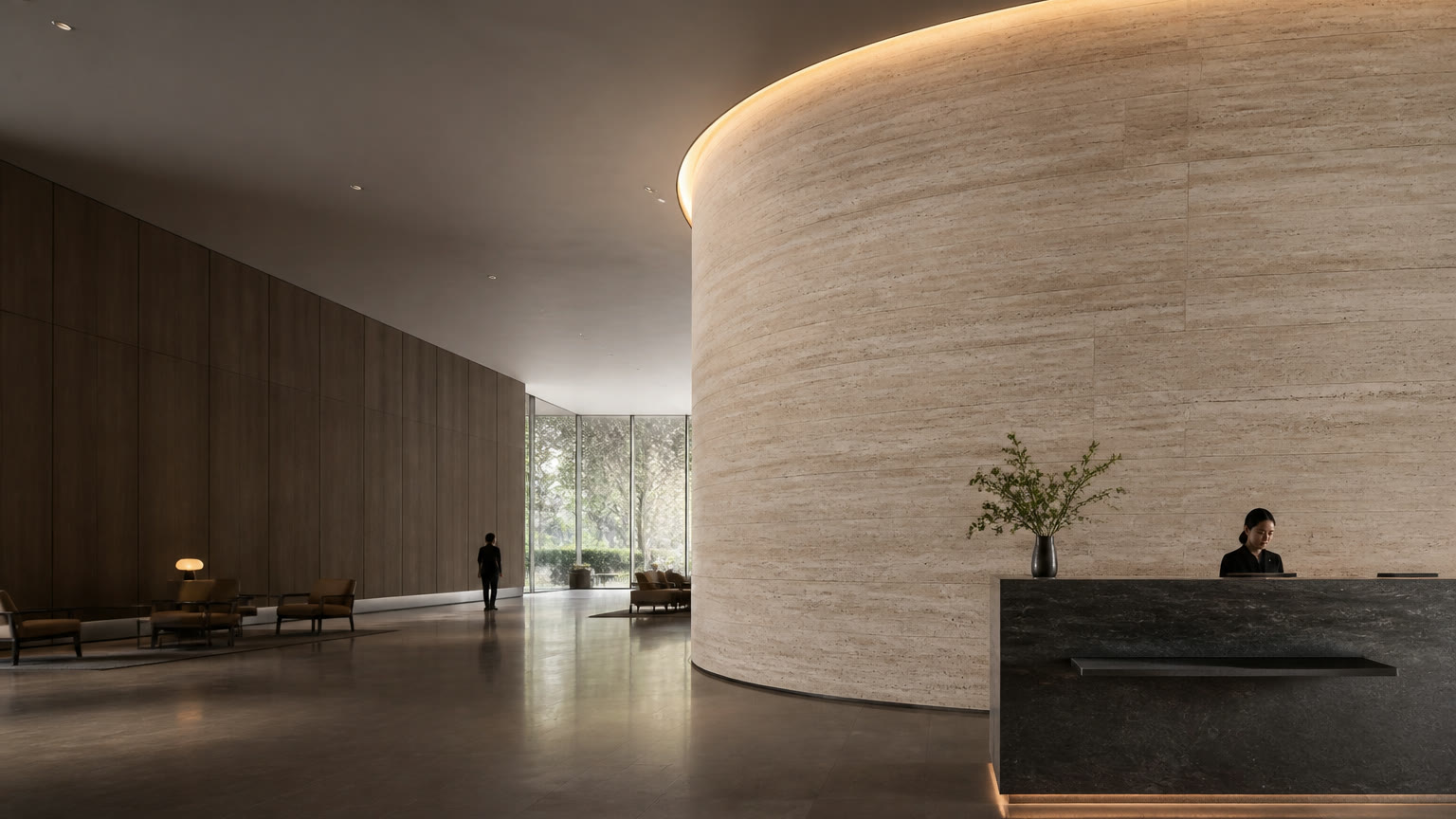
Curved wall and column continuity: 2.5–3.5 mm Travertine and Architectural Series MCM sheets wrap radii down to R >= 150–250 mm with continuous vein flow and 4–6% offcut waste, avoiding 25–40% CNC solid-block stone carving loss.
Rule-of-Thumb 3 (Curved Column Radius vs. Segmented Stone Kerfing Threshold): If a wall elevation or column schedule includes curved radii R <= 1,500 mm (down to R >= 200–250 mm cold wrap or R >= 150 mm with 50–70°C warm thermoforming), prioritize continuous 1,200 x 600 mm or 2,400 x 1,200 mm MCM flexible stone sheets over 20–30 mm quarried stone because rigid stone requires either $180–$350/m² CNC solid-block carving (25–40% waste) or faceted 50–100 mm polygonal strip cuts.
2. Quarry Vein Drift vs. Controlled MCM Pigment Consistency & Exposed Edge Detailing
- Quarry Batch Drift vs. MCM Shade Repeatability: Natural stone is extracted from geological strata where mineral oxidation, calcite veining, and pore density shift from one quarry bench to the next. Multi-phase rollouts (
> 500–5,000 m²across hotel chains, corporate offices, or retail flagships) frequently suffer jarring shade jumps unless all blocks are quarried and dry-laid simultaneously. MCM manufacturing blends weighed mineral powders and inorganic oxide pigments under closed-loop batch control, holding color variance withinDelta E <= 1.5–2.0across repeat orders (5–10%single-batch overage recommended; see custom flexible stone). - Outside Corners & Edge Depth (
2.5–4.5 mmvs20–30 mm): Because MCM is a thin2.5–4.5 mmsheet, leaving an overlap joint at a90°outside corner exposes the3 mmcomposite edge. As detailed in our corners and edges installation guide and joints and sealing guide, outside corners in MCM must be detailed using one of three engineered terminations: (1) a50–70°Cthermoformed continuous wrap (R >= 10–25 mmeased corner), (2) a43.5°–44.5°back-beveled miter joint (0.5–1.0 mmfactory face land filled with color-matchedISO 13007-3 CG2WA / RGgrout), or (3) an anodized aluminum L-profile or J-trim (3.0–6.0 mmreveal). When the architectural design relies on exposed20–30 mmsolid stone slab edges, deep carved window sills, or open-joint rainscreen slab depth, specify quarried natural stone.
Rule-of-Thumb 4 (Quarry Batch Consistency vs. Exposed Solid-Edge Threshold): If a commercial rollout spans multiple phases or exceeds 500 m² requiring uniform colour and texture repeatability (Delta E <= 1.5–2.0), or installs as a 3.5–5.5 mm renovation overlay over existing substrates, prioritize MCM flexible stone; if the design mandates exposed 20–30 mm solid stone bullnose/chamfered slab edges, load-bearing stone copings, or one-of-a-kind geological book-matched marble slabs, specify EN 1469 / ASTM C615 / C568 / C503 natural stone.
How do 20GP ocean container shipping density and 5-year TCO compare?
For international developers, contractors, and building material distributors, ocean container payload physics (ISO 668) creates a massive landed-cost gap between 2.5–4.5 mm MCM and 20–30 mm quarried stone slabs:
- Quarried Natural Stone Slabs (
25 mm,62.5 kg/m²packed on timber A-frames): A standard20-foot General Purpose (20GP)container has a maximum road-legal cargo payload ofM_max = 22,500–24,000 kgand a usable volume ofV_max = 26.0–28.0 m³. At62.5 kg/m²packed weight (55–60 kg/m²stone for20–25 mmtravertine/limestone or68–81 kg/m²for25–30 mmgranite, plus fumigated timber A-frame bundles), a20GPcontainer hits the22,500 kgweight limit at just320–400 m²(360 m²baseline)—leaving more than65%of the container's cubic volume completely empty. - MCM Flexible Stone (
2.5–3.5 mm,4.5 kg/m²packed in plywood crates): The same20GPcontainer loads4,500–6,000 m²(5,000 m²baseline) before reaching the22,500 kgpayload limit—a12.5x to 15xcontainer capacity multiplier that slashes ocean freight, customs clearance, and port drayage cost per square meter by92–93%. Review our flexible stone price breakdown and packaging and shipping guide for crate specifications.
20GP Container Landed Cost per Square Meter Formula
Q_20GP = min(M_max / m_packed, V_max / v_packed) ; c_landed_m2 = c_fob_m2 + (C_20GP / Q_20GP)
- Worked Arithmetic Example (
$3,600All-In20GPContainer Ocean Freight & Port Drayage): Given max safe cargo payloadM_max = 22,500 kg, usable volumeV_max = 27.0 m³, and all-in container freight rateC_20GP = $3,600:- MCM Flexible Stone (
3.0 mm,c_fob_m2 = $22.00/m²,m_packed = 4.5 kg/m²,v_packed = 0.0050 m³/m²):Q_20GP_MCM = min(22,500 / 4.5, 27.0 / 0.0050) = min(5,000, 5,400) = 5,000 m²/20GP→ Freight per square meter= $3,600 / 5,000 = $0.72/m²→ Landed costc_landed_MCM = $22.00 + $0.72 = $22.72/m². - Quarried Natural Stone Slab (
25 mmTravertine / Granite,c_fob_m2 = $48.00/m²,m_packed = 62.5 kg/m²,v_packed = 0.032 m³/m²):Q_20GP_stone = min(22,500 / 62.5, 27.0 / 0.032) = min(360, 843) = 360 m²/20GP→ Freight per square meter= $3,600 / 360 = $10.00/m²→ Landed costc_landed_stone = $48.00 + $10.00 = $58.00/m²(13.9xhigher ocean freight per m², saving$9.28/m²in shipping alone or$46,400in freight across a5,000 m²facade).
- MCM Flexible Stone (
5-Year SS316 Dry-Hang Subframe Elimination, 12x Container Freight Reduction & Seismic Spall Risk TCO Ledger (1,000 m² Commercial Project: 800 m² High-Rise / EIFS Facade + 200 m² Curved Columns)
Cost & Risk Component (1,000 m² Net Scope) | MCM Flexible Mineral Stone (2.5–3.5 mm Bonded System) | Quarried Natural Stone Slab (25 mm EN 1469 on SS316L Dry-Hang) | Fiberglass-Polyester Stone Veneer (1.5–3.0 mm Sliced Laminate) | Primary Engineering Driver & Failure Prevention |
|---|---|---|---|---|
| Cladding material + offcut / CNC curve waste | $20,000–$34,000 (4–6% utility-knife waste across 800 m² flat + 200 m² curved columns) | $58,000–$98,000 (12–15% flat slab waste + 25–40% CNC solid-block or stave waste on 200 m² curves) | $26,000–$42,000 (8–12% diamond/carbide cutting waste; natural slate delamination culls) | Continuous MCM sheet wrapping avoids CNC solid-block carving and quarry vein-matching culls (cut plan guide) |
Ocean freight & port drayage ($3,600 / 20GP baseline) | $720 (0.20 x 20GP container; 4,500 kg packed mass at 5,000 m²/20GP density) | $10,000 (2.8 x 20GP containers; 62,500 kg packed mass at 360 m²/20GP weight cap) | $650 (0.18 x 20GP container; 2,800 kg packed mass) | 92–94% lighter panel eliminates 2.6 containers of dead-weight stone freight per 1,000 m² |
| SS316L dry-hang sub-framing, primers & adhesives | $5,200–$7,500 (acrylic primer + 2.5 kg/m² EN 12004 C2TE S1 + EN 1504-2 sealer; $0 metal sub-frame) | $38,000–$62,000 (SS304/SS316L vertical channels, brackets, EN 13364 kerf/undercut pins & ASTM C1248 6-side sealer) | $8,500–$13,500 (100% reactive EN 12004 R2T polyurethane or MS-polymer adhesive required on resin back) | 3.5–5.5 kg/m² MCM mass stays within <= 15–20 kg/m² EIFS/adhered limit, eliminating $35–$65/m² stainless rails (adhesives) |
| Site installation & curved-column rigging labor | $18,000–$28,000 (no crane rigging; score-and-snap cutting; direct R >= 150–250 mm column wrap) | $62,000–$95,000 (mast-climber/crane slab lifting, anchor bolting, kerf slotting & curved column stave alignment) | $22,000–$34,000 (grinder cutting with resin dust extraction + clamping during PU adhesive cure) | Eliminates heavy slab rigging and multi-trade structural steel sub-frame coordination (installation guide) |
| 5-year maintenance, UV yellowing & seismic spall risk reserve | $900–$1,600 (breathable EN 1504-2 Class I sealer top-up at Year 5; zero brittle seismic spall risk) | $5,500–$11,000 (ASTM C920 / C1248 silicone joint replacement, poultice iron-stain removal & seismic kerf pin audits) | $6,500–$15,000 (exterior UV polyester yellowing, slate peel delamination repairs & high-rise fire code retrofit risk) | Inorganic EN 13501-1 A2-s1,d0 mineral matrix prevents UV resin yellowing and overhead rigid-slab spalling (maintenance) |
Estimated 5-Year Complete Installed TCO (1,000 m²) | $44,820–$71,820 ($45–$72/m²) | $173,500–$276,000 ($174–$276/m²) | $63,650–$105,150 ($64–$105/m²; interior-only where Class B/C fire is permitted) | 70–74% complete installed TCO reduction vs. dry-hung dimensional natural stone |
Note: Cost figures represent Standard Engineering Baselines under Reference Conditions ($3,600/20GP freight baseline, commercial high-rise facade + curved column scope); actual project pricing varies by stone variety, wind-zone bracket density, local labor rates, and selected MCM series.
When does this comparison not apply?
Specify quarried natural stone or alternative systems when the application crosses these verified physical boundaries:
- Pedestrian floors, stairs, plazas, and vehicular paving: HeyMaterials MCM flexible stone is engineered strictly for vertical walls, columns, and ceilings. Its
2.5–4.5 mmelastomeric-mineral body compresses under concentrated point loads; specify20–50 mmASTM C615granite,ASTM C568limestone, orISO 13006 Group BIaporcelain pavers on floors. - Load-bearing masonry, solid window sills, copings, and freestanding bollards: MCM is a bonded surface cladding (
3.5–5.5 kg/m²), not a structural masonry unit. Parapet copings, stair treads, and cantilevered window sills require fabricated dimensional stone or metal flashing. - Un-trimmed
20–30 mmexposed slab edge details: Where the architectural intent specifically celebrates thick, exposed, honed or split stone slab edges at open rainscreen joints or un-mitered corners, specify20–30 mmEN 1469natural stone slabs. - Submerged pool interiors, fountains, and pressurized steam rooms: Do not install MCM in continuously submerged water basins; specify dense granite/basalt or vitrified glass/porcelain mosaic over waterproof membranes.
To benchmark an exact Architectural Texture Series or Natural Stone Texture Series MCM SKU against a target natural stone on your project, send the engineering inputs in the What to send us table below through our project quote page or order physical verification swatches via request samples. We reply within 24 hours with SKU areal mass (kg/m²), minimum cold/warm bend radius (R_min), EN 13501-1 fire classification files, and a separated ex-works plus 20GP container freight quotation.
Related reading
- Flexible stone vs stone veneer — detailed breakdown of
2.5–4.5 mminorganic MCM (EN 13501-1 A2-s1,d0) versus1.5–3.0 mmfiberglass-backed polyester resin sliced stone veneer (Class B/C). - Flexible stone vs ceramic & porcelain tile — compare
3.5–5.5 kg/m²MCM against9–12 mmISO 13006 Group BIaporcelain wall tile on EIFS dead load, curved columns, and tile-over-tile overlays. - Alternatives to natural stone cladding — evaluate MCM, porcelain slabs, GRC, PU foam, and ACM panels across structural dead load and fire compliance.
- Flexible stone wall-load review guide — prepare structural dead-load schedules (
kg/m²) for curtain-wall spandrels, EIFS, and renovation overlays.
FAQ
Is HeyMaterials MCM flexible stone a sliced peel of quarried natural stone?
No. HeyMaterials MCM (Modified Clay Material) is an engineered composite made from 70–85% crushed inorganic mineral aggregate (quarried clay, quartz sand, natural stone dust, and mineral pigments) cross-linked with 15–30% waterborne elastomeric polymer on an alkali-resistant fiberglass mesh (2.5–4.5 mm thick, 3.5–5.5 kg/m²). Unlike 1.5–3.0 mm fiberglass-polyester stone veneers—which peel a 0.5–1.0 mm layer of slate onto flammable polyester resin—MCM contains no unsaturated polyester resin and achieves EN 13501-1 Euroclass A2-s1,d0 non-combustible performance.
How much facade dead load and sub-frame cost does MCM save compared to 20–30 mm natural stone slabs?
A 20–30 mm quarried granite (ASTM C615) or marble (ASTM C503) slab weighs 55–85 kg/m² (68 kg/m² typical for 25 mm granite) and requires an SS304 / SS316L mechanical dry-hang rail and pin sub-frame above 3.6–6.0 m elevation that adds another 12–18 kg/m² (67–103 kg/m² total assembly) and costs $35–$65/m² in hardware alone. A 2.5–4.5 mm MCM panel weighs 3.5–5.5 kg/m² (5.5–8.5 kg/m² bonded with EN 12004 C2TE S1 mortar)—reducing panel weight by 92–94%, keeping insulated EIFS / ETICS facades below their <= 15–20 kg/m² adhered limit, and eliminating 100% of the stainless-steel dry-hang sub-frame.
Why do fiberglass-backed polyester resin stone veneers fail high-rise fire codes that MCM passes?
Standard 1.5–3.0 mm sliced stone veneers fuse a thin slate peel onto a fiberglass mat saturated with 35–50% organic unsaturated polyester (UP) or epoxy resin (PCS = 18–25 MJ/kg). In EN 13823 and EN ISO 1716 fire testing, that organic polyester backing fuels flame spread and generates dense black styrene smoke (s2/s3), resulting in Class B/C or Euroclass D/E ratings that are barred from high-rise facades and public egress corridors. Inorganic mineral-matrix MCM (70–85% mineral content, PCS <= 3.0 MJ/kg) achieves EN 13501-1 Euroclass A2-s1,d0 (ASTM E84 Class A).
What is the minimum curved column radius MCM can wrap compared to quarried natural stone?
Quarried 20–30 mm natural stone slabs have 0 mm elastic flexibility; cladding a curved column (R <= 1,500 mm) requires either 5-axis CNC radial carving from solid quarry blocks (25–40% block waste, $180–$350/m²) or wet-sawing flat slabs into 50–100 mm polygonal staves. Standard 2.5–3.5 mm MCM sheets cold-wrap curves down to R >= 200–250 mm at ambient temperature (15–35°C) and down to R >= 150 mm when gently pre-warmed to 50–70°C with a hot-air gun, preserving continuous stone texture with 4–6% offcut waste.
How do outside corners and edge terminations differ between 2.5–4.5 mm MCM and 20–30 mm stone slabs?
Dimensional 20–30 mm stone slabs can be left with exposed honed, flamed, or bullnosed edges, or joined with quirk miters. Because MCM is 2.5–4.5 mm thick, overlapping two flat sheets at an outside corner exposes a raw 3 mm edge. Instead, MCM outside corners are detailed by (1) warm thermoforming (50–70°C) around eased corners (R >= 10–25 mm), (2) cutting a 43.5°–44.5° back-bevel miter (0.5–1.0 mm land) filled with color-matched ISO 13007-3 CG2WA / RG grout, or (3) installing anodized aluminum L/J-trims (3.0–6.0 mm).
How many square meters of MCM versus 25 mm natural stone fit in a 20GP ocean container?
A standard 20GP ocean container (22,500 kg road-legal payload limit, 27.0 m³ usable volume) holds only 320–400 m² (360 m² typical at 62.5 kg/m² packed on timber A-frames) of 25 mm natural stone slabs before reaching maximum weight—leaving > 65% of the container volume empty. The same 20GP container loads 4,500–6,000 m² (5,000 m² typical at 4.5 kg/m² packed in crates) of 2.5–3.5 mm MCM flexible stone. At a $3,600/20GP freight rate, ocean shipping drops from $10.00/m² for natural stone to $0.72/m² for MCM (92.8% freight savings).
How should buyers align RFQ scope when comparing natural stone and MCM quotations?
Never compare an ex-quarry 20–30 mm stone slab rate ($/m²) directly against an MCM sheet rate. Require both suppliers to price the complete installed wall assembly for the same drawings: (1) net wall area plus geometry-specific cutting/CNC waste (4–6% MCM vs 15–40% stone), (2) 20GP ocean freight and drayage per m², (3) fixing system (EN 12004 C2TE S1 adhesive vs SS316L dry-hang rails and kerf/undercut pins), (4) corner termination details, and (5) EN 13501-1 fire and EN 1504-2 sealer submittals.
What to send us
Scroll the table horizontally to see all columns.
| Item | Why we need it | Example format |
|---|---|---|
| Target stone identity, MCM series SKU & sheet format (L x W x t_panel mm) | Confirm whether quarried 20–30 mm stone edges are mandatory or match 2.5–4.5 mm Architectural / Natural Stone MCM | Reference stone photo or HeyMaterials SKU (600x1200 or 1200x2400 mm) and solid-edge requirement |
| Wall elevation height (m), dead-load cap (kg/m2) & substrate layer stack | Evaluate 5.5–8.5 kg/m2 adhered MCM (<= 15–20 kg/m2 EIFS cap) vs 67–103 kg/m2 SS316L dry-hung stone above 3.6–6.0 m | Dimensioned PDF elevation, max wall height (m), and substrate stack (concrete, render, EIFS/ETICS, existing tile) |
| Curved column / arch radii (R mm) & 90-degree outside corner details | Verify continuous cold/warm MCM wrap (R >= 150–250 mm) and select 43.5° miter, thermoformed return, or metal trim | Plan drawing with column radii (mm), outside corner count, and TCNA EJ171 movement joint bay spacing |
| Fire code classification (EN 13501-1 A2-s1,d0) & exterior weathering exposure | Screen out Class B/C polyester-resin stone veneers and specify EN 12004 C2TE S1 adhesive + EN 1504-2 Class I sealer | Authority fire submittal requirement (A2-s1,d0 / ASTM E84 Class A), solar UV / freeze-thaw zone, and interior/exterior tag |
| Net wall area (m2), multi-phase batch consistency target & destination port | Calculate gross sheet takeoff (4–6% waste), lock Delta E <= 1.5–2.0 pigment lot, and quote 5,000 m2/20GP ocean freight | Area schedule per finish (m2), rollout phase dates, and delivery city or port |
We reply within 24 hours.
Send your project detailsWhat to send us
Scroll the table horizontally to see all columns.
| Item | Why we need it | Example format |
|---|---|---|
| Target stone identity, MCM series SKU & sheet format (L x W x t_panel mm) | Confirm whether quarried 20–30 mm stone edges are mandatory or match 2.5–4.5 mm Architectural / Natural Stone MCM | Reference stone photo or HeyMaterials SKU (600x1200 or 1200x2400 mm) and solid-edge requirement |
| Wall elevation height (m), dead-load cap (kg/m2) & substrate layer stack | Evaluate 5.5–8.5 kg/m2 adhered MCM (<= 15–20 kg/m2 EIFS cap) vs 67–103 kg/m2 SS316L dry-hung stone above 3.6–6.0 m | Dimensioned PDF elevation, max wall height (m), and substrate stack (concrete, render, EIFS/ETICS, existing tile) |
| Curved column / arch radii (R mm) & 90-degree outside corner details | Verify continuous cold/warm MCM wrap (R >= 150–250 mm) and select 43.5° miter, thermoformed return, or metal trim | Plan drawing with column radii (mm), outside corner count, and TCNA EJ171 movement joint bay spacing |
| Fire code classification (EN 13501-1 A2-s1,d0) & exterior weathering exposure | Screen out Class B/C polyester-resin stone veneers and specify EN 12004 C2TE S1 adhesive + EN 1504-2 Class I sealer | Authority fire submittal requirement (A2-s1,d0 / ASTM E84 Class A), solar UV / freeze-thaw zone, and interior/exterior tag |
| Net wall area (m2), multi-phase batch consistency target & destination port | Calculate gross sheet takeoff (4–6% waste), lock Delta E <= 1.5–2.0 pigment lot, and quote 5,000 m2/20GP ocean freight | Area schedule per finish (m2), rollout phase dates, and delivery city or port |
We reply within 24 hours.
Send your project details